Alcoholism as metabolic disorder
People who get gastric bypass surgery to lose weight often become alcoholics, even with no prior history of problematic drinking. Many such cases.[1] Why? A few mechanisms have been proposed: Addiction transfer theory: Reduced post-surgery food intake transfers the food 'addiction' to alcohol,[2] changes in alcohol pharmacokinetics, higher rate of alcohol absorption post-surgery, and increased rewarding effects of alcohol postoperatively.[3]
I propose a more parsimonious explanation: because humans have evolved to not lose weight and alcohol is very energy dense, it's one of the best ways to get calories into a smaller stomach. More generally, the relationship between alcohol's calorie content, diet, and alcoholism is underdiscussed. I claim that people drink alcohol mostly for energy. I review evidence below:
Consider the calorie content of 1 gram of the different macronutrients compared to alcohol:
- Protein = 4 cal
- Carbs ~ 4 cal (simple sugars 3.9 cal, complex carbs 3.6- 4.1 cal)
- Alcohol = 7 cal
- Fat = 9 cal
Also, unlike other macros, alcohol is rarely ingested with fiber. So why don't we get addicted to fat? Drink oil like pro-cyclists? Fat can't be converted into energy as fast and so it's not as reinforcing. The Glycemic Index (GI) indicates how quickly carbohydrates raise blood sugar, and alcoholic drinks often have high GI due to fermentation (e.g. beer has a high GI (around 70) red wine (25-30)). Also, public health messaging has been warning against fat and it is more expensive per calorie than carbs and alcohol in the absence of alcohol taxes.
- Clinical evidence:
- High comorbidity between alcoholism and obesity[4]
- Alcohol intake is associated with obesity[5]
- GLP-1s:
- Rats drink less alcohol on ozempic[6]
- Semaglutide lowers the risk of alcoholism by 50%-56% compared to other weight loss drugs[7]
- Low-dose semaglutide reduces alcohol consumption in alcoholics[8]
- People who work out 2x more likely to drink[9]
- If it's colder, people drink more[10] maybe to compensate for lost energy
- Men drink more than women. Men need more calories than women.[11]
- Poverty causes alcoholism.[12]
- Alcohol withdrawal causes freezing and sugar cravings.[13]Drunkorexia: Anorexics often drink more alcohol [14]
- Diet affects alcohol consumption: A high-carb/low-protein diet lowers alcohol intake, while a low-carb/high-protein diet increases it. This demonstrates a reciprocal influence between food and alcohol intake.[15]
- SSRIs cause weight gain, and SSRIs can sometimes cause alcoholism[16]
- Dieting:
- Sweetened beverages are one of the main drivers of obesity.[17] Eliminating sweetened beverages ('don't drink your calories') is a highly effective, robustly evidenced weight loss strategy, causing rapid, significant weight loss in the very obese, though insufficient for achieving very thinness.
- Standard diet advice suggests we overeat calorie-dense, low-fiber, low-protein, highly palatable foods that offer little satiety, causing us to consume excess calories unknowingly, as fullness is the typical stop signal.[18] Volumetrics mirrors the gastric bypass finding: Switching to a low-calorie, high-fiber diet (like lots of broccoli) leaves alcohol as the only thing that can 'fit in the cracks' in the stomach, as it lacks fiber unlike desserts. Digestifs, spirits served after a meal, are typically liquor and have culturally evolved to top up a potentially low calorie meal with extra calories (spirits (40%) delay gastric emptying and inhibit absorption)[19]
- Also, incidentally, only with alcohol is it socially appropriate to switch around the order of the three course meal and have sugar on an otherwise empty stomach (e.g. after works pre dinner drinks)
- Historical evidence
- Drunken Monkey Hypothesis: humans like alcohol due to our primate ancestors' reliance on ripe, fermenting fruit as a primary food source.[20] Flies prefer alcohol for its calories.[21]
- Wild chimps drink the equivalent of a pint a day in fermented fruit[22]
- Hominid brain expansion was initially triggered by consuming externally fermented foods, defined as fermentation occurring outside the body (unlike internal gut fermentation). External fermentation likely boosted nutrient bioavailability and reduced digestive energy costs, supported by the smaller human colon.[23]
- Alcoholism is ~50% heritable and only ~10% due to shared environment.[24]
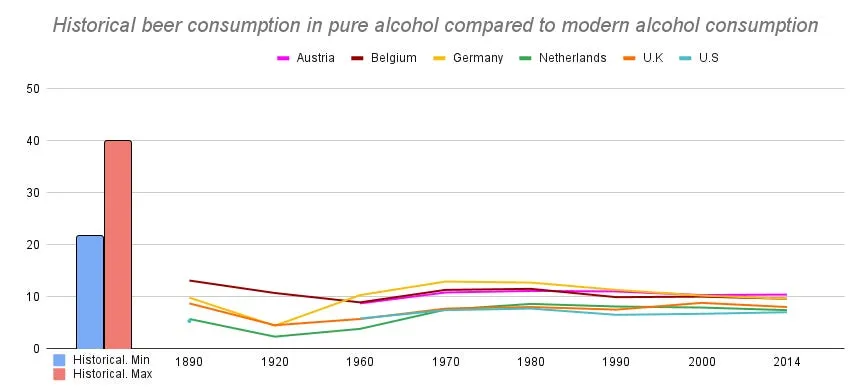
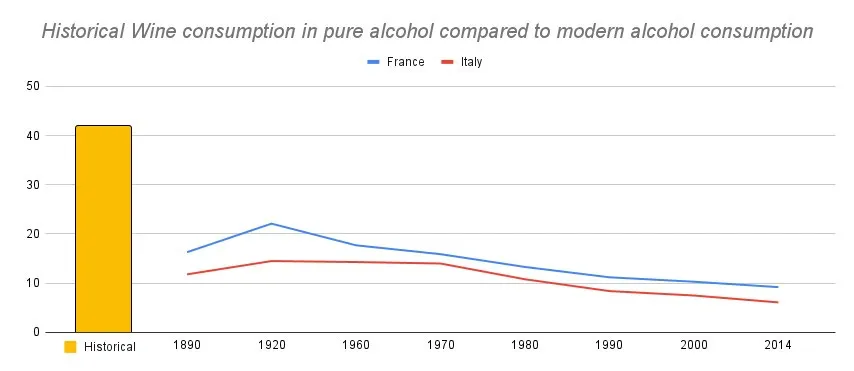
- Humans started drinking beer 13,000 years ago and might have evolved to like it as alcohol is more sterile and calorie dense.[25]
- People drank much more historically, when calories were more scarce:[26]
- Implications:
- Alcoholism's historical perception as a moral failing likely biased clinicians toward abstinence-only and cognitive interventions. But some alcoholism may merely stem from calorie deprivation (perhaps also exacerbated by outdated recommended daily calorie guidelines that underestimate actual needs).[27] Public health messaging that tries to get people to lose weight and reduce alcohol but those may run counter to one another.
- Lack of alternative: For depressed alcoholics, antidepressants might treat depression, alcohol dependence, or both, although the clinical relevance is modest[28] and SSRIs might increase alcoholism.[29] Overall, several psychotherapy like CBT to reduce drinking have shown promise, but so far their evidence is scarce,[30] and few new alcohol use disorder medications have been approved in nearly 20 years. Challenges exist in drug development, necessitating strategies like drug repurposing and using human acute laboratory models to improve the translational pipeline[31] (though see[32] and also low prescribing rates of pharmacotherapy for alcoholism limit potential public health impact).[33]
- And so, we should:
- study dietary interventions and/or GLP-1s to reduce alcohol intake. Clinical protocols for withdrawal and alcohol reduction should consider nutritional counselling to make up the calories from alcohol.
Notes
[2] Increased alcohol intake and alcohol use disorder following bariatric surgery: potential mechanisms - ScienceDirect
[3] Alcohol Use After Bariatric Surgery: A Comprehensive Review of Current Knowledge and Research Gaps
[4] Crosstalk between alcohol use disorder and obesity: two sides of the same coin? | Molecular Psychiatry
[5] The association between alcohol intake and obesity in a sample of the Irish adult population, a cross-sectional study
[6] Semaglutide reduces alcohol intake and relapse-like drinking in male and female rats - eBioMedicine
[7] Associations of semaglutide with incidence and recurrence of alcohol use disorder in real-world population
[8] Once-Weekly Semaglutide in Adults With Alcohol Use Disorder: A Randomized Clinical Trial | Substance Use and Addiction Medicine | JAMA Psychiatry
[9] Fit and Tipsy? The Interrelationship between Cardiorespiratory Fitness and Alcohol Consumption and Dependence
[10] Colder Weather And Fewer Sunlight Hours Increase Alcohol Consumption And Alcoholic Cirrhosis Worldwide - Pmc
[14] Drunkorexia: Understanding the Co-occurrence of Alcohol Consumption and Eating/Exercise Weight Management Behaviors
[17] The role of sugar-sweetened beverages in the global epidemics of obesity and chronic diseases | Nature Reviews Endocrinology
[24] The heritability of alcohol use disorders: a meta-analysis of twin and adoption studies | Psychological Medicine | Cambridge Core
[25] Fermented beverage and food storage in 13,000 y-old stone mortars at Raqefet Cave, Israel: Investigating Natufian ritual feasting - ScienceDirect
[28] Antidepressants for the treatment of people with co-occurring depression and alcohol dependence.