Growth and the case against randomista development
John Halstead, Hauke Hillebrandt
Opinions are ours, not those of our employers.
Summary
Randomista development (RD) is a form of development economics which evaluates and promotes interventions that can be tested by randomised controlled trials (RCTs). It is exemplified by GiveWell (which primarily works in health) and the randomista movement in economics (which primarily works in economic development).
Here we argue for the following claims, which we believe to be quite weak:
- Prominent economists make plausible arguments which suggest that research on and advocacy for economic growth in low- and middle-income countries is more cost-effective than the things funded by proponents of randomista development.
- Effective altruists have devoted too little attention to these arguments.
- Assessing the soundness of these arguments should be a key focus for current generation-focused effective altruists over the next few years.
We hope to start a conversation on these questions, and potentially to cause a major reorientation within EA.
We also believe the following stronger claims:
- Improving health is not the best way to increase growth.
- A ~4 person-year research effort will find donation opportunities working on economic growth in LMICs which are substantially better than GiveWell's top charities from a current generation human welfare-focused point of view.
However, economic growth is not all that matters. GDP misses many crucial determinants of human welfare, including leisure time, inequality, foregone consumption from investment, public goods, social connection, life expectancy, and so on. A top priority for effective altruists should be to assess the best way to increase human welfare outside of the constraints of randomista development, i.e. allowing intervention that have not or cannot be tested by RCTs.
We proceed as follows:
- We define randomista development and contrast it with research and advocacy for growth-friendly policies in low- and middle-income countries.
- We show that randomista development is overrepresented in EA, and that, in contradistinction, research on and advocacy for growth-friendly economic policy (we refer to this as growth throughout) is underrepresented
- We then show why some prominent economists believe that, a priori, growth is much more effective than most RD interventions.
- We present a quantitative model that tries to formalize these intuitions and allows us to compare global development interventions with economic growth interventions. The model suggests that under plausible assumptions a hypothetical growth intervention can be thousands of times more cost-effective than typical RD interventions such as cash-transfers. However, when these assumptions are relaxed and compared to the very good RD interventions, growth interventions are on a similar level of effectiveness as RD interventions.
- We consider various possible objections and qualifications to our argument.
Acknowledgements
Thanks to Stefan Schubert, Stephen Clare, Greg Lewis, Michael Wiebe, Sjir Hoeijmakers, Stephen Clare, Gregory Thwaites, Will MacAskill, Aidan Goth, Sasha Cooper, and Carl Shulman for comments. Any mistakes are our own.
Marinella Capriati at GiveWell commented on this piece, and the piece does not represent her views or those of GiveWell.
1. Defining Randomista Development
We define randomista development (RD) as an approach to development economics which investigates, evaluates and recommends only interventions which can be tested by randomised controlled trials (RCTs).
RD can take low-risk or more 'hits-based' forms. Effective altruists have especially focused on the low-risk form of RD: specifically, directly funding interventions that have been tested by RCTs, such as malaria bednet distributions and cash transfers. However, even within direct funding of such programmes, there is significant variation in the probability of success. For example, GiveWell thinks that deworming is a high risk/high-reward bet with a significant chance of having small effect but some chance of having a large effect. Other GiveWell recommended programmes offer a much more certain probability of impact.
More clearly hits-based forms of RD are possible. GiveWell has done various forms of more hits-based giving, including for example its support for the Center for Suicide Prevention, which advocates for policy change at the national level in India and Nepal. Co-Impact, a collaborative philanthropy group, is advocating for national scale-up of the RCT-supported education programme Teaching at the Right Level across Africa. By this definition, RD also includes advocacy and scale-up of scientific research that can be tested by RCTs, such as mosquito gene drives, researching vaccines or antibiotics, or the agricultural research that led to the Green Revolution.[1]
2. Randomista development is popular in EA
Global poverty remains a popular cause area among people interested in EA.[2] EA has especially focused on directly funding RCT-backed interventions. GiveWell moved $161m to RCT-backed charities in 2018.[3] The Effective Altruism Global Health and Development Fund has disbursed most of its funds to charities that directly implement RCT-backed interventions.
Recently, GiveWell announced that they will expand their research beyond RD to include difficult-to-evaluate interventions. This could include economic growth, though their initial focus is on improving health policy. Nonetheless, as things stand at the moment, most of the EA money in global development focuses on directly funding interventions that can be tested by RCTs. Almost all EAs interested in global development we have met at events like EAG seem focused on directly funding, or working for, organisations implementing interventions that can be tested by RCTs.
We too used to support direct funding of interventions that can be tested by RCTs, but now believe it is suboptimal. We will argue that research and advocacy for growth-friendly economic policies can often be orders of magnitude more cost-effective than direct funding of evidence-based interventions. The case against hits-based RD is less clear and we leave that to future work.
The ideas here rely heavily on work by Lant Pritchett of the Blavatnik School of Government in Oxford.[4] However, within economics there is considerable support for similar views (see Appendix 1).
3. The case for economic growth and against randomista development
In this section, we set out three arguments for the proposition that research and advocacy for growth is more cost-effective than directly funding interventions tested by RCTs. However, since economic growth is not all that matters, this does not necessarily mean that advocacy for growth is the best way to increase human welfare. To reiterate: we focus on economic growth here, and aim to show that research and advocacy for growth is better than randomista development. However, there may be other ways to cost-effectively increase human welfare outside of the constraints of RD (e.g. through decreasing inequality or improving the provision of public goods that are not properly reflected in GDP).
3.1. Economic growth explains a substantial fraction of the variance in human welfare today
In this section, we discuss the relationship between income per head and different objective and subjective measures of welfare.
Income per head and broad measures of welfare
Today, there is significant variation in income per head across the world:
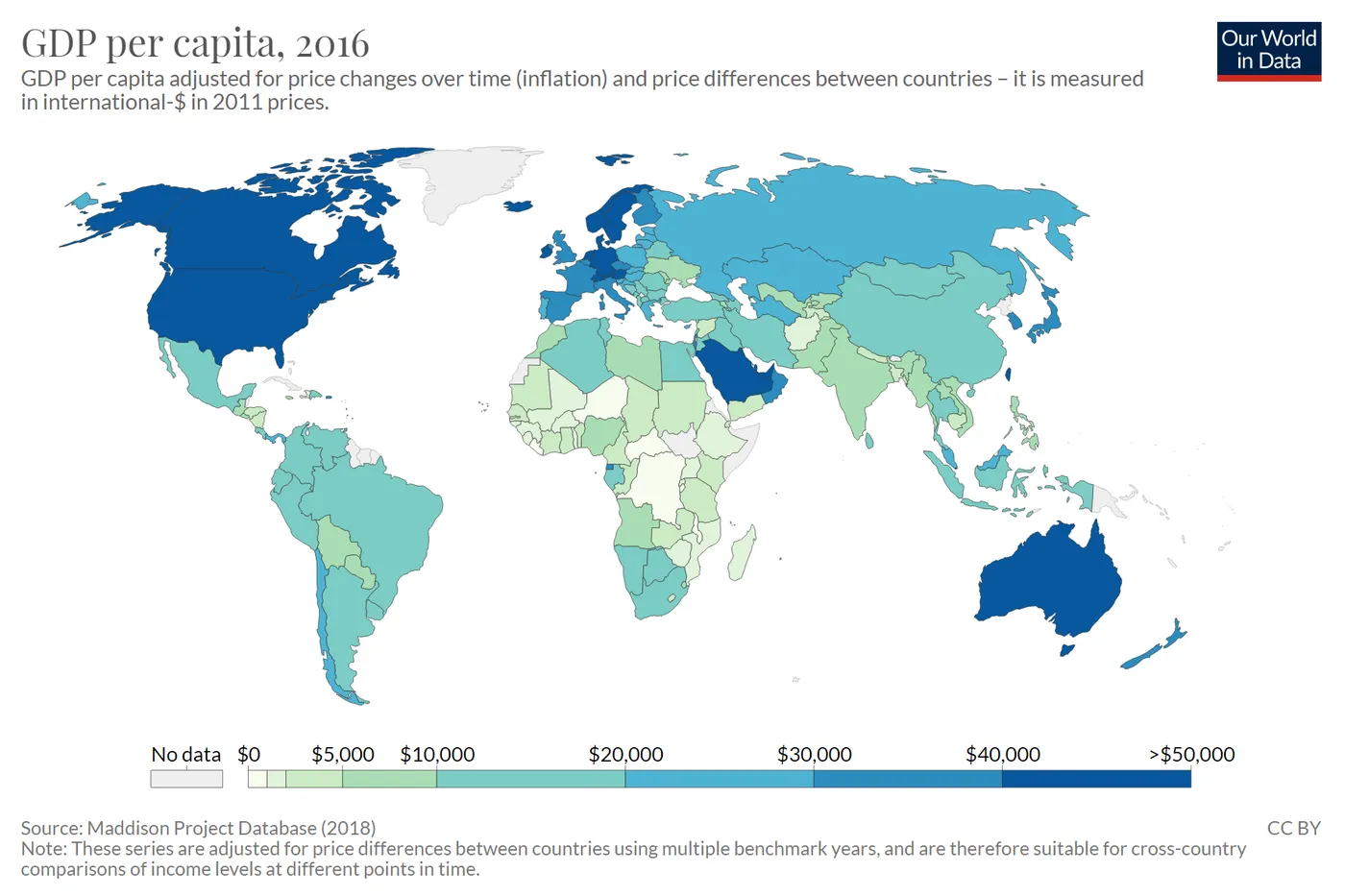
If markets function reasonably well and people are broadly rational, then richer people will buy more goods which have a substantial private good element,[5] such as:
- Food
- Transport
- Shelter
- Lighting
- Electricity
- Education
- Healthcare
Therefore, we have strong reasons to think that these large cross-national differences in income per head cause large differences in human welfare due to differential consumption of private goods.
This does not mean that GDP is all that matters. The metric of GDP per capita misses some crucial contributors to human welfare, including:
- Public goods: Increasing income per head reliably increases consumption of private goods. However, it might not necessarily increase public goods, such as public health interventions, clean air, public safety, electricity grids, sanitation, and so on.
- Consumption: High levels of investment increase GDP but also constitute foregone consumption, which involves a loss of welfare that is not reflected in GDP.
- Leisure: High hours worked per capita deliver higher GDP but also constitute foregone leisure time, which involves a loss of welfare that is not reflected in GDP
- Inequality: Individuals get diminishing marginal utility from income, so income gains to the better-off should be valued less than income gains to the worse-off. Thus, holding income per capita and everything else equal, societies with a more equal income distribution must have greater welfare per person. In addition, income and other resources might be positional goods- perceiving others to be richer might be another mechanism by which inequality might lead to lower overall welfare. This is a difference in welfare that is not captured by GDP.
- Social connection: Social connection is not represented in GDP statistics but is a major determinant of human welfare.
- Health: A country can have higher income per head than another, but the lives of its citizens could be worse if they die earlier or suffer greater morbidity.
It is therefore interesting to explore how well GDP per capita correlates with more holistic measures of welfare that try to account for these other determinants. There have been numerous attempts to build a more holistic measure of welfare than GDP per capita. In a 2016 paper, Jones and Klenow used measures of consumption, leisure, inequality, and mortality, to create a consumption-equivalent welfare measure that allows comparisons across time for a given country, as well as across countries.[6]
This measure of human welfare suggests that the true level of welfare of some countries differs markedly from the level that might be suggested by their GDP per capita. For example, France's GDP per capita is around 60% of US GDP per capita.[7] However, France has lower inequality, lower mortality, and more leisure time than the US. Thus, on the Jones and Klenow measure of welfare, France's welfare per person is 92% of US welfare per person.[8]
Although GDP per capita is distinct from this expanded welfare metric, the correlation between GDP per capita and this expanded welfare metric is very strong at 0.96, though there is substantial variation across countries, and welfare is more dispersed (standard deviation of 1.51 in logs) than is income (standard deviation of 1.27 in logs).[9]
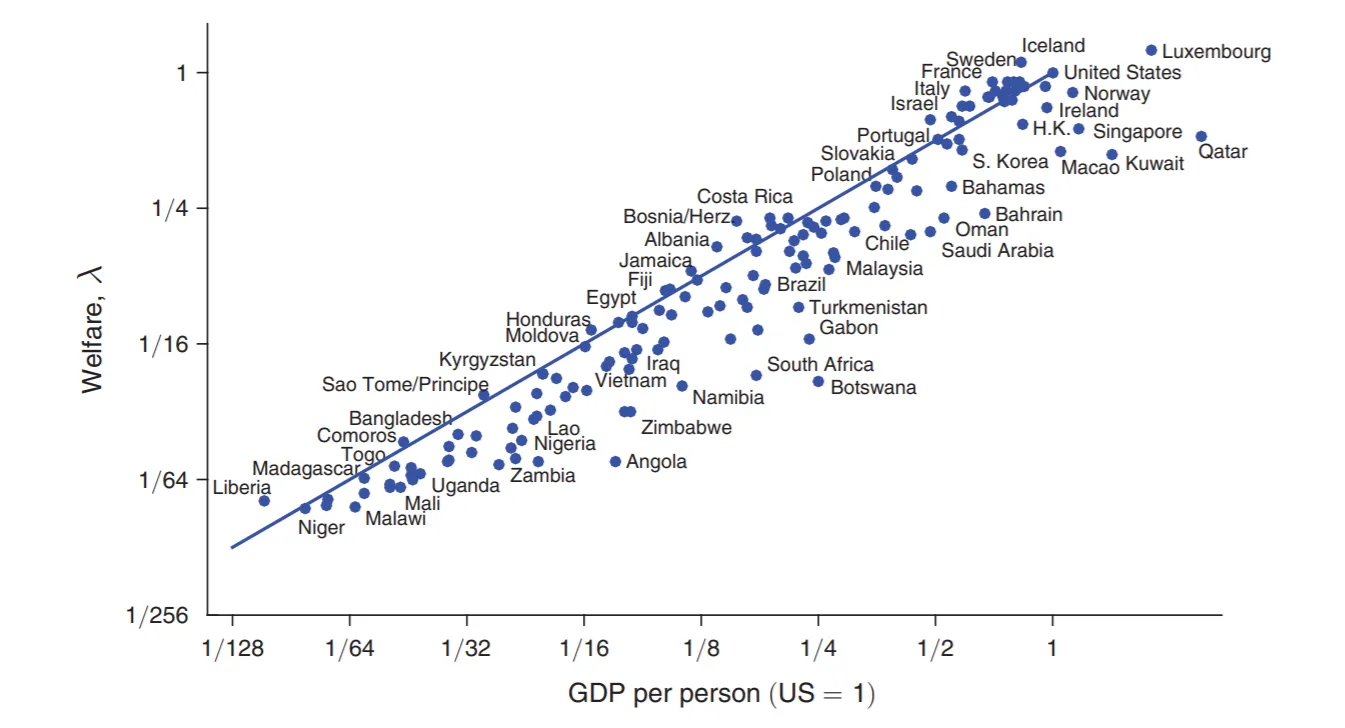
GDP per capita is also very strongly correlated with the Human Development Index, another expanded welfare metric.[10] If measures such as these are accurate, this shows that income per head explains most of the observed cross-national variation in welfare. It is a distinct question whether economic growth explains most of the observed variation across individuals in welfare. It is, however, clear that it explains a substantial fraction of the variation across individuals.
This suggests that: taking this expansive account of human welfare, only so much can be achieved for a country holding its income per head at a low level. For instance, unless a country's income per person is at least a quarter that of the US, then, empirically, its welfare per person can also not be more than a sixth that of the US.
Crucially, on the Jones and Klenow welfare metric, most developing countries are substantially poorer than incomes suggest because of a combination of shorter lives and extreme inequality. Lower life expectancy reduces welfare by 15 to 50 percent in the developing countries Jones and Klenow examine, which implies that global welfare inequality is greater than global income inequality.[11] Therefore, ensuring evenly shared growth and improved health is also important for human welfare. We do not investigate the best way to do that here, though we think that these goals are best advanced outside of the constraints of directly funding RCT-backed interventions.
We will now look in more detail at the relationship between income per head and some other indicators of human welfare.
Life expectancy
GDP per capita and life expectancy are correlated:
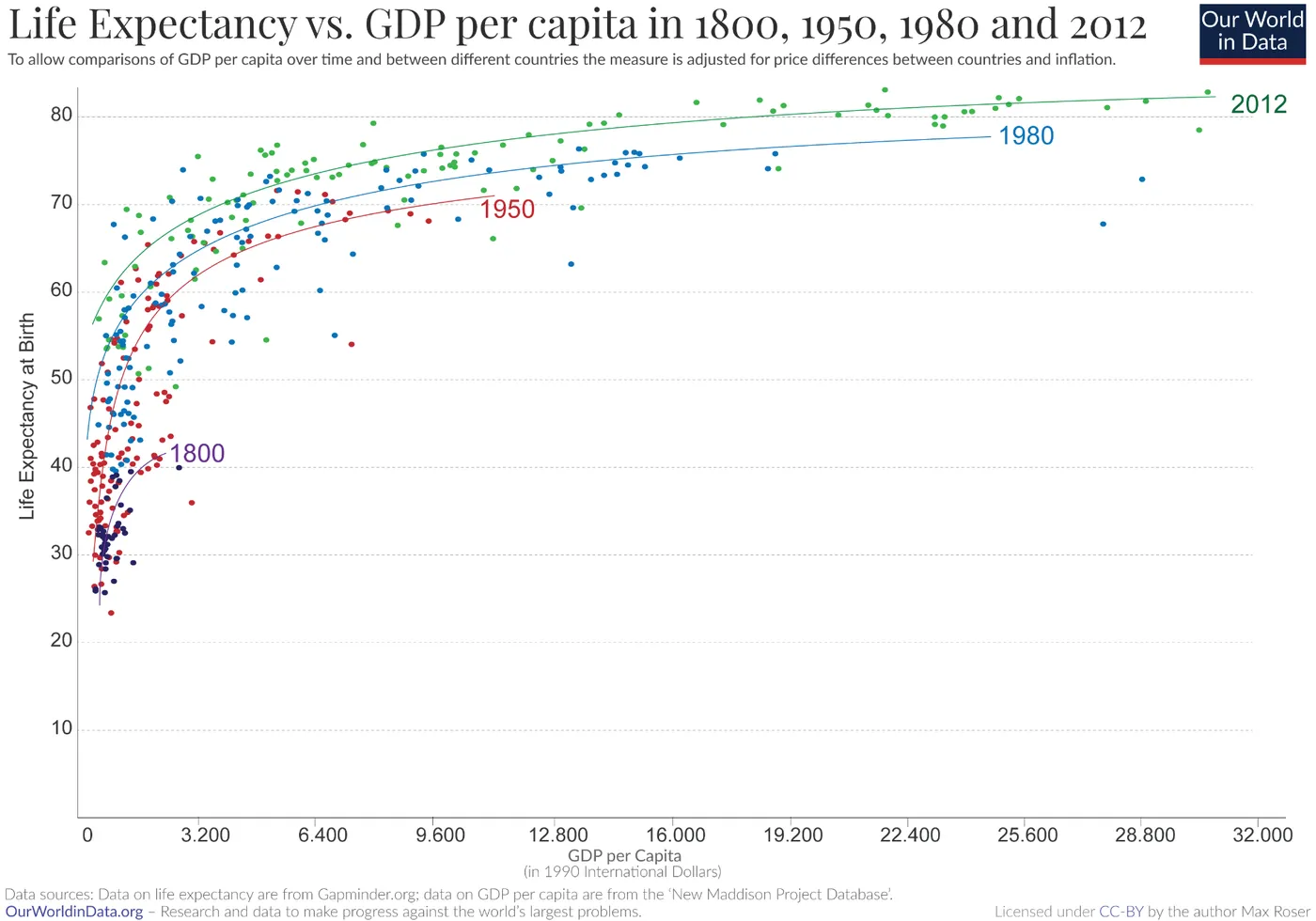 As this chart shows, the life expectancy associated with a given level of real income is rising over time. If economic development were the only determinant of health, countries that get richer would just move along the same curve. Since this is not the case, we can conclude that economic development cannot be the sole determinant of health: highly efficient public health interventions also play a major role. 60 years of public health improvements since 1950 increase cross-national life expectancy on average by around 8 years.
Nonetheless, the graph above shows that GDP per capita explains a significant fraction of the variation in life expectancy across countries. 60 years of sustained growth could shift a country from income per head of $1,000 to $32,500.[12] Today, this would be correlated with, though would not necessarily wholly cause, an increase in life expectancy by more than 20 years, on average. Today, almost no countries with income per head above $10,000 have life expectancy below 70 years. Most countries with income below $5,000 per head have life expectancy below 70 years, and a significant fraction have life expectancy below 60.
Life satisfaction
GDP per capita is also correlated with self-reported life satisfaction:
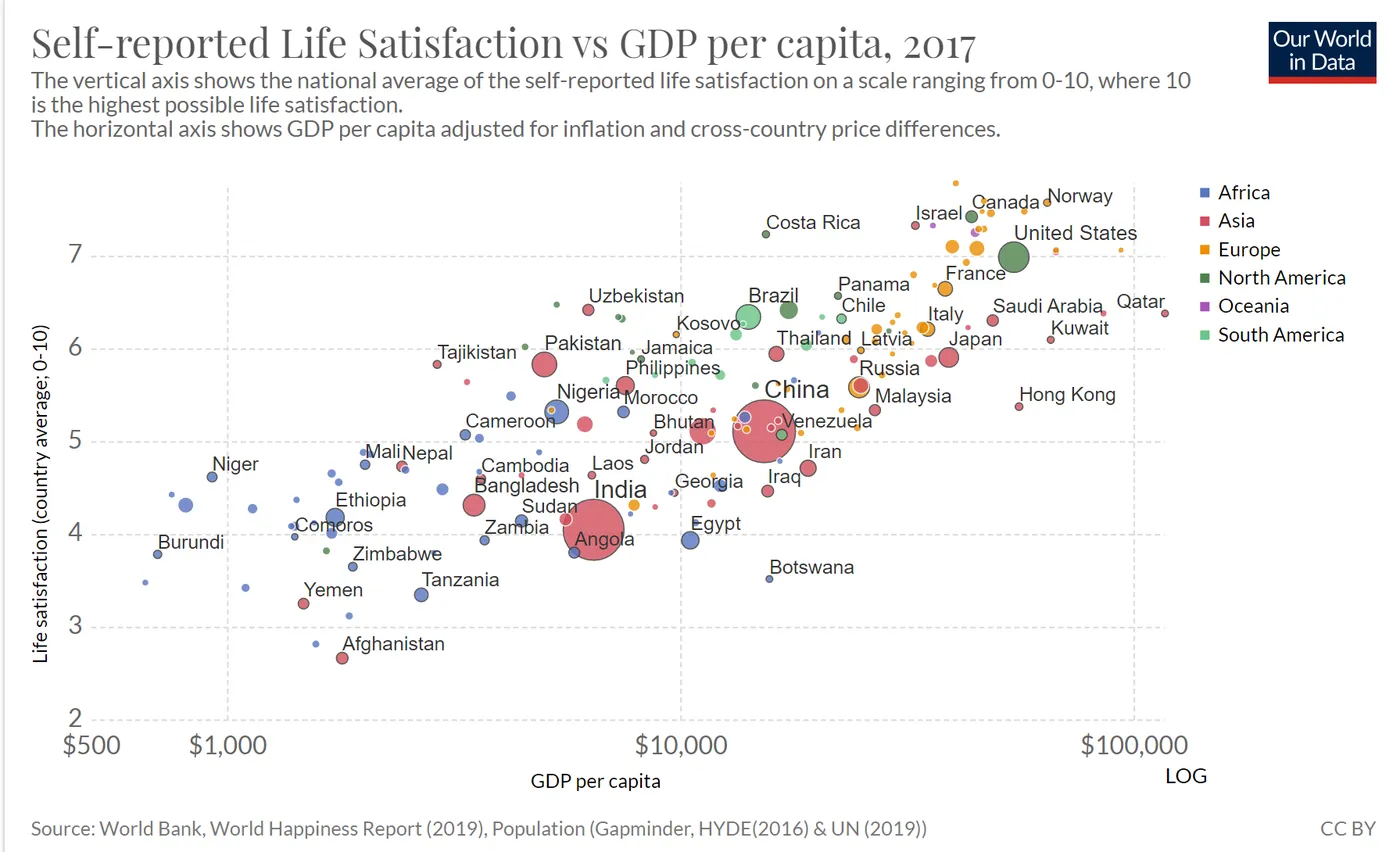
Once GDP per capita is above $20,000, no countries have average life satisfaction scores below 5; once it is below $3,000, almost no countries have self-reported life satisfaction scores above 5. The chart below shows the strength of the relationship more clearly as it does not put income on a logarithmic scale:
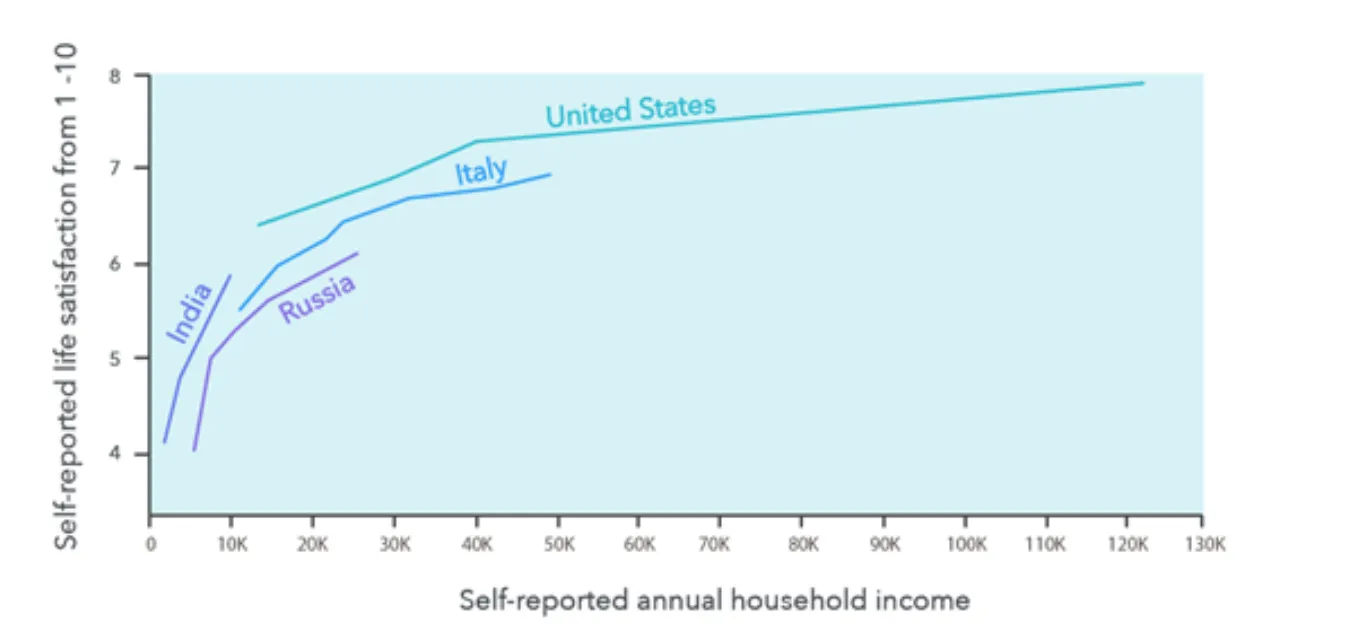
Source: 80,000 Hours
This shows the value of economic development for life satisfaction in low-income countries (as well as the limited benefits for rich countries).
Poverty
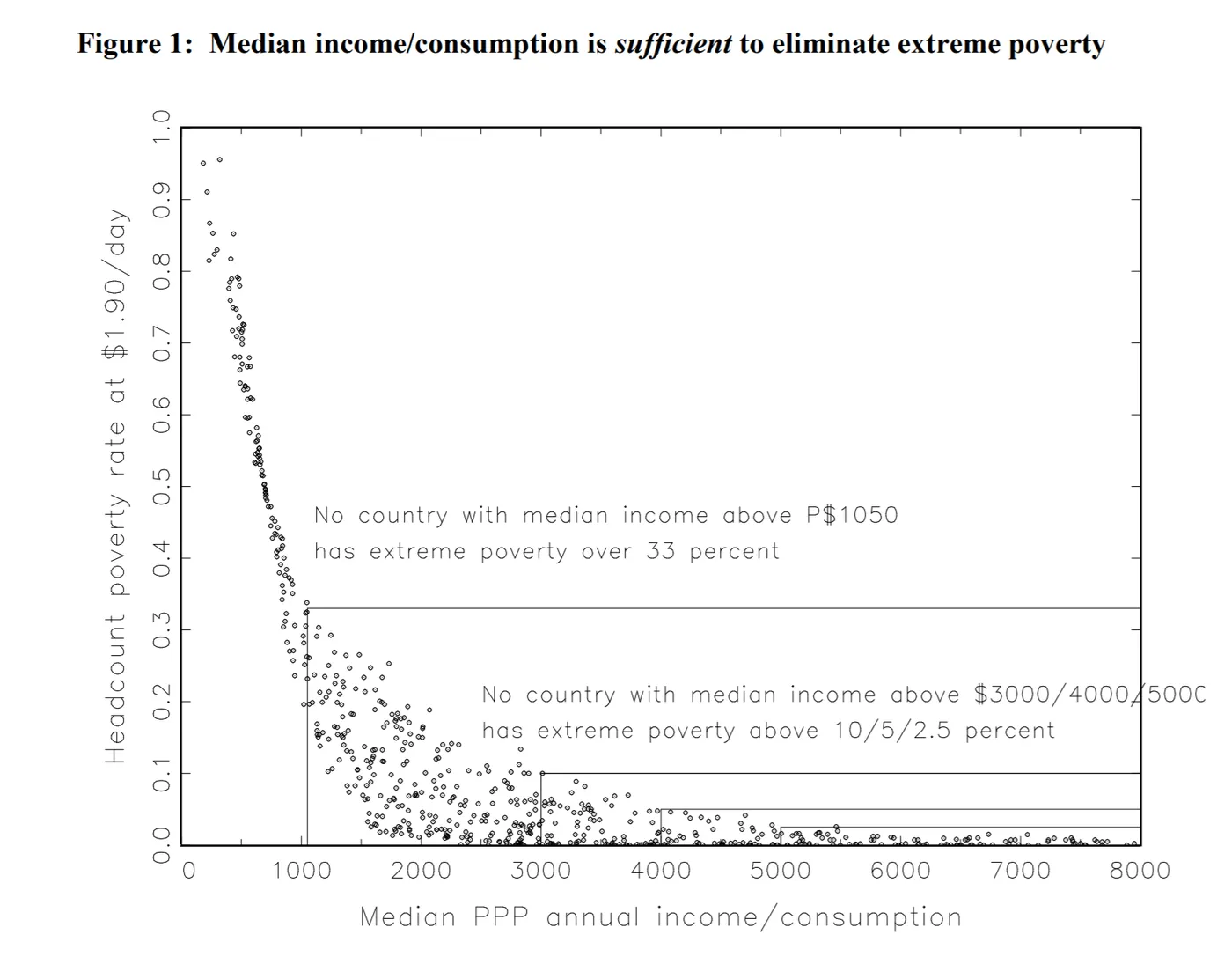
GDP per capita is very strongly associated with poverty reduction, on standard low-bar poverty thresholds. Increasing median income above a certain level is empirically sufficient to eliminate $1.90 a day poverty. Above a median income of $5,000, no country has low-bar poverty above 2.5%:
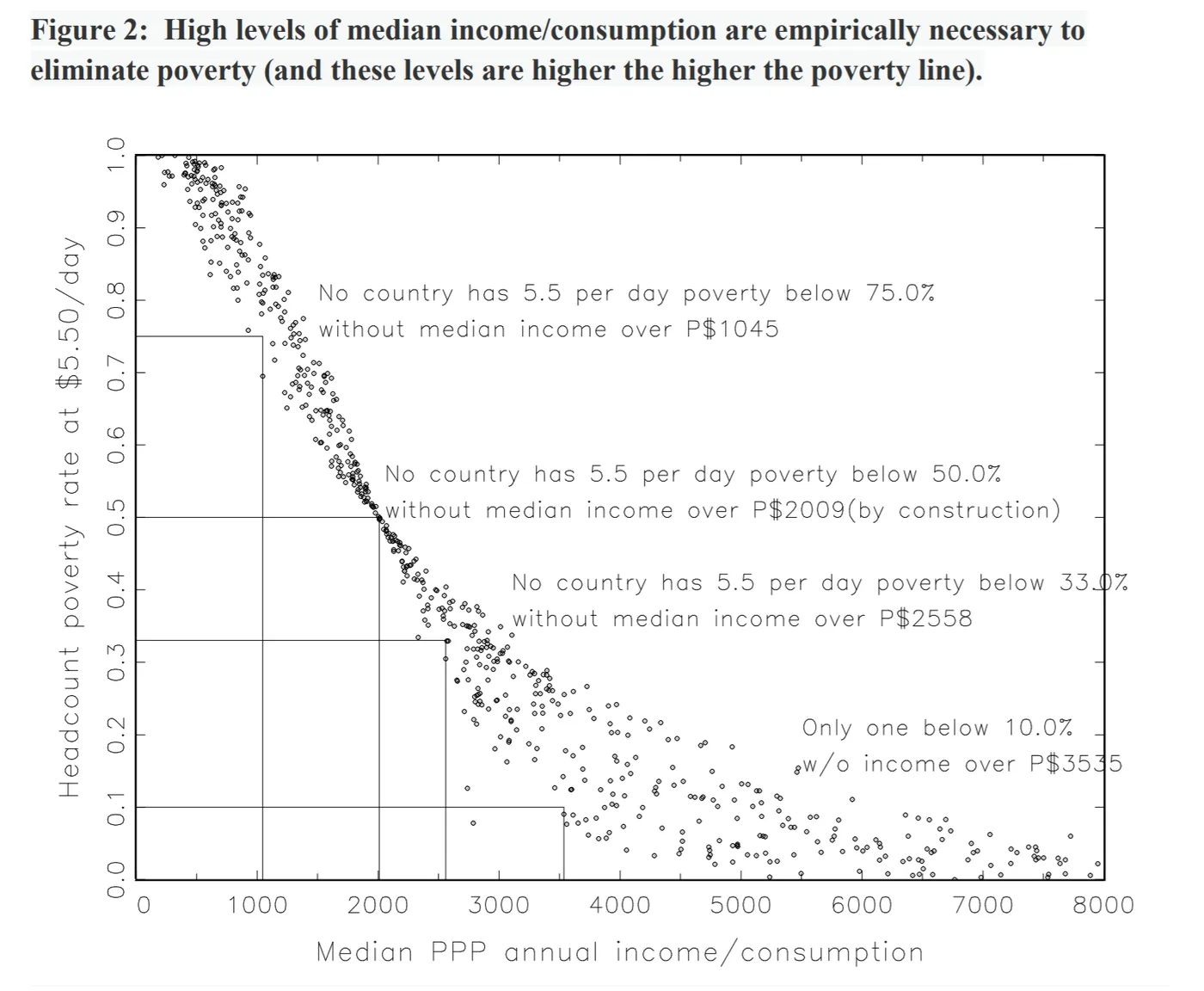
Increasing median per capita income above a certain level is also empirically necessary to eliminate poverty. No country (but one) has pushed $5.50/day poverty below 10 percent without increasing median income above $3,535.[13]
GDP and other indicators of welfare
There is also a strong correlation between GDP per capita and other indicators of welfare such as:
Economic growth as a driver of progress and the limitations of RD
The foregoing arguments show that GDP per capita is strongly correlated with many objective and subjective measures of welfare. Thus, empirical evidence shows that only so much can be achieved for a country at a low level of income per head. If a country has an income per head below $5,000, it is very likely to do poorly on most objective and subjective measures of welfare. If a country's income per head is above $20,000, it is very likely to do well on most objective and subjective measures of welfare.
As discussed above, there are also good reasons to believe that increased GDP per capita causes many of these increases in welfare. This suggests that when we are working out how to increase human welfare to the greatest extent possible, then we should start by figuring out how best to increase GDP per capita. However, to our knowledge, EAs have not publicly published any investigations of this question.
Moreover, the vast majority of proponents of RD do not tackle the question of whether the interventions they assess increase economic growth. Instead, RD is overwhelmingly focused on evaluating the success of programmatic attempts to solve a problem in a specific target population, such as depression, educational attainment, intestinal worms or malaria. This does not mean that the things assessed by RD do not increase economic growth at all: indeed some RD health interventions increase earnings and consumption later in life, and thus do increase growth to an extent. However, evaluating whether the effect size is trivial or not should be a top priority for proponents of RD. (Hauke discusses the relationship between health and growth in Appendix 3.4)
Independently of this, we do not believe that the vast majority of RD interventions are plausibly among the top 100 ways to increase growth. For example, it is implausible that direct funding of the following interventions is the best way to increase GDP per capita:[14]
- Malaria bednets
- Deworming
- HIV education
- Mobile phone reminders for vaccinations
- Improved cookstoves
- Cash transfers
- Etc.
The reason these things are unlikely to be the best way to increase growth is that they play no role in the causal story of the huge differences in GDP per capita across space and time. To illustrate:
- It is not the case that Danish people are better off than Ugandans because they have implemented direct programmatic efforts of this kind to a greater extent.
- It is not the case that Danish people today are better off than Danish people 100 years ago because they implemented this type of intervention.
- When looking at the huge human welfare gains in China, Indonesia, Vietnam, Singapore, South Korea and Hong Kong in the second half of the 20th century, no-one argues that this was because they engaged in more interventions of this type.
The role of direct programmatic assistance in explaining the variance in economic outcomes is mirrored in surveys of people who have moved out of poverty. The role of direct NGO programmatic assistance is as small as we would expect, given the above. In a survey of 4,000 people across three states in India, 3 named 'NGO assistance' (only slightly ahead of one person each naming 'illegal activity' and 'winning the lottery').
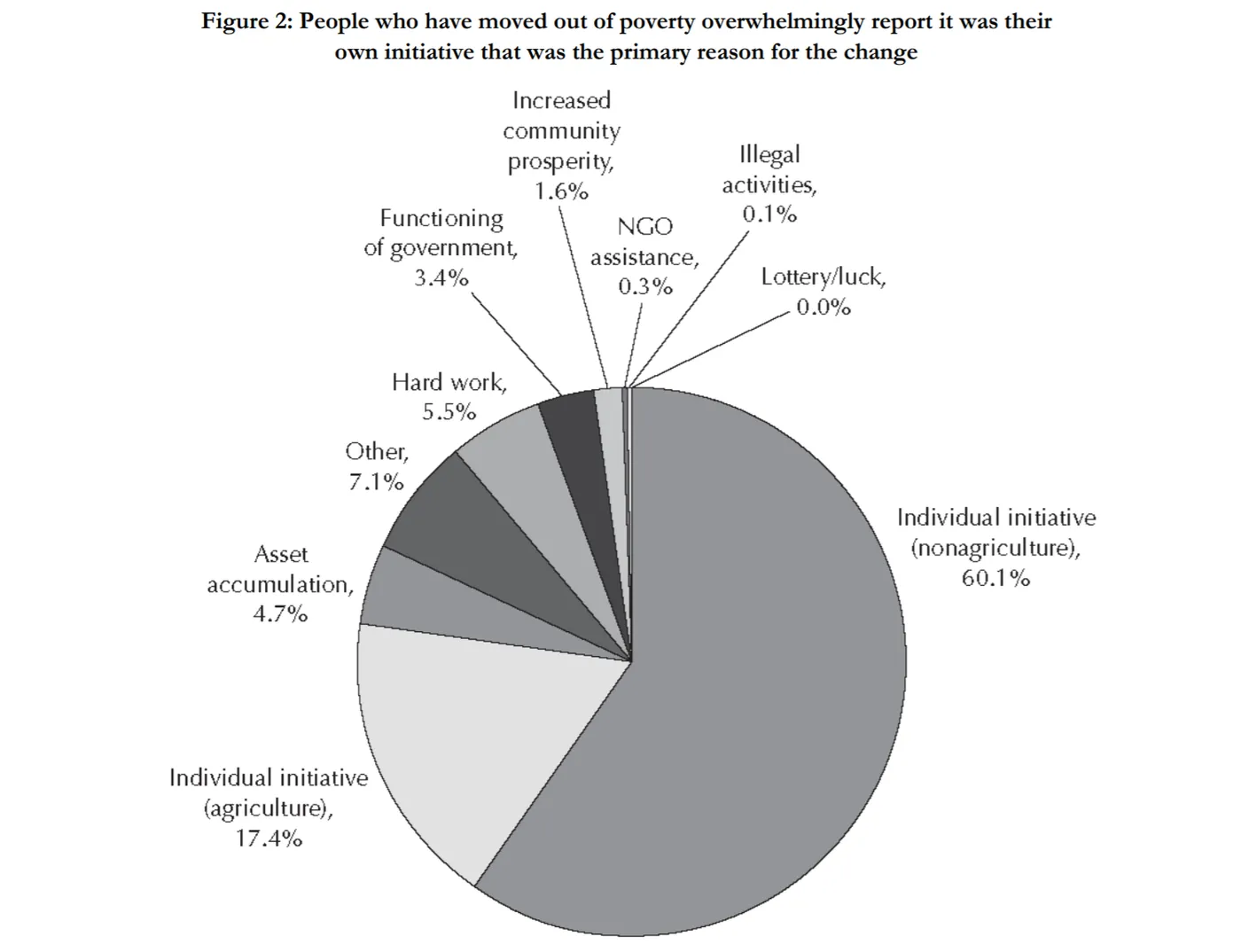
Source: Pritchett, 'Alleviating Global Poverty: Labor Mobility, Direct Assistance, and Economic Growth', Center for Global Development, page 8.
It is true that there might be biases at play here that may cause under-reporting of NGO assistance as a cause of escape from poverty. Firstly, people may naturally want to attribute their success to their own hard work, even if NGOs did play a role. Secondly, the impact of some NGOs may be difficult to see, even for beneficiaries. For example, most people may not be able to notice the substantial effect of salt iodisation or the Green Revolution on their lives because such work is largely invisible to them. Nonetheless, this survey does suggest that direct funding of RCT-backed interventions have played a very small role in escape from poverty.
Moreover, and more controversially, we do not believe that health interventions (whether directly funded or implemented by the state) are the best way to increase growth in the poorest countries.[15] Here, we want to start a discussion on what the most effective causes of growth are, given its huge importance.
Overall, it would be very surprising if directly funding RD interventions turned out to be the best way to increase growth (especially given that they were not recommended on that basis in the first place). Given the strength of the correlation between growth and welfare, this should lead us to question whether RD is the best way to increase welfare.
What does explain cross-national differences in GDP per capita?
Thus, many RCT-backed interventions do not seem to explain much of the cross-national variation in GDP per capita. What does? There are a range of factors including:
- Growth-friendly policies
- Geography
- Natural resources
- Human capital
- Culture
Within growth-friendly policies generally, some hits-based forms of RD may be promising. For example, the Green Revolution was a form of randomista development, and scale-up of that agricultural technology has saved the lives of hundreds of millions of people. There is also a correlation between educational performance and GDP per capita.[16] Thus, it is possible that scaling up RCT-backed educational interventions would increase GDP per capita. Assessing whether this and other RD interventions would be the most cost-effective way to increase GDP per capita should be a top priority for effective altruists.
However, many of the most promising growth-friendly policies are economic policies that cannot be tested by RCTs (though their impact is not outside the realm of empirical investigation, see Appendix 2.2). These would include things like:
- Infrastructure spending
- Economic liberalisation (Hong Kong, China)
- Trade liberalisation (India)
- Export-led development and state protection of industry (South Korea, China)
As Pritchett writes:
'... [Development] is fundamentally a process of social transformation—markets (and their supporting institutions and organizations (e.g. firms)) are social mechanisms that structure how people cooperate, governments (and their supporting institutions (e.g. agencies)) are social mechanisms. This social process of national development reliably produces higher human well-being in every dimension. However, no one can reliably and rigorously demonstrate exactly which actions best promote development (as, almost certainly they are contextual and complex) and certainly no one can reliably attribute development to specific organizations (and doing so may, in and of itself, cause less effectiveness).'[17]
This should lead us to be sceptical about RD. Growth is arguably the major driver of human progress, but proponents of RD rarely argue that the interventions that they recommend do increase growth.
Excursus on kinky poverty lines
RD might look like a plausibly effective way to reduce poverty, because of 'kinky poverty lines'[18] — which define 'extreme poverty' as living on less than $1.90 per day, and then do not measure progress above that level. On this poverty line, directly funding RCT-backed aid could 'pull people out of poverty'. Globally, around $180bn is spent on aid per year—roughly $500 million per day. There are 500 million people who are extremely poor. Assuming that all the extreme poor have $1 per day already, we could eradicate extreme poverty through cash transfers.
But this would raise their income by around $1 per day. And someone on $2 per day is still very poor even if they are above the kinky $1.90 threshold. Indeed, this poverty line is discriminatory and would never be used for citizens in a high-income country: in the US, the poverty line is $17 per day.[19] There is no reason that such thresholds should not apply to people outside high-income countries. On this more expansive definition of poverty, it is very difficult for direct funding of programmatic aid to lift people out of poverty.
Indeed, median income, rather than direct anti-poverty programmes at a given level of income, predicts nearly all of the observed variation in poverty, at any poverty line:
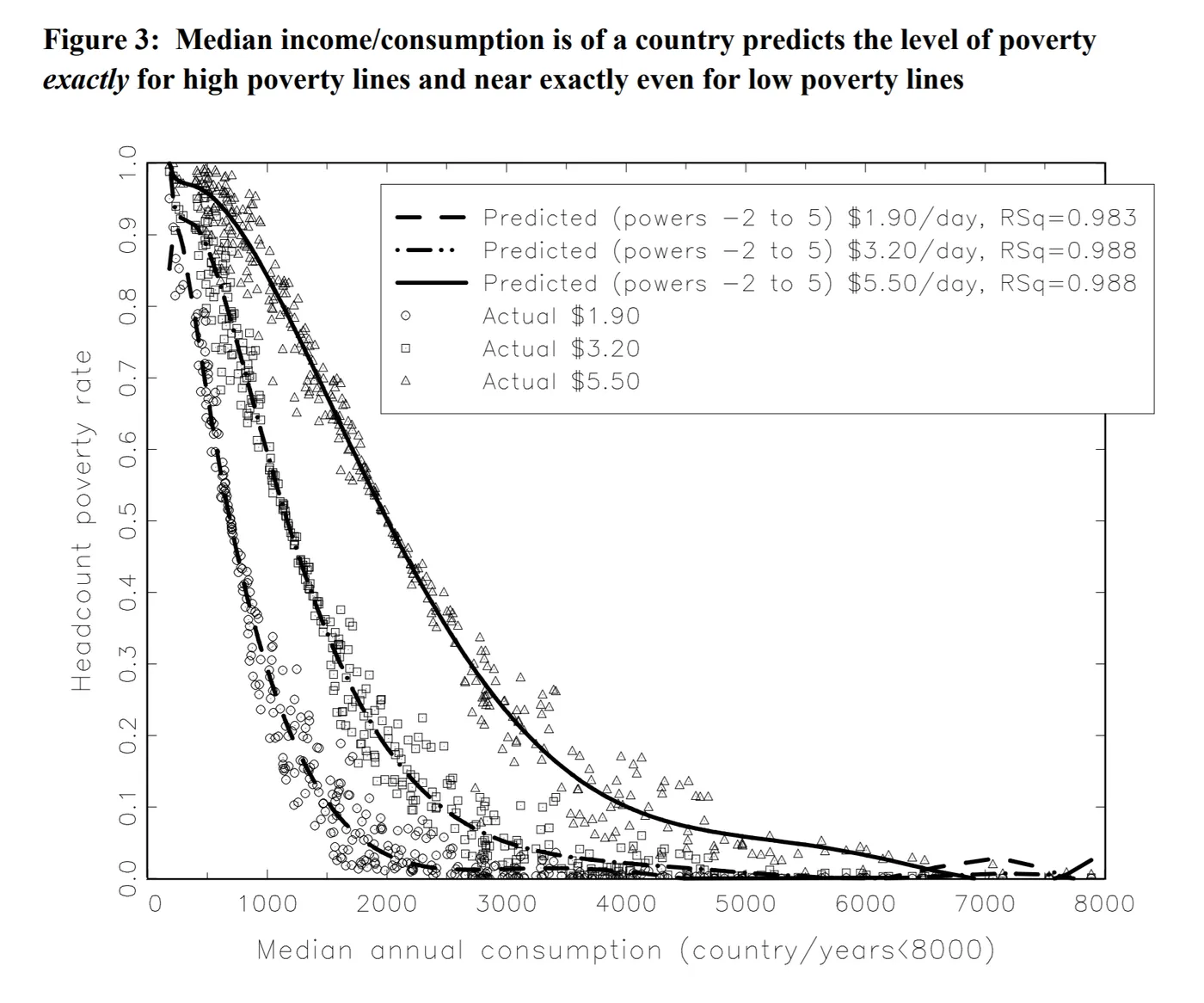
Source: Pritchett, 'Randomizing development: Method or madness?' (2019)
Direct anti-poverty programmes usually favoured by proponents of RD, such as cash transfers, microfinance, or the graduation approach, aim to raise the income of the poor at a given level of national median income. However, differences across the country/years in the impact of these targeted poverty programmes conditional on the median account for at the very most 1.2 percent of the total cross-national variation in poverty rates.[20] This suggests that identifying the best direct anti-poverty programmes currently being implemented and scaling them up can at most have very limited low-bar poverty reduction benefits, unless these can be shown to increase national median income per head. There is no reason to think that many current RD programmes, such as cash transfers or the graduation approach, increase national median income.
(This is not to say that decreasing inequality is not important: as we saw above, inequality can have large effects on a country's welfare per person.)
3.2. The success of the development era
The story of human welfare is well illustrated by this graph:
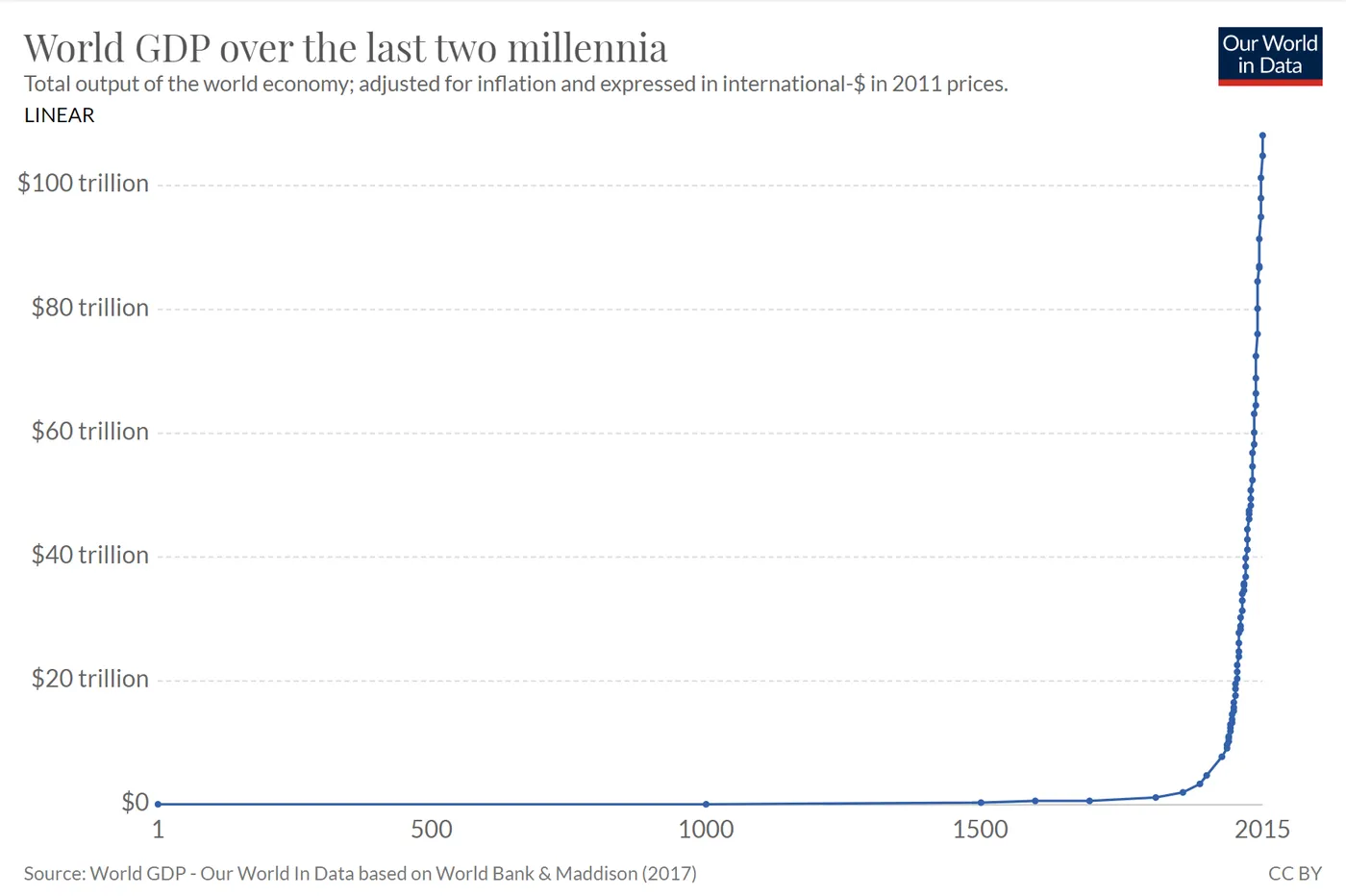
Until 1800, average human welfare was stagnant, but after the Industrial Revolution, living standards exploded. This preceded most development economics. However, the end of the Second World War marked the start of what Pritchett calls the 'development era' with:
- The end of colonisation with the liberation of India, Pakistan and Indonesia
- The founding of the Bretton Woods institutions- the IMF and the World Bank
- Truman's Four Point plan to provide technical assistance to developing countries
- Overall a concerted effort by economists and sovereign states to increase development[21]
The development era was a huge success: since 1950, human welfare has improved on all objective measures by more than all prior human history combined.[22] On the chart below, countries can move vertically up from the diagonal line (meaning that they had positive growth), or vertically down from the diagonal line (meaning that they had negative growth).
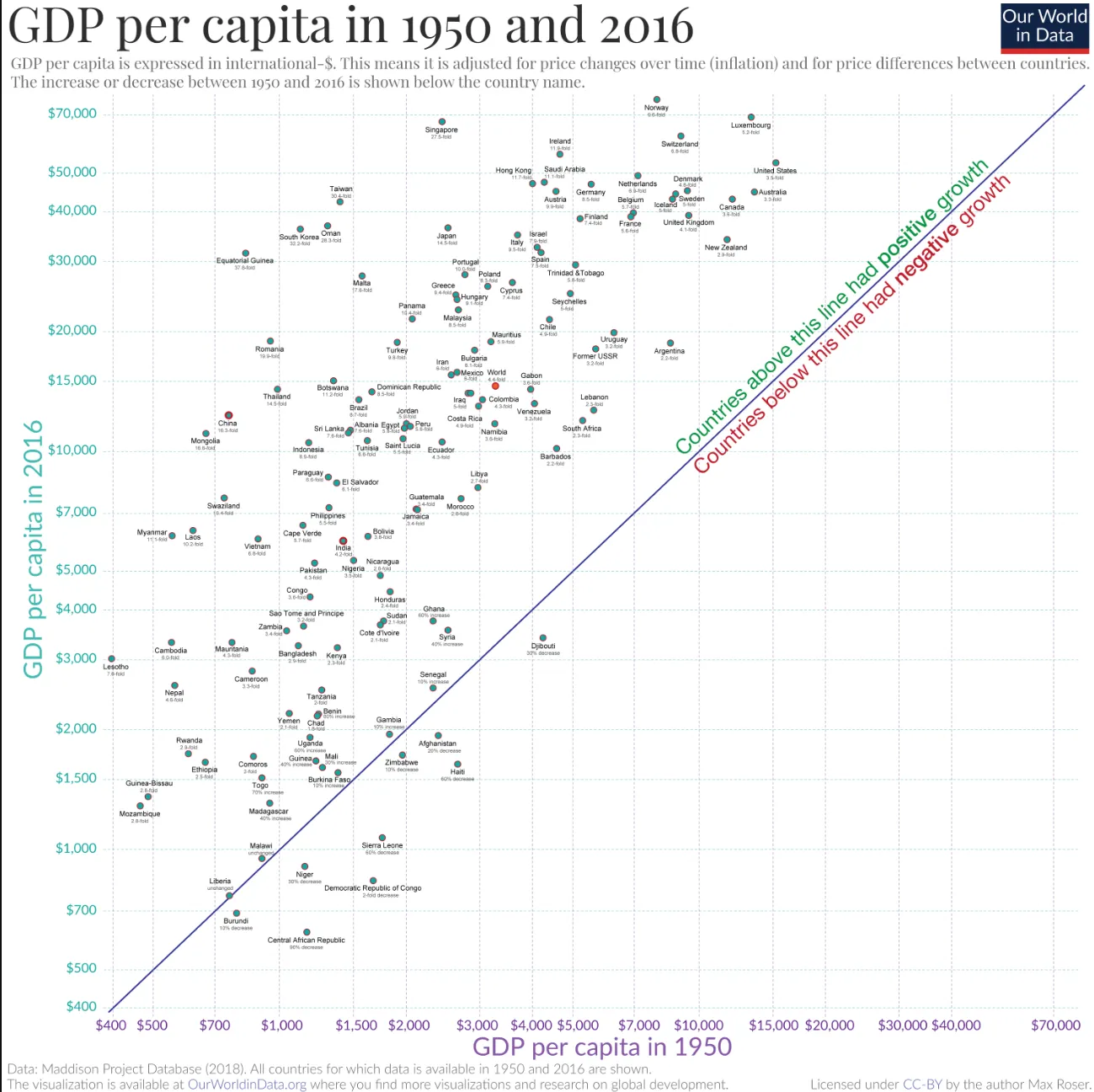
It is important to note that the development era was not all plain sailing and that there have been some major growth decelerations, as we discuss below. Nevertheless, the net effect of the era has been overwhelmingly positive.
If things are going so well, why would we start working on a completely different form of development economics? It seems like the best course would be to broaden and accelerate this process globally, and replicate previous successes. Moreover, the failures that do exist seem to make the case for improving our knowledge of growth and the likelihood of policy success. (We discuss this in more detail below).
RD has moved in an entirely different direction. Instead of replicating this success, it asks: among interventions that we can test with RCTs, what is most impactful? In the wake of the period with by far the greatest progress in human welfare of all time, this change in strategy is difficult to justify.
As a way to guide the comparison with RD, it is interesting to compare this progress with the estimated effect of deworming. Of GiveWell's top charities, Deworm the World is estimated to offer the most cost-effective way to improve economic outcomes for the very poor. But given the story above, it would be very surprising if this was the case: differences in rates of deworming explain a miniscule fraction of the variation in individual economic outcomes across the world. No-one argues that deworming is among the top 1000 causes of the huge economic transformation documented above.
Moreover, given that GiveWell estimates that deworming has similar impact on welfare (broadly conceived) to their other top charities, this should lead us to question whether their other top charities are the best way to increase human welfare, broadly conceived.
4. Cost-effectiveness analysis: RD vs. Growth
Though growth is a major determinant of human welfare today, it does not follow that research and advocacy for growth and national development are more cost-effective than RD interventions. While the payoff might be large, the probability of influencing policy, or the probability that you know better than policymakers, might be low enough to make the expected value of such work lower than RD.
Pritchett has a convincing response to this argument. He compares a popular form of RD, the Graduation approach, with research on and advocacy for growth.
The Graduation Approach
The Ultra Poor Graduation program gets people out of extreme poverty via livelihood training, productive asset transfers, consumption support, savings plans, and healthcare. It is one of the most well-tested and impactful direct anti-poverty programs. (Founders Pledge research suggests that Bandhan, a charity carrying out the Graduation approach, is 5x a cost-effective as cash. GiveWell estimates that Malaria Consortium is 15.8 times as cost-effective as cash. Thus, it seems fair to roughly assume that Malaria Consortium is around 3 times more cost-effective than the Graduation approach.)
A range of RCTs in different contexts have shown that the Graduation approach raised year 3 incomes in 5 out of 6 study sites. The study suggests that the intervention on average produces a 1.6x return in net present value.[23] Thus, $1000 invested in the intervention would produce $1,600 in net present value. There are around 100 million people in Ethiopia, so $1 billion invested in the graduation approach there would increase per capita income by $16.
Compare this to the per-person value of growth accelerations and decelerations documented by Pritchett et al (2016). These are defined as the change in output per capita resulting from one structural break in the trend growth of output to the next. These acceleration or deceleration typically range from 10 to 30 years. The per person benefits (costs) of these growth accelerations (decelerations) are orders of magnitude greater than the impact of the Graduation programme:[24]
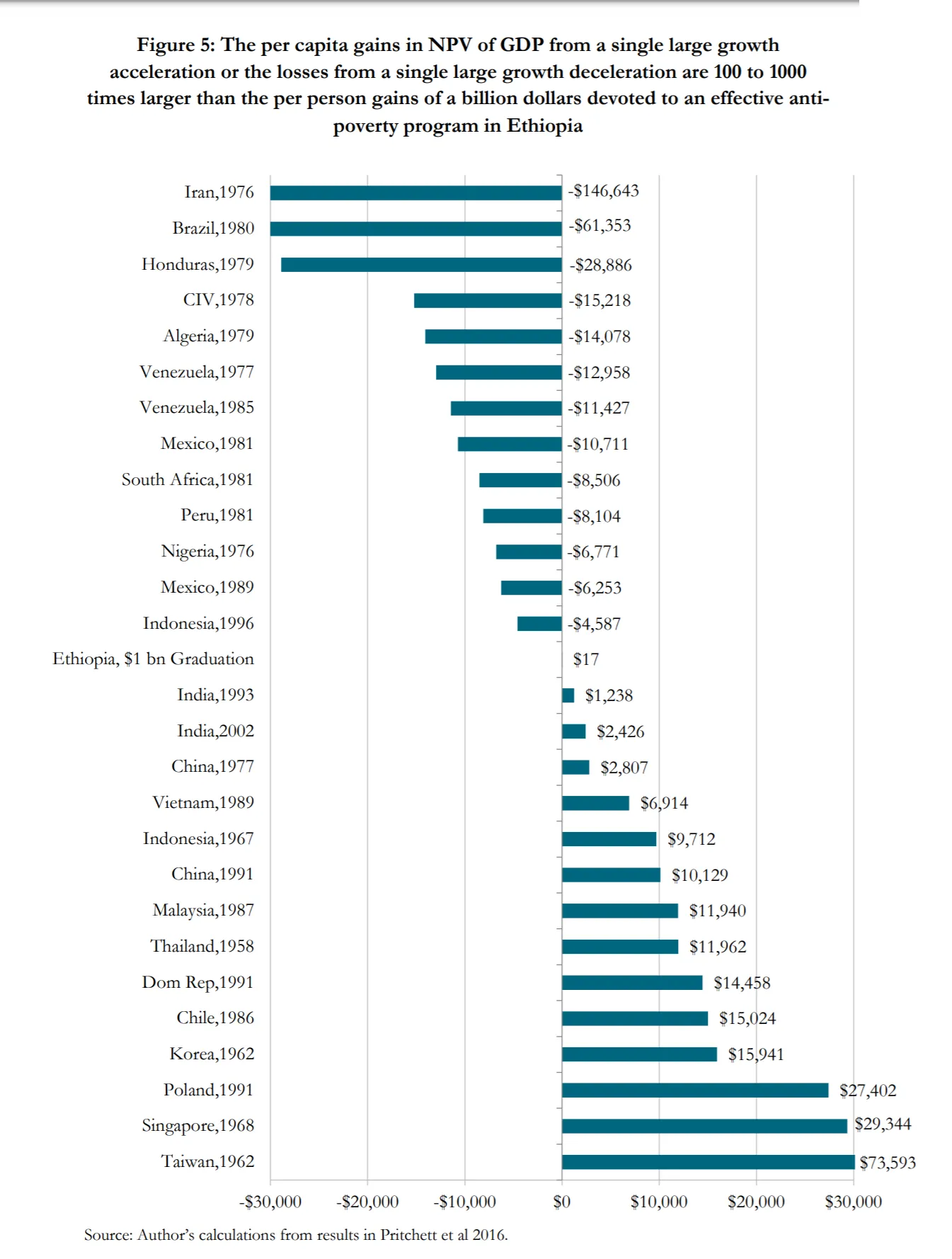
Many of the largest growth accelerations produce total benefits in the hundreds of billions of dollars in net present value.[25] The costs of growth decelerations are similarly vast.[26] The top 20 growth accelerations and decelerations have a Net Present Value of $30 trillion and minus $35 trillion.[27] (It should be noted that the later stages of the growth accelerations affect progressively richer people, so produce less utility from additional consumption.)
Thus, the benefits of growth are huge. And, as we shall now argue, the probability that economics can affect growth is also large enough to make the expected benefits of growth-friendly research and advocacy much larger than directly funding RD. There are a few ways to get purchase on this intuition.
All economists
The American Economics Association has 20,000 members. Assume there are twice as many economists globally costing around $150,000 each – at a total of $6bn. Suppose this was constant for 50 years and hence it cost $300bn to sustain the modern economics profession from 1960 to 2010. To be better than the graduation approach, the economics profession would need to have produced expected benefits in excess of ($300bn*1.6) = $480bn in NPV.
China's growth acceleration from 1977 onwards produced $14 trillion NPV in cumulative economic output. Thus, if the only thing the economics profession achieved in 50 years was to increase by 4 percentage points the probability that the Chinese government shifted to this new economic strategy, then it would have had greater economic benefits than the Graduation approach.[28] It is implausible that the economics profession had an influence this small, and there is in fact a lot of evidence for substantial development economics influence on Chinese economic thinking at this time.[29] From the blurb of a recent book Unlikely Partners:
'When Mao Zedong died in 1976, his successors seized the opportunity to reassess the wisdom of China's rigid commitment to Marxist doctrine. With Deng Xiaoping's blessing, China's economic gurus scoured the globe for fresh ideas that would put China on the path to domestic prosperity and ultimately global economic power. Leading foreign economists accepted invitations to visit China to share their expertise, while Chinese delegations traveled to the United States, Hungary, Great Britain, West Germany, Brazil, and other countries to examine new ideas. Chinese economists partnered with an array of brilliant thinkers, including Nobel Prize winners, World Bank officials, battle-scarred veterans of Eastern Europe's economic struggles, and blunt-speaking free-market fundamentalists.'
Moreover, this does not count the influence the profession had over all of the other growth accelerations and avoided decelerations. There is clear evidence of the influence of development economics on growth accelerations in India, Taiwan, Indonesia, Vietnam and other countries (see Appendix 2.2). We believe that on a realistic assessment of the evidence on the impact of development economics, the average cost-effectiveness of standard development economics is orders of magnitude better than RD. It remains to be seen whether growth-friendly development is more cost-effective on the margin. That depends on what funding opportunities are available within the cause of advocacy for growth-friendly economic policies.
The World Bank
The World Bank's expenditure on all of development economics in 2016 was about $50 million. To be better than the Graduation approach, this would have to have produced expected benefits greater than (1.6 * $50 million =) $80 million. The 2002 Indian growth acceleration was worth $2.5 trillion. Even if the only thing the World Bank achieved was to increase the probability of this occurring by 0.003%, then it would be better than the Graduation Approach.
The IMF
The total annual budget of the IMF is around $1.2 billion. If the IMF existed at that budget for 50 years at a cost of $60 billion cumulatively and even if all it ever did was have a 7% chance of averting a single $1 trillion crisis, then it would be better than the Graduation approach.
Philanthropic impact
Pritchett argues that philanthropists, and not just international institutions, have in the past helped to increase growth in low-income countries. For example, due to economic liberalisation causing growth accelerations in 1991 and 2002, India created an additional $3.6 trillion in GDP, relative to its 'business as usual' growth trajectory.[30]
Pritchett argues that Ford Foundation funding of the Indian Council for Research on International Economic Relations (ICRIER) was integral in this growth episode:
'There is a narrative in which Ford Foundation, a global philanthropy, provides some millions of dollars of funding that play some role in creating a think tank [ICRIER] that itself then plays some role in providing the conditions in which good policy choices are made that then results in the creation of $3.6 trillion in additional output of Indians.' [31]
Pritchett asks us to suppose that the Ford Foundation gave ICRIER $36m.
'Optimistically, suppose this gift increased by 50 percent the chance ICRIER was created and became an effective think tank (perhaps other funding could have come along, perhaps not) and suppose the existence and actions of this think tank increased by 10 percent the odds India adopted growth accelerating policies (my read of the situation is that it was higher). Then the expected value of Ford Foundation's 36 million of support was 180 billion dollars (bracketing discounting), a 5000-fold return per dollar of investment.
Pessimistically, suppose the Ford Foundation funding only increased the likelihood of an effective think tank by 10 percent (someone else almost certainly would have funded it) and the impact of ICRIER on the likelihood of a growth accelerating policy outcome was only 1 percent, the investment still returns 100-fold—3.6 billion on 36 million.
Suppose instead the Ford Foundation had given 36 million in what many regard as the highest return individualized investment: girl's education. There are hundreds of studies showing a positive return both to wages and to other outcomes—fertility, child survival, empowerment, etc. Let's suppose, super optimistically, the return on this investment was 20 percent. This means an additional 7.2 million dollars.'[32]
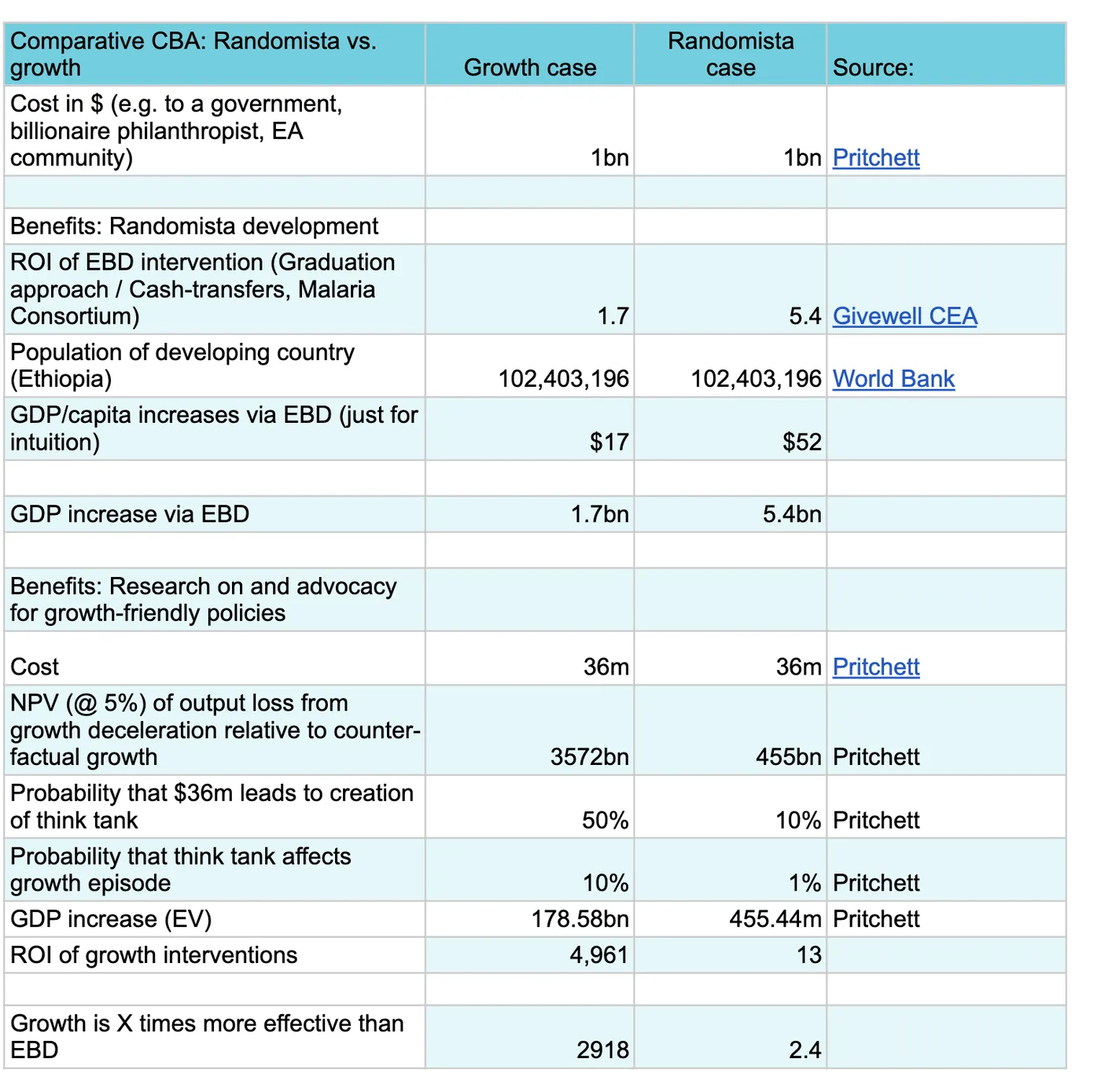
Spreadsheet model
Below we have a spreadsheet model comparing the relative effectiveness of direct funding of RD with a hypothetical growth intervention using some of the parameters from above.
Note that the model's assumptions are based on figures from other sources. As such, this model aims to highlight and disentangle the debate about the relative effectiveness of the randomista approach in the literature.
The case for Growth:
Here, the Graduation approach has a 1.7x ROI. Ethiopia's population is around 100 million. $1bn spent on the Graduation program would increase the GDP/capita by $17 and the overall return would be $1.7bn.
Pritchett compares this to spending $36m on research and advocacy increases the probability by 50% that a think tank is created. He assigns 10% probability that the think tank then affected India's 1993 and 2002 growth episodes (3,572 billion or roughly 3.6 trillion). This would create $178.58bn in benefits and be 2918x as cost-effective as the Graduation approach.
The case for Randomista development:
In contrast to the case above, we find that the randomista approach is on a similar order of effectiveness as our hypothetical growth intervention, if we make the following assumptions:
- We use Pritchett's pessimistic numbers where $36m on research and advocacy only increases the probability by 10% that a think tank is created by 1% that the think tank affects policy
- We use only the median growth episode in Pritchett's sample (which is Vietnam, 1989, corresponding to an increase of $6,914 GDP per capita) to be affected by a think tank
- We compare this to Malaria Consortium, which is 15.8x more cost-effective than the cash-transfers[33] and 3x as effective as the graduation approach[34]
Comparative CBA: Randomista vs. growth | Growth case | Randomista case | Source: |
Cost in $ (e.g. to a government, billionaire philanthropist, EA community) | 1bn | 1bn | |
Benefits: Randomista development | |||
ROI of EBD intervention (Graduation approach / Cash-transfers, Malaria Consortium) | 1.7 | 5.4 | |
Population of developing country (Ethiopia) | 102,403,196 | 102,403,196 | |
GDP/capita increases via EBD (just for intuition) | $17 | $52 | |
GDP increase via EBD | 1.7bn | 5.4bn | |
Benefits: Research on and advocacy for growth-friendly policies | |||
Cost | 36m | 36m | |
NPV (@ 5%) of output loss from growth deceleration relative to counter-factual growth | 3572bn | 455bn | |
Probability that $36m leads to creation of think tank | 50% | 10% | |
Probability that think tank affects growth episode | 10% | 1% | |
GDP increase (EV) | 178.58bn | 455.44m | |
ROI of growth interventions | 4,961 | 13 | |
Growth is X times more effective than EBD | 2918 | 2.4 |
5. Possible responses
5.1 Extreme scepticism about growth economics
One counterargument to this is to appeal to extreme scepticism about growth economics, specifically the claim that we know which economic policies can spur growth in the future. For example, Chris Blattman, a prominent randomista argues that '[the argument that advocacy for economic growth] has to be made partly on faith, because it is very, very difficult to connect the salary of a growth economist to somebody's life being better off in 40 years.'[35] Banerjee and Duflo make a similar argument in 'How Poverty Ends' in Foreign Affairs essentially arguing that we know very little about how to increase growth.
The first thing to say about this argument is that evaluating it should be the focus of significant research attention from effective altruists working to reduce global poverty. Within EA funding alone, there is >$150m per year at stake in the choice between advocacy for growth and RD. If the case against growth relies on such a controversial claim, then assessing that claim should be a top priority in EA. In spite of this, to our knowledge, this question has received no publicly published attention from the EA community.
There are some arguments for the extreme sceptic position. The Industrial Revolution in England happened before the vast majority of development economics, and the cause of the Industrial Revolution is still a subject of active debate in the field.[36] However, as we have argued above, the 'development era' had started by 1950.
The extreme sceptic view outlined above implies that though in the last 70 years, we have witnessed more economic development than all prior human history combined, the deliberate and prominent efforts of economists had no effect on this happening. This is prima facie implausible. It is worth here quoting Pritchett at length:
'This argument is at odds with commonly accepted interpretations of events in a number of countries. One, there are a number of countries (e.g. China, India, Vietnam, Indonesia) that said (1) 'Based on our reading of the existing evidence (including from economists) we are going to shift from policy stance X to policy stance Y in order to accelerate growth', (2) these countries did in fact shift from policy stance X to Y and (3) the countries did in fact have a large (to massive) accelerations of growth relative to [business as usual] as measured by standard methods (Pritchett et al 2016).
One had to be particularly stubborn and clever to make the argument: 'Politicians changed policies to promote growth based on evidence and then there was growth but (a) this was just dumb luck, the policy shift did not actually cause the shift in growth something else did or (b) (more subtly) the adopted policies did work but that was just dumb luck as there was not enough evidence the policies would work for this to count as a win for 'evidence' changing policy.'
There are also a fairly large number of countries that did the opposite. Economists (from their country and others) have said to the leadership of countries: (1) 'If you persist in policy stance X you are going to experience large (to massive) negative consequences for economic growth,' (2) the leaders have not listened, and (3) there have been precisely the predicted negative consequences. The Venezuelan economy is not in 2018 spiraling into hyperinflation and in the midst of a tragic economic depression because 'economists have little useful to say about economic growth' in the sense the advice, if followed, would be useful. If the argument is that research can learn reliable advice but this doesn't mean it will change the course of events, then the question is whether it never changes the course of events. There are also cases in which governments have said 'based on what economists say we are going to switch paths to avoid massive downturns/hyperinflation', have done so, and it has worked (in the sense at least that a crisis did not happen). While the 'growth accelerations' might have been hard to predict with standard policies (Hausmann, Pritchett, Rodrik 2005) there is empirical evidence that 'growth collapses' are rather more predictable (Breuer and McDermott 2011).
This is not to say that all research based claims about policies for growth have been right. The 'lost decades' in Latin America and the 'transition depression' in some (not all) former Soviet dominated countries are both examples of adopting policies for growth based on recommendations that seemed not to work. However, as a paper in this volume points out, among the top ten most prescribed medicines many work on only a third of the patients. So because a recommendation is not universally successful does not mean it is not a good recommendation. If I can give you a tip that increases your odds of winning a million dollar lottery by 10 percent, it is massively worthwhile. More recent reviews suggest the 'pox on all the houses of growth research' stance and a view recommendations had been worthless are too extreme (e.g. Easterly 2018 on the 'Washington Consensus', Irwin 2019 on trade).'[37]
In addition to this, as we have argued above, there is clear evidence that growth economics had an effect on Chinese economic policy, and this alone probably makes growth economics more cost-effective than the best that RD could do. We of course cannot settle the debate on the overall effect that growth economics has had here. However, as we have said, assessing its truth should be a top priority for proponents of RD and the EA community.
5.2. Economic growth and risk of harm
One other criticism of advocacy for growth is that it involves substantial risk of harm. Economists were involved in some of the growth decelerations that we have seen since the Second World War. The risk of harm is indeed a downside of advocacy for growth against RD.
Several things may be said in response to this. Firstly, this in effect concedes the argument against the extreme scepticism outlined above that development economics does influence national policy, and is therefore potentially high leverage. One cannot both claim that advocacy for growth-friendly economic policies has no effect on policy or on growth and also that it involves unacceptable risk of harm.
Secondly, RD also involves the risk of harm. For example, there was recently controversy about whether GiveDirectly's cash transfer programme in the past imposed harm on non-recipients.[38]
Thirdly, the historical record since 1950 suggests that the net expected gains from advocacy for growth have been very large, even if they have sometimes involved harm.
One could respond that we ought to avoid interventions risking substantial harm, even if the expected value of the intervention is higher than all others. If this is the ethical assumption underlying RD, then it should be made explicit going forward.
Finally, we are here arguing for high-quality effective research on how to encourage growth, and advocacy for that research. If such research could prevent harm being done by international institutions or others, then there is good reason to think, per the cost-effectiveness argument above, that doing such research would be better than RD. Preventing, at reasonable cost, just one error by the IMF or the World Bank would have expected benefits far in excess of RD. Moreover, if harm minimisation is the ethical aim, then research on how to prevent bad growth policy looks highly promising.
Economists have been studying growth, created models of how countries grow, created a field of 'growth diagnostics' (which uses historical and quantitative analysis to determine the causes of growth with the view of predicting growth bottlenecks of on a country-by-country basis), and make concrete policy prescriptions to cause growth (or prevent deceleration). Hauke discusses this in Appendix 2.
5.3. Is there anything to fund?
Another counterargument is that there are limited funding opportunities for philanthropists and that the space is already crowded with states and iNGOs, which usually aim to increase growth. Three things may be said in response. Firstly, establishing the truth of this claim should be a top priority for EAs who are focused on reducing global poverty. EAs are now moving more than a hundred million dollars every year in this space, so evaluating a crucial consideration such as this is of paramount importance.
Secondly, it is less clear whether advocacy for growth is crowded relative to its scale, which is the more relevant comparison. The scale of the problem economic growth solves are at least in the tens of trillions of dollars in net present value.
Thirdly, we present several suggestions for the kinds of things that could be funded in Appendix 3. These are not meant to be recommendations, but they do suggest that it is unlikely that careful analysis will find no promising funding opportunities in this space.
5.4. Politicisation
One additional downside of research and advocacy for growth-friendly economic policies is the politicised nature of such work. Direct poverty and health programmes, such as cash transfers or distributing malaria bednets, are fairly uncontroversial. In contrast, advocacy for economic policies like trade liberalisation or opening up economies to markets are highly politicised. Thus, if the EA movement did get involved in funding this sort of work, it would take on additional political risks. This is especially concerning for Western funders working in low- and middle-income countries.
However, it is worth noting that EA funders are already involved in some highly politicised work, such as advocacy for increasing migration and criminal justice reform. Nonetheless, the political risks are a strike against advocacy for growth-friendly economic policies, and need to be considered carefully.
5.5. GDP isn't everything
We noted at the start of this post that economic growth is not all that we care about from a near-termist human welfare-maximising point of view. Income per head does not account for:
- Inequality
- Foregone consumption from investment
- Leisure time
- Social connection
- Public goods
- etc
To take the example of public goods, some public goods are at best weakly correlated with GDP per capita:
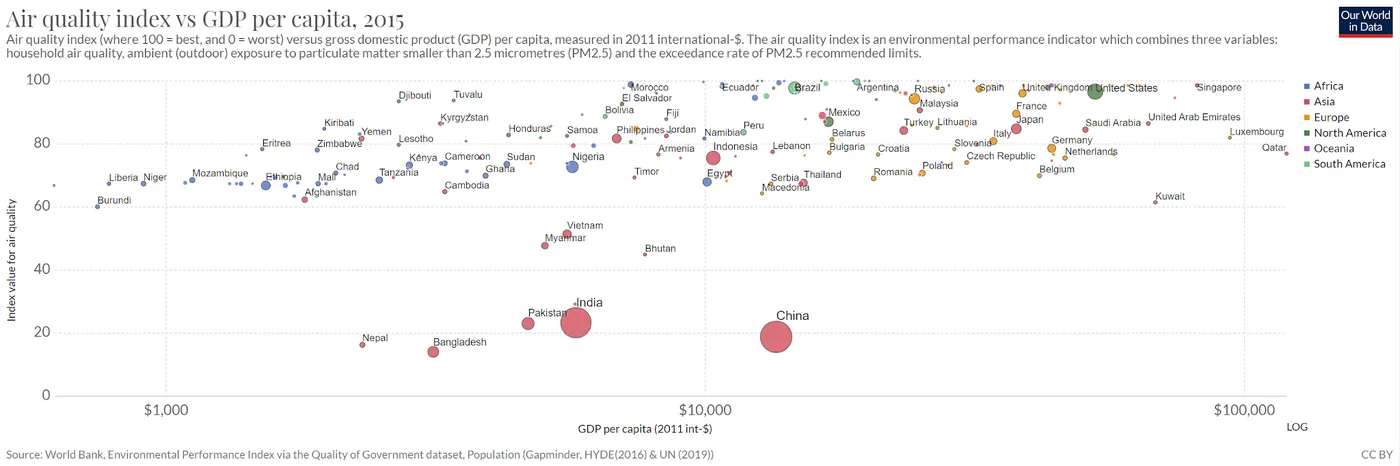
For public good provision, two factors are crucial: the responsiveness of the polity (i.e. how democratic it is) and state capacity. Pritchett has shown that environmental quality correlates well with measures of state capacity and responsiveness of polity.[39] To give another example, measures of personal safety do not correlate strongly with income per head or state responsiveness, but do correlate with state capacity.[40]
Pritchett constructs a broad measure of national development that includes income per head, polity responsiveness and state capacity. National development, thus defined, is extremely strongly correlated with subjective and objective measures of wellbeing.[41] At a given level of national development, a country can only increase welfare modestly, whereas increasing a country's level of national development can increase welfare substantially.
In sum, while we have focused on GDP here to make the case against RD, growth is not everything: accounting for inequality, leisure time and consumption is crucial, as is accounting for the provision of public goods, which is best ensured by a responsive and capable state. Assessing the best way to improve these things, outside of the constraints of RD, should also be a priority for effective altruists.
6. Conclusion
Economic growth has been a major driver of human progress so far. In spite of this, within global development, EAs have largely ignored the question of how to increase growth. Instead they have instead focused on (promoting) directly funding the best interventions that can be tested by RCTs. There are plausible arguments which suggests that focusing on growth could be substantially more cost-effective than this dominant approach. This question should be the subject of significant attention from EAs working on global health and development. This is a crucial consideration, which could cause a major shift in our view of interventions.[42]
More strongly, we believe that a 4 person-year research effort would find donation opportunities working on growth that are substantially more cost-effective than GiveWell's top charities.
It is less clear whether advocacy for growth-friendly economic policies is better than more 'hits-based' randomista development, such as advocacy for national scale-up of RCT-backed programmes, research into vaccines and antibiotics, or gene drives for malaria. Moreover, as we have said, economic growth is not everything and there may be even larger gains from improving reducing inequality, or improving state responsiveness and state capability. Investigating these questions should be a top priority for near-term human welfare-focused effective altruists.
In any case, we would like to open a discussion on whether, by relaxing constraints on risk and ambiguity aversion, and taking more of a hits-based approach in global development, donors can greatly increase their impact.
7. Further reading
- The two most compelling Pritchett papers on this topic are:
- 'Randomizing Development: Method or Madness?' (2019)
- 'Alleviating Global Poverty: Labor Mobility, Direct Assistance, and Economic Growth', Center for Global Development, (2018)
- Pritchett on Econtalk podcast [43]
- 2018 Lecture by Pritchett titled 'The Debate about RCTs in Development is over. We won. They lost.'
- Easterly, 'In Search of Reforms for Growth: New Stylized Facts on Policy and Growth Outcomes', NBER (2019)
- Popular book about the importance of economic growth: Tyler Cowen- Stubborn Attachments (audiobook takes <2h at 2x speed)
- Contrapoint:
- Banerjee and Duflo: Good Economics for Hard Times (especially chapters on trade liberalization and growth)
- Banerjee and Duflo, 'How Poverty Ends', Foreign Affairs.
- Paper by Dani Rodrik on recent economic policy advice and growth diagnostics: 'Goodbye Washington Consensus, Hello Washington Confusion? A Review of the World Bank's Economic Growth in the 1990s: Learning from a Decade of Reform'
- Aschenbrenner on Existential Risk and Economic Growth- EA Forum
- Joan Gass' thesis (written under Lant Pritchett) 'What's the best ROI of international development talent?- How to make a difference with your international development career'
Hauke's Appendices to 'Growth and the case against randomista development'
These appendices to Growth and the case against randomista development were written by Hauke, and do not necessarily represent John's view. This document is in a more rough state/note form and only intended as a starting point for further discussion.
Epistemic status: Uncertain and speculative. I don't excessively hedge my claims throughout for clarity's sake ('better wrong than vague', 'say wrong things', 'Big, if true', 'Strong stances', 'Correct me if I'm wrong', 'Embarrass Me Now, Please', Cunningham's Law: 'the best way to get the right answer on the internet is not to ask a question; it's to post the wrong answer.').
Table of contents
2.2 The field of 'Growth diagnostics'
'Once-and-for-all changes vs. growth rate changes' — Solow vs. incremental returns model of growth
RD programmes with 'zero marginal cost'
Appendix 1: Evidence-based development is just one part of development economics
Randomista Development is just one part of development economics.
- Economic consensus: A poll of top economists showed that almost all agree with the statement that RCTs are a valuable tool for answering some long unsettled questions in development economics research. However, while very many also agree with the statement that RCTs are a valuable tool for making significant progress in poverty reduction, a few are uncertain and some even disagree. [44],[45]
- Academia: Development economics is split between macro-development—focusing on growth, trade, and fiscal/macro policies—and micro-development—studying microfinance, education, health, and other social programs.[46] RCTs are still a minority of published development research: in 2015 the top 5 economics journals published 32 papers, of which 10 were RCTs.[47]
- Aid Spending: Globally, around $180B/year is spent on aid.
RD-related aid is at most around $90B/year:
- Social Infrastructure and Services $65B / year to develop the human resource potential and improve living conditions (Education, Health, Water and Sanitation).
- Humanitarian Aid: $26B / year: emergency and distress relief in cash or in kind (e.g. food aid, short-term reconstruction relief and rehabilitation, disaster prevention and preparedness).
Growth-friendly aid is around $50B/year:
- Economic Infrastructure and Services (networks, utilities and services that facilitate economic activity): around $38B
- Production Sectors: $12B this is to develop Agriculture, Industry, Mining and Construction.
Yet though it is a relatively even split, EA is almost entirely neglecting growth-friendly policies. For instance, while health aid is $12.9B, $6.2B was spent on technical assistance, which has received far less treatment.
Famous critics
Some prominent economics have argued that focusing on growth is likely more effective than evidence-based development:
- Lant Pritchett, Professor at Oxford University
- Angus Deaton, Nobel prize winner and Professor of Economics at Princeton.[48]
- Dani Rodrik, Harvard economics professor.[49]
- Daron Acemoglu, MIT economics professor.[50]
Appendix 2: Growth diagnostics
2.1 Theoretical model of growth
Historically, almost all non-poor countries have grown their economies in three steps [51],[52]:
- Rural to urban migration: Unskilled (subsistence) farmers migrate to cities and start working in factories. Over night, this increases their productivity many times over.
- Manufacturing absorbs vast amounts of unskilled labor: These workers need very little human capital: they do not need to be educated because work in factories is very simple. Poor population health does not prevent growth either, because there are enough people to replace sick workers.
- Manufacturing exports niche products to the world market: The factories find their niche product (e.g. initially often garments) and export to the world market, which can absorb large amounts of the same good (e.g. billions of shoes)
Increased incomes are invested into education of children, and the economy can transition to high productivity manufacturing (e.g. automotive industry, chemicals, where workers need education) and finally to services.
At every step, policy interventions could intervene and thus speed up growth. For instance, reducing within-country restrictions on rural to urban migration, might cause farmers to become factory workers in manufacturing. Or one could improve access to high-income countries markets through trade reform. For instance, in 2002, a US-Vietnam Bilateral Trade Agreement led to large reductions in US tariffs on Vietnamese exports- as a result the share of manufacturing workers in Vietnam in the formal sector increased by 5 percentage points. We review more concrete policy suggestions below.
One can distinguish between transformational, structural top-down change and fundamental change differently.
Structural change causes industrialisation. Examples of structural change policies are:
- Creating a more business-friendly environment
- Improving domestic manufacturing industries
- Liberalizing internal and external trade,
- stable fiscal and monetary policies.
Structural change often leads to rapid growth and thus dramatically improves welfare. For instance, rapid structural change in Vietnam led to massive rural to urban migration and more manufacturing (mostly garments). Manufacturing is labor-intensive and absorbs millions of unskilled workers (farmers can easily start working as garment factory workers, without education or good healthcare).
This industrialization process can go on for decades- during which income and productivity levels converge with rich countries. Only then, when this way of growth is exhausted, a more skilled workforce is necessary for further growth.
In contrast, structural changes are different from what Rodrik calls 'fundamental capabilities' and bottom-up interventions- education, health, infrastructure, and governance.
Rapid structural transformation leads to fast, but episodic growth and investment in fundamentals is needed to sustain this growth. Thus, for rapid, sustained growth, one needs not only structural transformation but also invest in fundamentals such as health and education (see Figure 0.2).
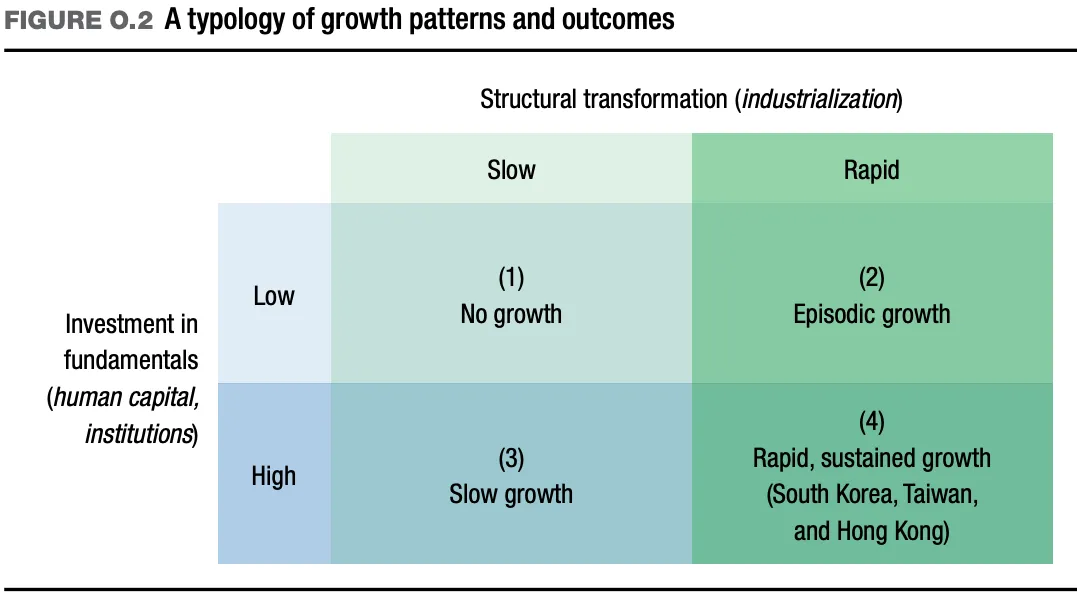
Examples of cell (3) slow growth are Latin American countries in the in 1990s, an example of (2) episodic growth is an example of Import substitution industrialization countries (such as Latin American countries from 1950s until the 1980s), and (4) rapid, sustained growth (examples are South Korea and Taiwan)
2.2 The field of 'Growth diagnostics'
A field in economics called growth diagnostics tries to find the causes of growth accelerations and decelerations. What is Growth Diagnostics?
Gass[53] defines it as:
'Growth diagnostics is a strategy to help identify the binding constraint(s) on economic activity in a given setting. It does not prescribe a 'one size fits all' approach to growth, nor does it proscribe a long list of reforms. It identifies the binding constraint by providing a decision tree that seeks to identify 'what keeps growth low.' Different factors are considered such as access to finance, natural capital, infrastructure (electricity, transport, water), human capital (education, health), appropriability risks (political instability, policy uncertainty, corruption, labor regulation) and other factors.'
The literature suggests that we perhaps know enough about growth relative to its expected value.
Angus Deaton has criticized RD and argued that most poverty reduction is due to growth, we have empirical knowledge about the causes of growth, and RDs effect on growth is small.[54]
A recent book 'Deals and Development' edited by Pritchett and others 'provides a novel framework for understanding how growth episodes emerge and when growth is maintained for a sustained period. It draws on country specific examples to ground theory in practice and explains actionable methods of intervention to improve a country's chance at achieving transformative economic growth'.[55]
For instance, Spain, which was poorer than Latin American countries in the 50s, has been argued to have become rich because they were helped by IMF, World Bank, and the OECD, prescribed a 'stability plan', which committed Spain to a rather standard program of fiscal and monetary stability, opening to international trade and foreign investment, and growing integration with international economic organizations.'
Economic advisers have often been suggested to have created growth in several countries:
- A new book 'Unlikely Partners: Chinese Reformers, Western Economists, and the Making of Global China' describes the influence western advisor had on Chinese Economic policy
- Deming is supposed to have improved Japanese Manufacturing
- Economic policy advisor John Cowperthwaite has been called Hong Kong's 'architect of prosperity'
- Albert Winsemius (1910–1996) was a Dutch economist best known for serving as an economic adviser to Singapore from 1961 to 1984.
- Western countries set up the Intergovernmental Group on Indonesia (IGGI) to ensure a long-term coordinated plan of official assistance for Indonesia in the '60s
- American advisers encouraged Korea to expand its export capacity (in part because of America's growing military involvement in Vietnam[56]) and western advisors argued cutting the birthrate was essential for fast economic growth and modernization.[57]
Historically, life used to be relatively simple for economic policy advisors in developing countries who could pick the low-hanging fruit by telling country leaders to 'Stabilize, privatize, and liberalize'.[58]
The 'Washington Consensus' for example are a set of 'economic policy prescriptions considered to constitute the 'standard' reform package promoted for crisis-wracked developing countries' by the IMF, World Bank and US treasury, which inspired a wave of reforms in Latin America and Sub Saharan Africa.[59]
These policies are:[60]
- Fiscal discipline
- Reorientation of public expenditures
- Tax reform
- Financial liberalization
- Unified and competitive exchange rates
- Trade liberalization
- Openness to DFI
- Privatization
- Deregulation
- Secure Property Rights
- Corporate governance
- Anti-corruption
- Flexible labor markets
- WTO agreements
- Financial codes and standards
- 'Prudent' capital-account opening
- Non-intermediate exchange rate regimes
- Independent central banks/inflation targeting
- Social safety nets
- Targeted poverty reduction
Just as one example, take the importance of trade liberalization on infant mortality (trade (liberalization) is usually consider to cause growth.[61] For instance, one natural experiment suggests that a US trade agreement with Sub-saharan Africa caused infant mortality to drop by ~9%. Another study found trade liberalization reduced child mortality in ~50% of developing countries they looked at and in most of those countries child mortality was reduced by more than 20%.[62] This is big, if true.
In contrast to RD, which has high costs and small benefits, trade deals are low or negative costs (gains from trade) with very high benefits (to get to a similar reduction in infant mortality as with trade deals, one would have to distribute many millions of bednets). This is why some economists claim that trade deals have a much higher benefit-cost ratio than global health interventions.[63] Also, as a general rule, destroying value is often easier than creating value, market distortions such as artificial trade barriers can be seen as destroying value, and taking them away might often be more effective than creating value (e.g. building houses).
These days, 'standard prescriptions' might not work any longer and we should be skeptical of top-down, comprehensive, universal solutions.
However, technical assistance by more specialized agencies (e.g. DFID, USAID, GIZ as well as the World Bank's country offices), and also NGOs such as the International Growth Center, the Copenhagen Consensus, etc. can do 'growth diagnostics' to find out where growth is bottlenecked and then help with tailor-made policies on a country-by-country basis.[64]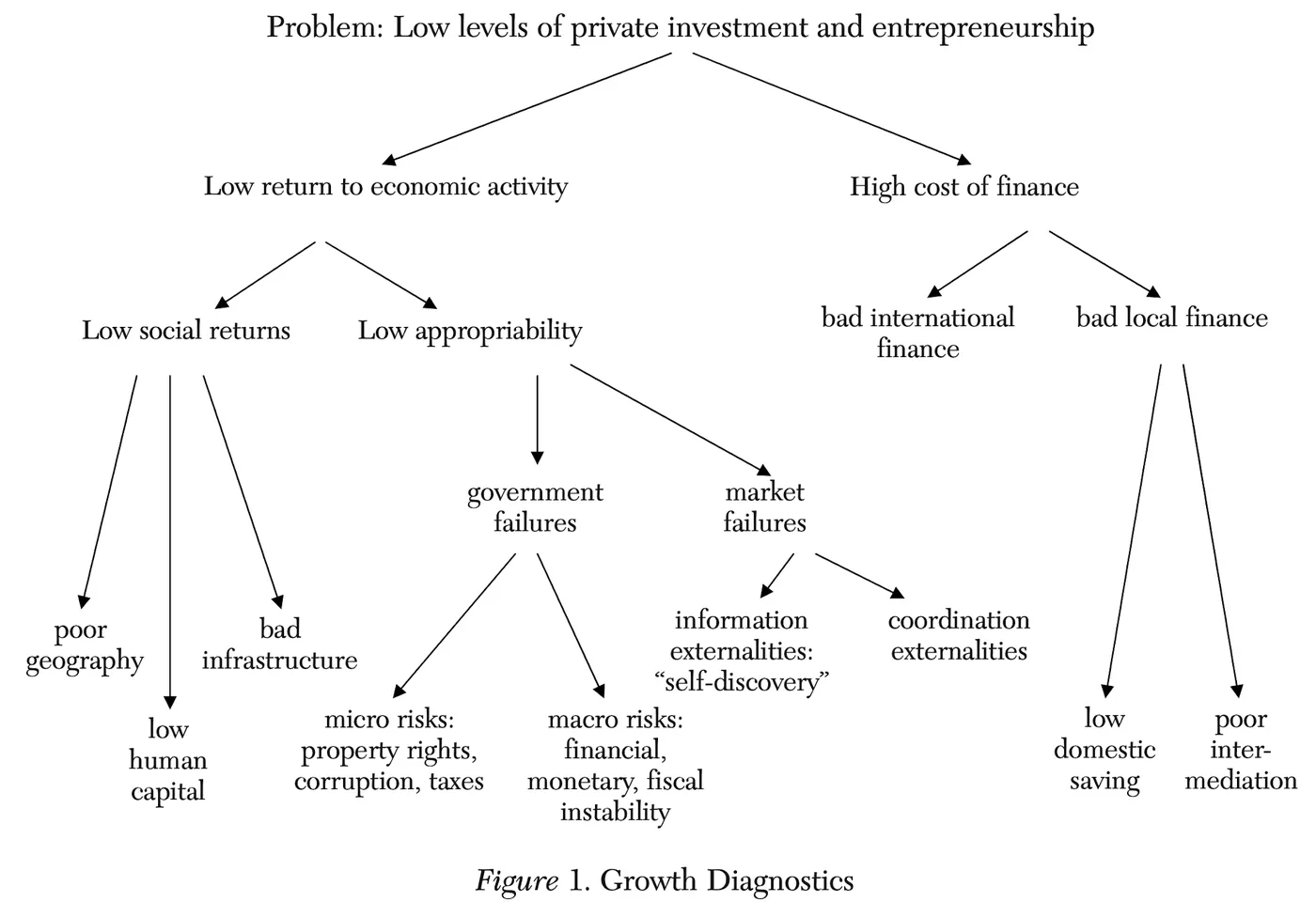
The World Bank published many papers on India and growth in the 1990s,[66] with agendas and prescriptions on how to grow the economy. For instance, one paper presented in 1999 in New Delhi argued that India should engage more actively in the multilateral trading system.[67]
The main proponents of RD, Duflo and Banerjee, are much more skeptical about growth-friendly policies.[68] While they agree that, generally, switching from extreme state controlled socialism to capitalism causes growth, they are much more skeptical that removing remaining barriers has much of an effect. They also question whether breaking into international trade is the way forward for the average poor country of today.[69] They believe that we do not know much about growth and studies often using cross country comparisons, suffer from methodological issues such as reverse causality, omitted variable bias, etc. They also think that we know much less about the causes of the Indian 1991 growth episode than other economists. Finally, they also worry that liberalizing trade increases inequality. We list some relevant quotes below.
In contrast, Pritchett seems much more optimistic about growth diagnostics and believes that while we might not know everything, we generally have a reasonable understanding of what causes growth and can even influence it.[70]
Pritchett has edited a whole volume on growth diagnostics, including on the causes of growth in India.
Growth diagnostics might get harder the richer a country becomes, by virtue of there being less and less data from other countries on how they developed. Thus, for the poorest countries, growth diagnostics might be easiest because we can draw lessons from all other countries on how they developed.
Because effective altruism often tries to focus on the poorest countries, where a dollar goes 100x further than in rich countries, there is perhaps most hope for growth diagnostics.
So perhaps Duflo is right in that 'Growth is likely to slow, at least in China and India, and there may be very little that anyone can do about it.' And this is actually born out in China's and India's performance on the World Bank's Doing Business indicators, where they score 63th and 31st out of 189 countries, though being relatively poor. Thus, there seem no low hanging fruit to improve their economic policy.
However, below I show a table where I multiply population size of every country by their poverty multiplier (i.e. $1 is worth x times more going to this country than to the richest country in the sample. See appendix 2 of this doc for more info). This can then be ordered by the utility created by increasing GDP per capita by $1. India comes out on top because of its large population (1.3B) and relatively low GDP per capita ($6,574). China comes 3rd, because though it has a large population, it is already relatively rich ($15,531). Recall that the problem is that we might not know how to increase growth in India and China.
However, there are many smaller very poor countries in the top 10 sample such as DRC and Ethiopia- very poor countries with 100 million population. This can then also multiplied further by neglectedness/tractability criteria. For instance, in a country's ranking on the WB Doing Business ranking divided by GDP. There one can see that, relative to its GDP per capita, China already does quite well on the Doing Business ranking. However, the DRC and Ethiopia do poorly on the 'doing business' ranking, even relative to their GDP. These countries could be most cost-effective for economic policy assistance.
GDP per capita (PPP) | Population | Poverty multiplier (1/GDP) / max(1/GDP) to scale | Importance: Population * Poverty weight | WB Doing business rank | Neglectedness: WBDB/GDP | I*N | |
DRC | $868 | 79M | 147 | 115,637 | 183 | 0.21 | 24,380 |
Ethiopia | $1,734 | 102M | 74 | 75,285 | 159 | 0.09 | 6,903 |
Mozambique | $1,216 | 29M | 105 | 30,224 | 138 | 0.11 | 3,430 |
Bangladesh | $3,580 | 163M | 36 | 58,025 | 168 | 0.05 | 2,723 |
India | $6,574 | 1B | 19 | 256,777 | 63 | 0.01 | 2,461 |
Uganda | $1,819 | 41M | 70 | 29,076 | 116 | 0.06 | 1,854 |
Pakistan | $5,238 | 193M | 24 | 47,021 | 108 | 0.02 | 970 |
Nigeria | $5,861 | 186M | 22 | 40,454 | 131 | 0.02 | 904 |
China | $15,531 | 1B | 8 | 113,162 | 31 | 0.00 | 226 |
The Copenhagen Consensus Center is assisting countries / highlighting the need to improve their economic policies. For instance, they helped Bangladesh to improve its economy and prioritize which policies would have the highest social, economic and environmental benefits for every dollar spent. On top of their list is e-procurement across government and land records digitization- related to criteria used to rank countries on the WB Doing Business index.
Quotes from Duflo and Banerjee
From 'Good Economics for Hard Times'
- 'How would anyone know whether pre-1991 growth would have continued had there been no crisis and the trade barriers not been brought down in 1991? To complicate matters, trade was being liberalized gradually starting in the 1980s; 1991 just sped that up (a lot). Was the big bang necessary? We will never know unless we are allowed to rewind history and let it go down the other path. Unsurprisingly, however, economists find it very hard to let go of this sort of question.'
- CHASING THE GROWTH MIRAGE
- 'Unfortunately, just as we don't know much about how to make growth happen, we know very little about why some countries get stuck but others don't—why South Korea kept growing but Mexico did not—or how one gets out.'
- 'Perhaps the reason why some countries, like China, can grow so fast for so long is that they start with a lot of poorly used talent and resources that can then be harnessed'
- 'Solow's was what economists call an exogenous growth model, where the word 'exogenous,' meaning driven by outside effects or forces, acknowledges our inability to do anything about the long-run growth rate. Growth, in short, is beyond our control.'
- 'The growth tide does raise all boats, but it doesn't lift all boats to the same level—many economists worry that there may be such a thing as the middle-income trap, an intermediate-level GDP where countries get stuck or nearly stuck. According to the World Bank, of 101 middle-income economies in 1960, only 13 had become high income by 2008. Malaysia, Thailand, Egypt, Mexico, and Peru all seem to have trouble moving up. '
- 'In Indian manufacturing there was a sharp acceleration in technology upgrading at the plant level, and some reallocation toward the best firms within each industry after 2002. This appears to be unrelated to any economic policy, and is described as 'India's mysterious manufacturing miracle.'121 But it is no miracle. At its root, it is a modest improvement from a dismal starting point, and one can imagine various reasons it happened. Perhaps a generational shift, as control passed from the parents to their children, often educated abroad, more ambitious, and savvier about technology and world markets. Or the effect of the accumulation of modest profits that eventually made it possible to pay for the shift to bigger and better plants.'
- 'One very real danger is that in trying to hold on to fast growth, India (and other countries facing sharply slowing growth) will veer toward policies that hurt the poor now in the name of future growth. The need to be 'business friendly' to preserve growth may be interpreted, as it was in the US and UK in the Reagan-Thatcher era, as open season for all kinds of anti-poor, pro-rich policies (such as bailouts for over indebted corporations and wealthy individuals) that enrich the top earners at the cost of everyone else, and do nothing for growth. If the US and UK experience is any guide, asking the poor to tighten their belts, in the hope that giveaways to the rich will eventually trickle down, does nothing for growth and even less for the poor. If anything, the explosion of inequality in an economy no longer growing has the risk of being very bad news for growth, because the political backlash leads to the election of populist leaders touting miracle solutions that rarely work and often lead to Venezuela-style disasters. Interestingly, even the IMF, so long the bastion of growth-first orthodoxy, now recognizes that sacrificing the poor to promote growth was bad policy. It now requires its country teams to include inequality in factors to take into consideration when providing policy guidance to countries and outlining conditions under which they can receive IMF assistance.123
- 'The bottom line is that despite the best efforts of generations of economists, the deep mechanisms of persistent economic growth remain elusive. No one knows if growth will pick up again in rich countries, or what to do to make it more likely. The good news is that we do have things to do in the meantime; there is a lot that both poor and rich countries could do to get rid of the most egregious sources of waste in their economies. While these things may not propel countries to permanently faster growth, they could dramatically improve the welfare of their citizens. Moreover, while we do not know when the growth locomotive will start, if and when it does, the poor will be more likely to hop onto that train if they are in decent health, can read and write, and can think beyond their immediate circumstances. It may not be an accident that many of the winners of globalization were ex-communist countries that had invested heavily in the human capital of their populations in the communist years (China, Vietnam) or countries threatened with communism that had pursued similar policies for that reason (Taiwan, South Korea). The best bet, therefore, for a country like India is to attempt to do things that can make the quality of life better for its citizens with the resources it already has: improving education, health, and the functioning of the courts and the banks, and building better infrastructure (better roads and more livable cities, for example).'
- On climate: 'Mitigation through better technologies may not do the trick; people's consumption will need to fall. We may have to be content not only with cleaner cars but also with smaller cars, or no cars at all.'
From their Foreign affairs article[71]:
- 'There are many ways to improve allocation, from the moves away from collectivized agriculture that China made under Deng to the efforts India made in the 1990s to speed the resolution of debt disputes and thus make credit markets more efficient. But the flip side to this is that at a certain point, the gains start to diminish. Many developing economies are now reaching this point.'
- 'Quality of life means more than just consumption. Although better lives are indeed partly about being able to consume more, most human beings, even the very poor, care about more than that. They want to feel worthy and respected, keep their parents healthy, educate their children, have their voices heard, and follow their dreams. A higher GDP may help the poor achieve many of those things, but it is only one way of doing so, and it is not always the best one.'
- Note that this contra Pritchett who argues that higher GDP is necessary and the best way to achieve this
Appendix 3: Steelmanning RD (against growth)
In this section I describe some counterarguments to the view that RD is not as effective as growth-inducing policies. I'm unsure in how far they affect the overall conclusions and they should perhaps more seen as a starting point for further discussion on which RD interventions might be particularly effective, why growth-policies are not as effective anymore, and what the reasons are for why the EA community recommends certain RD interventions.
'Premature deindustrialization' due to technological unemployment make human capital interventions relatively more effective
There was exceptionally weak global trade growth over recent years.[72] Merchandise trade decreased by 10% between 2011 and 2015.[73] Automation has become increasingly less labor-augmenting and more labor-displacing.[74] There are increasingly fewer factory jobs.[75] Even in China, where labor costs are low, humans are replaced by robots in factories.[76]
The Chinese and Indian growth model might no longer possible, [77] because automation in high income countries could decrease the labour cost advantage of poorer countries, preventing traditional development. The US added 135,000 robots and 230,000 jobs [78] to its auto industry and the U.S. has become the second-most-competitive manufacturing location.[79]
Low-skilled jobs in emerging economies are particularly susceptible to automation- see figure below.
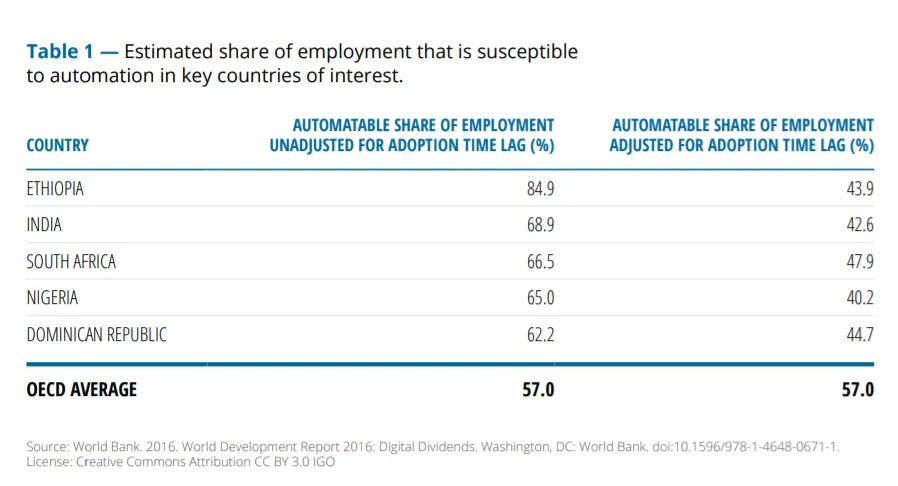
(though the consequences of this so-called 'premature deindustrialization' [80], [81], [82], [83] are debated: robotization might actually increase welfare in developing countries.[84])
This suggests that human capital interventions (e.g. health, education) are needed immediately in poor countries and thus perhaps RD interventions are better.
Relatedly, trade liberalization has reduced wages and employment of poor people in rich countries, which caused them to vote for populists like Trump [85] and far right-wing parties in Europe.[86] A policy solution to this might be to reduce barriers to trade (or increase migration) more gradually so that poor people in developed countries have more time to adapt — this does not mean that migration or trade should be reduced in absolute terms.
Growth is not as neglected as RD, its low-hanging fruit have been picked, and the marginal dollar is not as effective
'The evidence that macroeconomic policies, price distortions, financial policies, and trade openness have predictable, robust, and systematic effects on national growth rates is quite weak—except possibly in the extremes. Humongous fiscal deficits or autarkic trade policies can stifle economic growth, but moderate amounts of each are associated with widely varying economic outcomes.'[87]
For instance, take the debate over trade liberalization. Recall that there was exceptionally weak global trade growth over recent years.[88] Relatedly to the previous point, some argue that the 'low-hanging fruit' of economic liberalization has already been picked. For instance, Weyl argues that in 'Radical markets':
'There is a consensus that the economic gains from further opening international trade in goods is minimal. Studies by the World Bank and prominent trade economists find that eliminating all remaining barriers to international trade in goods would increase global output by only a small amount, 0.3–4.1%. For global investment, the most optimistic estimate in the literature finds a 1.7% increase in global income from the elimination of barriers to capital mobility.[89] Many believe that liberalization of international capital markets has gone too far. Three top IMF economists recently argued that even liberalization that has already taken place has brought limited gains to economies while generating inequality and instability.[90]'
Others argue that trade policy is still very relevant. [91] Complete rich-country liberalization would, after a 15- year adjustment, increase income in developing countries by $100B per year, which is approximately twice current aid flows.[92]
Also, guarding against protectionism and not losing the growth from trade might be very important: one study suggest that an 'increase in tariffs to average bound rates of 44.7% in highly protectionist countries such as India, Bangladesh, Pakistan and Sri Lanka would translate into a decline in real income in South Asia by 4.2% or welfare losses of close to $125B relative to the baseline by 2020'.
'Once-and-for-all changes vs. growth rate changes' — Solow vs. incremental returns model of growth
The following quotes come from Cowen's 'Stubborn Attachments'- they explain two different models of growth, which have different implications for our argument here.
'The Solow model [93] [94] [...] implies economies should recover quickly from one-time negative shocks, such as earthquakes or destructive wars. Although the capital stock has fallen from the destruction, the rate of return on capital is now higher, precisely because the capital stock has fallen. Additional savings should make up the gap and, over time, restore the economy to its previous growth path. That's another example of this more general phenomenon of catch-up [growth]'
'In contrast to the Solow model, increasing returns models [95],[96] suggest that growth begets more growth. In this view, larger economies should grow more rapidly than smaller economies, and growth rates should continue to increase over time. Improvements beget further improvements and negative events are likewise cumulative, thus the moniker 'increasing returns.''
'The increasing returns model that virtually any gain in resources can be translated into higher growth in the long run, rather than washing out in the adjustment process. Under increasing returns models, a one-time negative shock harms the long-run rate of growth. '
'The Solow model suggests a picture of greater resilience, since catch-up effects prevent each and every mistake from compounding over time into a larger collapse.'
Arguments for the overwhelming importance of growth to an extent rely on the 'increasing returns model'. If the Solow model is correct, then temporary growth decelerations or accelerations of particular countries might not be that important. However, even if the 'increasing returns' model of growth is false, growth can still be very important due its large effects on welfare in the medium term.
Health does not cause growth, but improving cognitive development might
Generally, increasing average population health does not cause much growth.[97]
GDP and health are strongly correlated. Healthier people can work harder and learn more in school and so one might expect better health to cause growth. However, the evidence for health causing growth is weak and the effect is small.[98] (Though there is some disagreement in the literature- for instance, 'targeted interventions to improve the health conditions of women and children, such as iodine supplementation or vaccination against human papilloma virus, are likely to yield very high returns in terms of economic growth, well-being, and long-run development.)'[99])
Similarly, there is little evidence that human capital aid (e.g. education, health) causes growth.[100],[101], [102] In contrast, the evidence is clear that growth improves human capital such as health.[103] Very poor countries where your dollar goes 100x further are perhaps less likely to be bottlenecked by human capital (e.g. health and education).
However, perhaps some targeted effective investments in health might cause growth or otherwise have outsized effects on welfare.
Our best bet is the literature on the 'fetal origins hypothesis' and child development, where early environment affects cognitive development and later life outcomes. [104] Some of the effect sizes are downright incredible and its implications might be big (if true). For example, salt iodization is cheap and might improve (population-level) cognitive development and IQ. [105], [106] Other examples are pollution[107], nutrition, disease, weather, smoking, alcohol etc.[108] (Also note that the IQ of the top 5% better at predicting GDP than average IQ: Cognitive Capitalism: The Effect of Cognitive Ability on Wealth, as Mediated Through Scientific Achievement and Economic Freedom).
A counterpoint though is that because growth causes population health,[109] and income has also been shown to improve birth weight, test scores etc, growth might still dominate this.
A counterpoint to this:
'Though dietary patterns vary geographically, with respect to a variety of micronutrients important for human development, iodine availability is likely to exert a stronger independent influence on economic outcomes than dietary prevalence of other micronutrients and many climatic conditions due to the fact that it has little correlation with local food availability. Hence, while other micronutrient deficiencies are likely to be resolved with economic development by way of rising caloric intake, iodine deficiency is more likely to exert a persistent influence on economic outcomes.' Field, Robles and Torero 2009, Pg. 141[110]
RD programmes with 'zero marginal cost'
Increasing growth benefits almost everyone in the economy and improving policies such as trade policies reach users with 'zero marginal cost'. In other words, a think tank advocating for lower tariffs for Nigeria to EU markets provides a public good for all 190 million Nigerians. Adding another Nigerian due to population growth is increasing this intervention effectiveness at zero marginal cost.
Similarly, while many RD approaches 'do not scale', i.e. the marginal cost of adding another e.g. cash-transfer recipient is constant, some RD do have zero marginal cost and do scale. For instance, Development Media International promotes health behaviours through mass media to thousands of people, and might save a life on the order of ~10k, but could perhaps scale, increase their audience by 100x while only increasing their operating cost by a factor of 2x and increase their effectiveness considerably. See for instance [111]
Cash transfer advocacy is very cost-effective because the size of the humanitarian aid budget is relatively fixed but ineffective
Humanitarian aid is a large part of aid. Though research and policy on growth might be more effective than humanitarian aid, it might not be politically tractable to divert humanitarian aid to it. Thus, advocacy for cash transfers might be very effective, because it moves ineffective humanitarian aid (such as food aid) to more effective humanitarian interventions (such as cash). This plausibly makes cash-transfer advocacy a very effective intervention.
Similarly, a large part of the $300B/year donated in the US alone will likely go to 'straightforward charity'. This might make it effective for people in EA to promote RD.
Differential technological development
Speeding up growth might speed up GCRs from emerging technologies. [112],[113] However, it is unclear when growth will speed up x-risk. [114],[115]
Further, when it comes to differential technological development, not all growth is equal. What speeds up risks from emerging technologies is mostly growth in highly technical sectors in high-income countries. Growth in low-income countries will not increase world growth much and is less likely to cause risks from emerging technologies.
Put simply: Burundi's catch-up growth won't speed up global growth by much, is unlikely to speed up risks from AI or bio any time soon. Growth has been argued to lead to 'Greater opportunity, tolerance of diversity, social mobility, commitment to fairness, and dedication to democracy.'[116] Perhaps growth in poor countries will actually increase stability and thus be good from a differential technological development point.
Lower skilled labor also competes with AI R&D and so increasing trade and migration decrease AI R&D (see 'Why Are [Silicon Valley] Geniuses Destroying Jobs in Uganda?' and [117]).
But even if growth in poor countries will slightly increase x-risks, then it might still be optimal to support it and offset the x-risk increase through targeted interventions to decrease x-risks. This is because multiobjective optimization for both x-risk reduction and global poverty is likely harder than single objective optimization for the most effective interventions in each category separately.
Benefit cost ratios of advocacy might be high, but benefit minus cost is higher without leverage
Alex Berger on the 80k podcast: '2.5B DALYs lost to all causes every year [...] GiveWell thinks they can save a disability-adjusted life year for something like $50. If you were trying to spend just a billion dollars a year, which is 3% of the NIH budget, less than 0.3% of U.S. philanthropic dollars every year, on stuff that's as cost effective as that, then you would need to be reducing total global life years lost from all causes everywhere by just under 1%. that number, that's just really, really high. [...] at a scale a hundred times bigger, you literally couldn't because you would have already solved all health problems. I don't know where the curve is of declining marginal returns, but I would guess it sets in pretty steeply before even ten times bigger than that. I think people sometimes underestimate the size of the opportunities when they think, 'Oh, we can make a leveraged play that could be 10x better.' Maybe an individual donor could, but Open Phil will need to eventually be giving away a billion dollars a year, maybe more. We're giving at a scale where it has to be able to absorb more resources. [...] Okay, so there could be particularly good grants in science and politics that do this, but it's just they're not going to be able to absorb nearly as much money as you need to be able to give away. So you want to make those, but then it's also going to be very important to find other things that can actually take billions.'[118]
Appendix 4: Growth policies
In this section I list a few research findings, policy prescriptions, and funding opportunities to illustrate potential starting points for further inquiry to work on growth.
Research on growth
One could fund translation of these books on Economic growth into more languages or help the author to publish the 4th edition of his textbook on growth faster. Alternatively, see this growth textbook. Or fund Harvard's growth lab: For instance, they recently published a study on how Uganda should grow.
Improving business environment
- Funding opportunity: The Copenhagen Consensus Center is helping Bangladesh to liberalize its economy and prioritize which policies would have the highest social, economic and environmental benefits for every dollar spent. Bangladesh has a large population and many people living in extreme poverty, so there's maybe an opportunity to repeat what was done in India. They have also recently started a programme in India funded by the Gates Foundation: India Consensus, starting with the states Andhra Pradesh and Rajasthan. Other organizations that work on finding the causes of growth in developing countries and trying to speed up developing country growth are Growthdialogue.org and The International Growth Center. Think tanks can often have a lot of leverage: for instance, the Aid Transparency Index is another think tank, with less than $1M/year in funding has improved transparency of the aid sector.
- Business environment improvement: Generally, improve scores of countries on the World Bank Doing Good Business index (though this might not cause much growth). For instance, Kieran Holmes is a tax consultant, who advises developing country governments to get better at tax collection. He has improved Burundi's 'doing good business' indicators. He has also helped to increase annual tax revenue in Rwanda by 6.5x after automating the collection process, which reduced errors and opportunities for fraud. One could also look into funding the Public Expenditure and Financial Accountability (PEFA).
- Developing country tax reform: A value added tax in India leads manufacturing firms to produce less – and it's not just reporting. (Velayudhan)
- Banning fixed-term contracts in the Indian state of Andhra Pradesh reduced contract labor usage in core activities, and increased regular labor. Revenue and profits significantly declined, potentially due to higher input costs. (Chaurey and Soundararajan)
- A large, size-based industrial policy reform in India reserved several products to be manufactured by small firms which increased consumer welfare by 1.62%. (Chiplunkar) [119]
Improving trade
- Global Development: Fund Trademark East Africa which tries to improve trade in East Africa. Or fund Cuts International, Geneva, which also works on improving trade for least developed countries. Trade is important because it attracts investment, creates jobs, and reduces poverty.
- Drawing on data from across Sub-Saharan Africa, a new model explores the link between the costs of doing trade and the adoption of fertilizer in agriculture. 'Greater adoption [of fertilizer subsidies] lowers local food prices substantially under existing high trade costs, but fertilizer subsidies only increase farmer incomes when trade costs are low.' (Porteous)
- 'The literature provides clear guidance to policy-makers in several areas. It is good at estimating the effect of FTAs on the parties' trade flows. All but one of the 19 high or moderate quality primary studies that estimated trade growth found that the FTA had positive effects in at least some cases, and none found it to be negative. But the picture is mixed, with the range of estimated effects wide. In some cases the estimated trade effect was substantial, in others it was modest, and some partners were found to have gained nothing.' [120]
Migration
- Rich countries increased their temporary migrant worker stocks by an amount equal to just 3% of their labor forces, global income would increase $150B, with most of that accruing to the temporary workers themselves. Complete liberalization could generate vastly larger gains for temporary workers.[121]
- A UN study found that 80% of countries had policies to reduce rural-urban migration (up from only 38% in 1996). It is also more pronounced in poorer countries: 88% of the least developed countries reported policies to reduce migration to urban areas. Rural to urban migration is a crucial part in economic development for any country in human history. Some studies run simulation that suggest that 'across the period 2011–22, if the labor participation rate of the non-agricultural sector increases by 1 percent per year, China will increase its potential growth rate by 0.88% (Cai and Lu 2013). [and] the most important measures to improve labor force participation include reform of the household registration system and improvements in urban public goods and services, both of which would help to stabilize and expand the employment of migrant workers in the urban economy and non-agricultural industries. [...] Traditional factor-driven growth can still contribute if reform increases labor force participation, most significantly through easing restrictions on rural–urban migration through reform of the household registration system and other means.'[122] [Study] One could fund more research on this topic or fund Fei-ling Wang, who advocates for incremental reform in China and might be willing to convene a conference on lessons for other countries. More on this topic.
- Internal migration generates big welfare gains in Uganda, with even larger effects for moves to urban areas (Mensah & O'Sullivan)[123] 'Moving to a rural destination yields welfare returns of 56 percentage points, while the returns to urban moves, at 65 percentage points, are markedly higher. Policies to capture the welfare gains from migration to cities should focus on further urbanization, the development of road infrastructure, and investments in education for men and women in rural areas. '
Appendix 5. Biases against growth/for RD
Several cognitive biases might lead to the neglect of growth and the preference for RD:
- Loss aversion is a cognitive bias that refers to people's tendency to prefer avoiding losses to acquiring equivalent gains: it is better to not lose $5 than to find $5. Similarly, one might not even realize much, that one has missed a growth acceleration. 2008 caused every American to 'lose' $70k.[124] However, most of these lost earnings were not very traumatic because people didn't 'really have them' in the first place.
- Social norms against coming across as a 'superior culture': people do not want to come across as a 'A white in shining armor' —the fallacy of viewing the developed-world donor as the only person who can improve things for the beneficiaries and so we should focus on health interventions and cash exclusively. [125] But there is no principled difference between scientific knowledge about medicine vs. economics. Often we have more certainty that malaria nets will prevent malaria than whether central banks should introduce negative interest rates. But we are more certain that reducing rich countries' tariffs unilaterally for developing countries is positive than whether population deworming is effective.
- Relatedly, perhaps there is too much epistemic humility—throwing our hands up in the air— about what causes growth.[126] For instance, some believe cross-country growth regressions to be pointless, yet even Nobel prize winner Deaton actually does believe that we have learned something from them.[127]
- Path dependency and status quo bias: The Gates foundation and the EA community have supported RD for a long time and so there might be substantial path dependency to switch. The reversal test can be used to sanity check against any status quo bias. For example, rather than asking whether one should switch from supporting RD to growth one could ask: 'If an organization supporting growth-friendly policies (e.g. IGC, Copenhagen Consensus) already had an extra $100k, would I take it away from them and give it to GiveDirectly?' If not, then status quo bias is likely.
- Relatedly, Justification drift:[128] If we start to notice that the community's interest in RD stays constant, but the reasons given for focusing on it change over time, then this would be sort of a potential check engine light, or at least a sort of trigger to be especially self-conscious or self-critical, because that may be some indication of motivated reasoning going on. For instance, deworming used to be prioritized because of its health effects, and later for its effects on income.
- Suspicious convergence: EA has its roots in Singer's Drowning Child argument. Singer has argued that people should give to RD interventions since the '70s — it would be suspicious convergence if what someone untrained in development economics suggested then, should still be the most effective thing to improve development. Combined with the proposition that the cheapest way to be fairly sure that you save a life costs ~$5,000, it is tempting to conclude that we therefore ought to make precisely this investment. This does not follow. Indeed, it would be surprising and suspicious convergence. The Drowning Child argument illustrates the strength of our duties of beneficence whatever they happen to be; it does not imply anything about actually being sure that we have saved a particular life.
- Law of triviality ('bicycle-shed effect') is a bias where people give disproportionate weight to trivial issues, because they're more readily understood. RD is relatively easier to understand and argue about than macroeconomics.
- Precision bias ('searching under the lamp'), a fallacy as the result of confusing accuracy and precision.[129] Conducting ever more elaborate, explicit cost-effectiveness modeling, while neglecting crucial considerations about growth does not increase.
- Risk and ambiguity aversion: altruists should not be risk-averse.
- Taboo trade offs:[130] Comparative cost-effectiveness analyses in RD are equivalent to 'tragic tradeoffs', whereas 'the taboo tradeoff' prioritization argues that research or advocacy with more diffuse benefits should be prioritized over RD with clear beneficiaries, then this might be considered a taboo.
- Zero-risk bias is a tendency to prefer the complete elimination of a risk in a sub-part even when alternative options produce a greater reduction in risk (overall).[131] This might relate to polio eradication.
- The 'identifiable victim effect' refers to the tendency of individuals to offer greater aid when a specific, identifiable person ('victim') is observed under hardship, as compared to a large, vaguely defined group with the same need.[132]
- Bill Gates, whose foundation has heavily influenced EA thought (e.g. by funding the Disease Control Priorities Project) seems to believe that human capital investments (e.g. education, health) increase growth.[133] 'A focus on charity work is likely how Bill Gates and Chris Blattman get to talking about chickens and their impact. 29 However, to confuse this tiny little segment of the world with the broader process of development is madness. South Korea today is not the South Korea of the early 1960s because its government did a better job promoting ownership of chickens. The world today is night and day better on nearly all objective measures of human well-being because of broad based national development and improved sector wide performance of the kind development was meant to promote (Pritchett 2017). To imagine that the same tools that international NGOs want to use to identify effective humanitarian interventions for the poorest of the poor that are directly attributable to the NGO's actions (and attribution is essential only for the NGO, not the recipient) are the 'best investment' in poverty reduction, much less the best investment in development, is the legitimate use of a rigorous method, it is madness.'[134]
- The i-Frame and the s-Frame: How Focusing on Individual-Level Solutions Has Led Behavioral Public Policy Astray
Notes:
- How much economic growth is necessary to reduce global poverty substantially?
- Degrowth: solving the impasse by magical thinking- by Branko Milanovic- Global Inequality and More
- Effect of economic recession and impact of health and social protection expenditures on adult mortality: a longitudinal analysis of 5565 Brazilian municipalities
- 'Before the Fabians, communism was a pastime of wild-eyed labor activists promising bloody revolution. The Fabian Society helped introduce the idea of incremental democratic socialism – not just in the sense of Bernie Sanders, but in the sense of the entire modern welfare state. In the process, they pretty much invented the demographic of champagne-sipping socialist intellectuals. Famous Society members included George Bernard Shaw, Muhammed Ali Jinnah, Jawaharlal Nehru, and Tony Blair; Fabian ideas were imported wholesale into the economic policies guiding newly-independent India, Nigeria, Egypt, Syria, among others.'[135]
- Beltway bandits (e.g. Adam Smith international, technical assistance)
- Economic Growth and Poverty Reduction in Sub-Saharan Africa
- Market Integration, Demand, and the Growth of Firms: Evidence From a Natural Experiment in India
- Economic growth shocks are a predictor of violent conflict in a country [136]
- 'Take poverty. Many observe the enormous chasm between rich and poor nations and, understandably, wonder why poverty exists. But the real question, in the constrained vision, is why wealth exists. 'Standards of living far below what we would consider to be poverty have been the norm for untold thousands of years. It is not the origins of poverty which need to be explained,' Sowell writes in his recent Wealth, Poverty and Politics. 'What requires explaining are the things that created and sustained higher standards of living.' '[137]
- 'Some programs have received strong hints that they will be killed off entirely. The Oxford Policy Fellowship, a technical advisory program that embeds lawyers with governments that require support for two years, will have to withdraw fellows from their postings, according to Kari Selander, who founded the program.'
- Growth still is good for the poor 'Incomes of the bottom 20% and bottom 40% of the income distribution generally rise equiproportionally with mean incomes as economic growth proceeds'
- The Value of a Statistical Life-Year in Sub-Saharan Africa: Evidence From a Large Population-Based Survey in Tanzania
Notes
[1] However, the hits-based version of RD does raise questions for proponents of RCT-focused development. Advocacy campaigns for evidence-based interventions cannot be tested by RCTs, but few proponents of RCTs would take this to be a reason not to do such campaigns. Why then should evaluability by RCTs be a condition on other interventions?
[2] Which cause is most popular depends on cause categorisation and most surveyed EAs seem to be long-termists in some broad sense. EA Survey 2018 Series: Cause Selection" 18 Jan 2019, EA Survey 2018 Series: Cause Selection
[3] “Currently, the best giving opportunities we’ve found in this category are recommended by GiveWell”. Open Philanthropy Project ‘Global Health and Development’
[4] Pritchett, "Randomizing Development: Method or Madness? - cloudfront " '19 Randomizing Development: Method or Madness?
[5] These goods have a private good element because their consumption also requires the provision of certain public goods, such as an electricity grid, public safety, transport networks and so on. We discuss public goods in more depth in section 4.5.
[6] Jones and Klenow, ‘Beyond GDP? Welfare across Countries and Time’, American Economic Review 2016, pp. 2426–2457
[7] Jones and Klenow, p.2427.
[8] Ibid.
[9] Jones and Klenow, p.2439.
[10] We should in part expect this because the HDI includes GDP per capita. However two things may be said about this. Firstly, GDP per capita is included in the HDI because it is recognised to be a key determinant of human welfare. Secondly, GDP per capita is also correlated with the other weighted components of the HDI - life expectancy, literacy and educational enrolment.
[11] Jones and Klenow, pp.2427-2428.
[12] This was South Korea’s experience from 1950 to 2010. Data from the Our World in Data Economic Growth entry.
[13] Pritchett, "Randomizing Development: Method or Madness? Page 7.
[14] Lant, is your impact eval.
[15] A recent meta-analysis by Brown University economist David Weil concludes “If improving health leads to growth, this would be a reason, beyond the welfare gain from better health itself, that governments might want to make such investments. However, the evidence for such an effect of health on growth is relatively weak. Cross-country empirical analyses that find large effects for this causal channel tend to have serious identification problems. The few studies that use better identification find small or even negative effects. Theoretical and empirical analyses of the individual causal channels by which health should raise growth find positive effects, but again these tend to be fairly small. Putting the different channels together into a simulation model shows that potential growth effects of better health are only modest, and arrive with a significant delay.” "Health and Economic Growth - CDN." Health and Economic Growth
[16] World Bank, Education Quality and Economic Growth (2007).
[17] Pritchett, perils of partial attribution
[18] Pritchett, Getting Kinky with Chickens
[19] Pritchett, Kinky
[20] Pritchett, ‘Randomizing development: Method or madness?’ (2019), page 12.
[21] Lant, perils of partial
[22] Pritchett, Perils of partial.
[23] Banerjee et al. ‘A multifaceted program causes lasting progress for the very poor: Evidence from six countries’ Science, (2015): table 4 line 11. This is the average of all of the interventions.
[24] Pritchett, labour 25. Note that Pritchett’s estimate of the impact of the Graduation approach is slightly different to ours. We are not sure of how Pritchett arrived at his estimate.
[25] Pritchett, Trillions gained and lost: Estimating the magnitude of growth episodes, p289. Trillions gained and lost: Estimating the magnitude of growth episodes
[26] Pritchett, Trillions gained and lost: Estimating the magnitude of growth episodes, p290. Trillions gained and lost: Estimating the magnitude of growth episodes
[27] Pritchett, trillions, p289. Trillions gained and lost: Estimating the magnitude of growth episodes
[28] 480 billion / 14 trillion = 3.4%
[29] "Western economists and China's rise - The Economist." '17 Outsiders and the Middle Kingdom - Western economists and China's rise | Books and arts
[30] Pritchett, perils of partial, The Perils of Partial Attribution: Let’s All Play for Team Development
[31] "The Perils of Partial Attribution: Let's All Play for Team Development " '17 The Perils of Partial Attribution: Let’s All Play for Team Development
[32] "The Perils of Partial Attribution: Let's All Play for Team Development " '17 The Perils of Partial Attribution: Let’s All Play for Team Development
[33] "2019 GiveWell Cost-Effectiveness Analysis - Google Docs." '19 2019 GiveWell Cost-Effectiveness Analysis — Version 6 (public)
[34] Recall that Founders Pledge research suggests that Bandhan, a charity carrying out the Graduation approach, is 5x a cost-effective as cash. GiveWell estimates that Malaria Consortium is 15.8 times as cost-effective as cash. Thus, it seems fair to roughly assume that Malaria Consortium is around 3 times more cost-effective than the Graduation approach
[35] "Two views on fighting world poverty - Chris Blattman." '17 Two views on fighting world poverty Accessed 7 Nov. 2019.
[36] Gregory Clark, A Farewell to Alms: A Brief Economic History of the World, Princeton University Press (2009).
[37] Pritchett, ‘Randomizing Development: Method or Madness?’ (2019), p. 23-24.
[38] Berk Özler, ‘Most good you can do. But for whom?’, World Bank Blogs (October 2018)
[39] Pritchett, "Randomizing Development: Method or Madness? Page 17.
[40] Pritchett, "Randomizing Development: Method or Madness? Page 17.
[41] Pritchett, "Randomizing Development: Method or Madness? Page 14.
[42] "Crucial Considerations and Wise Philanthropy - Effective " '14 Crucial Considerations and Wise Philanthropy
[43] "Lant Pritchett on Poverty, Growth, and Experiments - Econlib - EconTalk." '17 Lant Pritchett on Poverty, Growth, and Experiments
[44] 'Experimental Research, Development Economics and Poverty ' '19 Experimental Research, Development Economics and Poverty Reduction
[45] 'Experimental Research, Development Economics and Poverty ' '19 Experimental Research, Development Economics and Poverty Reduction
[46] 'Dani Rodrik - Publications - Harvard University.' The New Development Economics: We Shall Experiment, but How Shall We Learn? Dani Rodrik John F. Kennedy School of Government - H
[47] 'Randomized Controlled Trials, Development Economics and Policy ' Randomized Controlled Trials, Development Economics and Policy Making in Developing Countries
[48] 'Deaton Randomization revisited v2 2019 - Princeton University.' '19 Deaton Randomization revisited v2 2019
[49] 'Dani Rodrik - Publications - Harvard University.' The New Development Economics: We Shall Experiment, but How Shall We Learn? Dani Rodrik John F. Kennedy School of Government - H
[50] Daron Acemoglu, ‘The Logic of Effective Altruism’ Boston Review
[51] 'Structural Change, Fundamentals, and Growth: A Framework ' '17 Structural Change, Fundamentals, and Growth: A Framework and Case Studies
[52] 'The Recent Growth Boom in Developing Economies: A ' '19 The Recent Growth Boom in Developing Economies: A Structural-Change Perspective
[54] 'Deaton Randomization revisited v2 2019 - Princeton University.' '19 Deaton Randomization revisited v2 2019
[55] 'Deals and Development - Oxford University Press.' Deals and Development - Lant Pritchett; Kunal Sen; Eric Werker
[56] 'How and why did South Korea transition to an ... - AWS.' How and why did South Korea transition to an economic model of export-led industrialization? Benjamin Pham Political Science 211
[57] 'South Korea's Economic Development, 1948–1996 - Oxford ' South Korea's Economic Development, 1948–1996 - Oxford Research Encyclopedia of Asian History
[58] 'Goodbye Washington Consensus, Hello Washington ... - Jstor.' Goodbye Washington Consensus, Hello Washington Confusion? A Review of the World Bank's 'Economic Growth in the 1990s: L
[59] 'Goodbye Washington Consensus, Hello Washington ... - Jstor.' Goodbye Washington Consensus, Hello Washington Confusion? A Review of the World Bank's 'Economic Growth in the 1990s: L
[60] 'A Review of the World Bank's Economic Growth in the 1990s.' Goodbye Washington Consensus, Hello Washington Confusion? A Review of the World Bank's Economic Growth in the 1990s: Learning
[61] 'Does trade cause growth? - Our World in Data.' '18 Does trade cause growth?
[62] 'Trade liberalization and child mortality: A Synthetic Control ' Trade liberalization and child mortality: A Synthetic Control Method
[63] 'The Economist | Copenhagen Consensus Center.' The Economist
[64] 'A Review of the World Bank's Economic Growth in the 1990s.' Goodbye Washington Consensus, Hello Washington Confusion? A Review of the World Bank's Economic Growth in the 1990s: Learning
[65] 'A Review of the World Bank's Economic Growth in the 1990s.' Goodbye Washington Consensus, Hello Washington Confusion? A Review of the World Bank's Economic Growth in the 1990s: Learning
[66] See for instance, https://scholar.google.com/scholar?start=40&q=india+AND+%22economic+growth%22+site:worldbank.org&hl=en&as_sdt=0,5&as_ylo=1990&as_yhi=2000 or here use the search mask here http://documents.worldbank.org/curated/en/docadvancesearch
[67] 'India and the Multilateral Trading System after Seattle - World ' '00 India and the Multilateral Trading System after Seattle: Toward a Proactive Role
[68] 'Good Economics for Hard Times: Abhijit V. Banerjee, Esther ' Good Economics for Hard Times: Abhijit V. Banerjee, Esther Duflo: 9781610399500
[69] https://books.google.co.uk/books?id=NNGXDwAAQBAJ&q=How+would+anyone+know%22+#v=snippet&q=How%20would%20anyone%20know%22&f=false
[70] Pritchett, ‘Randomizing Development: Method or Madness?’ (2019), p. 23-24.
[71] 'How Poverty Ends - Foreign Affairs.' '19 Nobel Laureates Esther Duflo and Abhijit Banerjee on How to Lift People Out of Poverty
[72] 'The great normalisation of global trade | VOX, CEPR Policy ' The great normalisation of global trade | VOX, CEPR Policy Portal
[73] 'Automation, AI, and the Emerging Economies | Center For ' '17 Automation, AI, and the Emerging Economies
[74] 'Is automation labor-displacing? Productivity ... - Brookings Institution.' '18 Is automation labor-displacing? Productivity growth, employment, and the labor share
[75] 'Why Factory Jobs Are Shrinking Everywhere - Bloomberg.' '14 Why Factory Jobs Are Shrinking Everywhere
[76] 'Chinese factory replaces 90% of human workers with robots ' '17 Chinese factory replaces 90% of human workers with robots. Production rises by 250%, defects drop by 80%
[77] 'Artificial Intelligence - World Wide Web Foundation.' ARTIFICIAL INTELLIGENCE
[78] 'US auto industry installed 135,000 robots and added 230,000 jobs ' '16 US auto industry installed 135,000 robots AND added 230,000 jobs
[79] 'Why Factory Jobs Are Shrinking Everywhere - Bloomberg.' '14 Why Factory Jobs Are Shrinking Everywhere
[80] 'Premature deindustrialization: the new threat to global ... - Vox.' Premature deindustrialization: the new threat to global economic development | The new new economy
[81] 'Premature deindustrialization in the ... - Dani Rodrik's weblog.' '15 Premature deindustrialization in the developing world
[82] 'Promoting inclusive and sustainable industrialisation in Africa ' http://ulspace.ul.ac.za/handle/10386/1881
[83] 'New Technologies, Global Value Chains, and ... - Dani Rodrik.' New Technologies, Global Value Chains, and the Developing Economies
[84] 'Robots, Tasks and Trade - World Bank eLibrary.' https://elibrary.worldbank.org/doi/abs/10.1596/1813-9450-8674
[85] 'Importing Political Polarization? The Electoral Consequences ' http://www.nber.org/papers/w22637
[86] 'The path from trade to right-wing populism in Europe ' https://www.sciencedirect.com/science/article/pii/S0261379418303779
[87] 'A Review of the World Bank's Economic Growth in the 1990s.' https://web.stanford.edu/group/scspi/media/_media/pdf/Reference%20Media/Rodrik_2006_Development%20Economics.pdf
[88] 'The great normalisation of global trade | VOX, CEPR Policy ' https://voxeu.org/article/great-normalisation-global-trade
[89] 'The Elusive Gains from International Financial Integration.' http://www.nber.org/papers/w9684
[90] 'Neoliberalism: Oversold? - International Monetary Fund.' https://www.imf.org/external/pubs/ft/fandd/2016/06/ostry.htm
[91] 'The Effects of Trade Policy∗ Pinelopi K. Goldberg Yale University ' https://www.dartmouth.edu/~npavcnik/docs/Handbook_GP.pdf
[92] 'Trade Policy and Global Poverty | Center For Global ' '04 https://www.cgdev.org/publication/9780881323573-trade-policy-and-global-poverty
[93] 'Technical Change and the Aggregate Production Function - jstor.' https://www.jstor.org/stable/1926047
[94] 'A Contribution to the Theory of Economic Growth - jstor.' https://www.jstor.org/stable/1884513
[95] 'Increasing Returns and Long-Run Growth | Journal of Political ' https://www.journals.uchicago.edu/doi/10.1086/261420?mobileUi=0
[96] 'Advanced Macroeconomics (The Mcgraw-hill Series in ' https://www.amazon.com/Advanced-Macroeconomics-McGraw-Hill-Economics-David/dp/0073511374
[97] 'Health and Economic Growth - EconPapers.' https://econpapers.repec.org/RePEc:eee:grochp:2-623
[98] 'If improving health leads to growth, this would be a reason, beyond the welfare gain from better health itself, that governments might want to make such investments. However, the evidence for such an effect of health on growth is relatively weak. Cross-country empirical analyses that find large effects for this causal channel tend to have serious identification problems. The few studies that use better identification find small or even negative effects. Theoretical and empirical analyses of the individual causal channels by which health should raise growth find positive effects, but again these tend to be fairly small. Putting the different channels together into a simulation model shows that potential growth effects of better health are only modest, and arrive with a significant delay.' 'Health and Economic Growth - CDN.' Health and Economic Growth
[99] 'Health and Economic Growth - IZA Institute of Labor Economics.' Health and Economic Growth
[100] 'The Aid Effectiveness Literature: Is It Over Yet? • Free Policy ' '15 https://freepolicybriefs.org/2015/02/16/the-aid-effectiveness-literature-is-it-over-yet/
[101] 'Aid and growth at the regional level | Oxford Review of ' '15 https://academic.oup.com/oxrep/article-abstract/31/3-4/420/1799314
[102] 'Aid and Growth. New Evidence Using an Excludable ... - SSRN.' '15 https://www.ssrn.com/abstract=2674572
[103] 'Improvements in health have indeed been the result of economic growth.'
''Health and Economic Growth - ScienceDirect.' https://www.sciencedirect.com/science/article/pii/B9780444535405000033
[104] 'hceo working paper series - University of Chicago.' http://humcap.uchicago.edu/RePEc/hka/wpaper/Almond_Currie_Duque_2017_childhood-circumstances-ii.pdf
[105] 'Did iodized salt raise the IQ of 50 million Americans by 15 ' '16 https://www.givingwhatwecan.org/post/2016/01/are-we-underestimating-benefits-salt-iodization/
[106] 'Salt Iodization | GiveWell.' https://www.givewell.org/international/technical/programs/salt-iodization
[107] 'Prenatal exposure to airborne polycyclic aromatic ... - NCBI - NIH.' '14 https://www.ncbi.nlm.nih.gov/pubmed/24804951
[108] 'hceo working paper series - University of Chicago.' http://humcap.uchicago.edu/RePEc/hka/wpaper/Almond_Currie_Duque_2017_childhood-circumstances-ii.pdf
[109] 'Health and Economic Growth - EconPapers.' https://econpapers.repec.org/RePEc:eee:grochp:2-623
[110] 'Salt Iodization | GiveWell.' https://www.givewell.org/international/technical/programs/salt-iodization#footnote162_se5l42q
[111] 'Implementation and Scale-Up of the Standard Days Method of ' '20 https://www.ghspjournal.org/content/8/1/114
[112] 'On Progress and Prosperity - EA Forum - Effective Altruism Forum.' '14 https://forum.effectivealtruism.org/posts/L9tpuR6ZZ3CGHackY/on-progress-and-prosperity
[113] ''The Vulnerable World Hypothesis' (Nick Bostrom's new paper) - EA ' '18 https://forum.effectivealtruism.org/posts/wZzMvwi55cqGhsvSE/the-vulnerable-world-hypothesis-nick-bostrom-s-new-paper
[114] 'Existential Risk and Economic Growth - EA Forum - Effective ' '19 https://forum.effectivealtruism.org/posts/xh37hSqw287ufDbQ7/existential-risk-and-economic-growth-1
[115] 'Stubborn Attachments - Overcoming Bias.' '18 https://www.overcomingbias.com/2018/11/stubborn-attachments.html
[116] 'the moral consequences of economic growth - Harvard ' https://scholar.harvard.edu/files/bfriedman/files/the_moral_consequences_of_economic_growth_0.pdf
[117] 'Automation, AI, and the Emerging Economies | Center For ' '17 https://www.cgdev.org/publication/automation-ai-and-emerging-economies
[118] https://80000hours.org/podcast/episodes/alexander-berger-improving-global-health-wellbeing-clear-direct-ways/#:~:text=two%20and%20a,actually%20take%20billions.
[119] 'A Race to the Top? The Aid Transparency Index and the ' '19 https://www.cambridge.org/core/journals/international-organization/article/race-to-the-top-the-aid-transparency-index-and-the-social-power-of-global-performance-indicators/FBF57E06B892D98D687E1AF05878B39C
[120] 'The Impact of Free Trade Agreements between Developed ... - Gov.uk.' '15 https://www.gov.uk/dfid-research-outputs/the-impact-of-free-trade-agreements-between-developed-and-developing-countries-on-economic-development-in-developing-countries-a-rapid-evidence-assessment
[121] 'Relaxing the Restrictions on the Temporary Movements of ' https://www.researchgate.net/publication/4754247_Relaxing_the_Restrictions_on_the_Temporary_Movements_of_Natural_Persons_A_Simulation_Analysis
[122] 'Structural Reform for Economic Growth - Wiley Online Library.' https://onlinelibrary.wiley.com/doi/abs/10.1111/1467-8462.12248
[123] 'Panel Data Evidence on Migration and Poverty in ... - Editorial Express.' https://editorialexpress.com/cgi-bin/conference/download.cgi?db_name=CSAE2016&paper_id=1000
[124] 'The Financial Crisis at 10: Will We Ever Recover? - Federal ' '18 https://www.frbsf.org/economic-research/publications/economic-letter/2018/august/financial-crisis-at-10-years-will-we-ever-recover/
[125] 'How not to be a 'white in shining armor' - The GiveWell Blog.' '12 https://blog.givewell.org/2012/04/12/how-not-to-be-a-white-in-shining-armor/
[126] 'The root causes of poverty - The GiveWell Blog.' '09 https://blog.givewell.org/2009/02/21/the-root-causes-of-poverty/
[127] 'The Rise and Fall of Cross- Country Growth ... - Semantic Scholar.' https://pdfs.semanticscholar.org/8793/93032473ffa3a1c1d5696a47061218acbe48.pdf
[128] 'How sure are we about this AI stuff? - Effective Altruism.' '19 https://www.effectivealtruism.org/articles/ea-global-2018-how-sure-are-we-about-this-ai-stuff/
[129] 'Precision bias - Wikipedia.' https://en.wikipedia.org/wiki/Precision_bias
[130] 'Overcoming Bias : Automatic Norms.' '17 http://www.overcomingbias.com/2017/12/automatic-norms.html
[131] 'Zero-risk bias - Wikipedia.' https://en.wikipedia.org/wiki/Zero-risk_bias
[133] 'Bill Gates talks with Ezra Klein about global progress in ... - Vox.' '18 https://www.vox.com/future-perfect/2018/10/15/17957266/bill-gates-interview-poverty-economics-ai
[134] 'Randomizing Development: Method or Madness? - cloudfront ' '19 https://d101vc9winf8ln.cloudfront.net/documents/32264/original/RCTs_and_the_big_questions_10000words_june30.pdf?1565974982
[135] 'Book Review: History Of The Fabian Society | Slate Star Codex.' https://slatestarcodex.com/2018/04/30/book-review-history-of-the-fabian-society/
[136] 'Forecasting the dividends of conflict prevention ... - ReliefWeb.' '20 https://reliefweb.int/report/world/forecasting-dividends-conflict-prevention-2020-2030
[137] 'Listen to Thomas Sowell | City Journal.' https://www.city-journal.org/thomas-sowell-race-poverty-culture