Human-level cognition uses surprisingly little compute
Perhaps surprisingly, humans don't have brains that are much bigger, much more efficient, or much more complex than other animals. And so, the amount of compute needed for higher-level cognition can't be that large.[1]
- Brain size: While the number of neurons correlates with cognitive ability,[2] the correlation is not perfect: whales and elephants have bigger brains with more neurons than humans, yet do not have the same general problem solving abilities:[3]
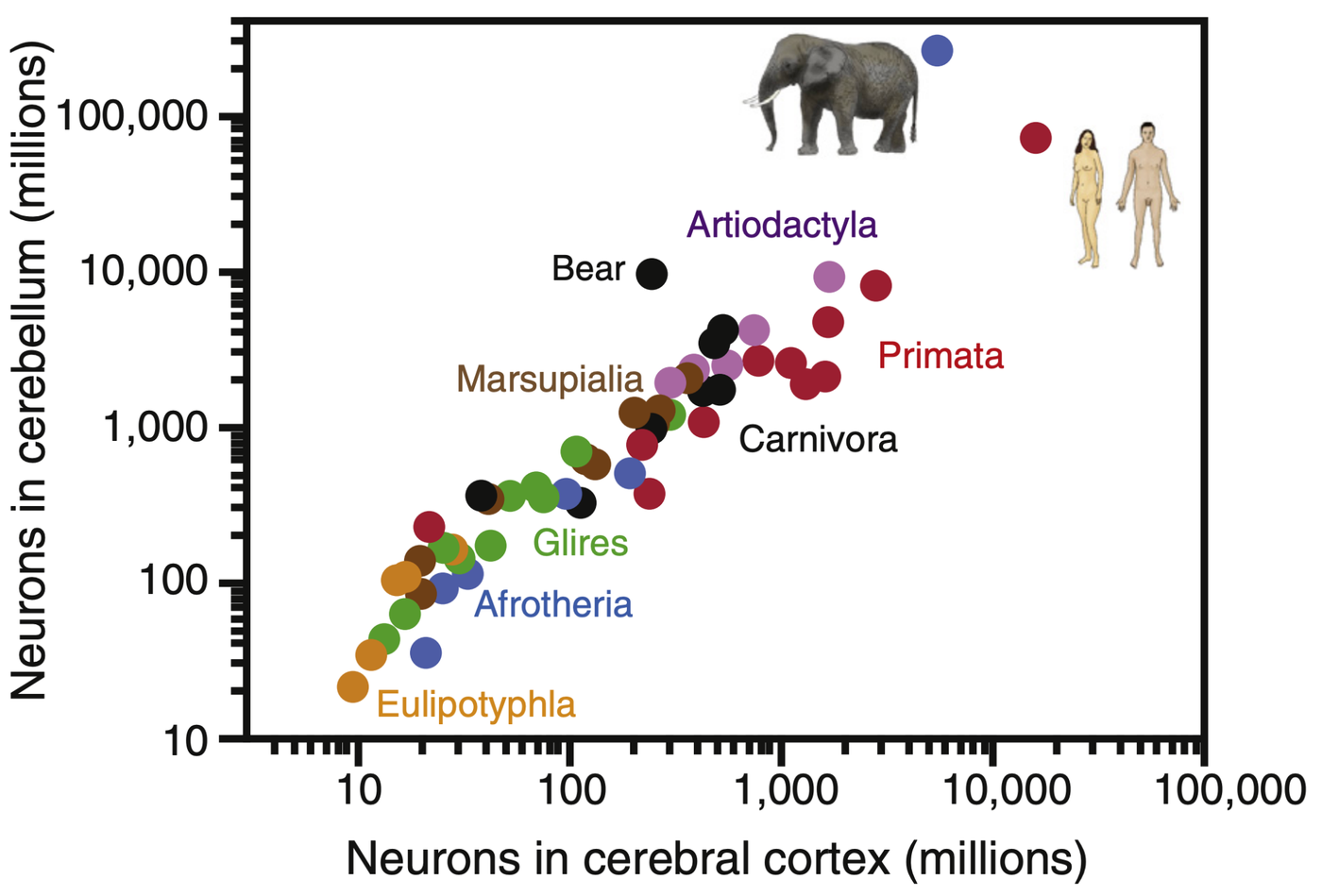
Figure from[4]
While elephant brains have mostly non-cortical neurons, neanderthals and other hominoids had brains with wide frontal areas that were almost as big as humans:
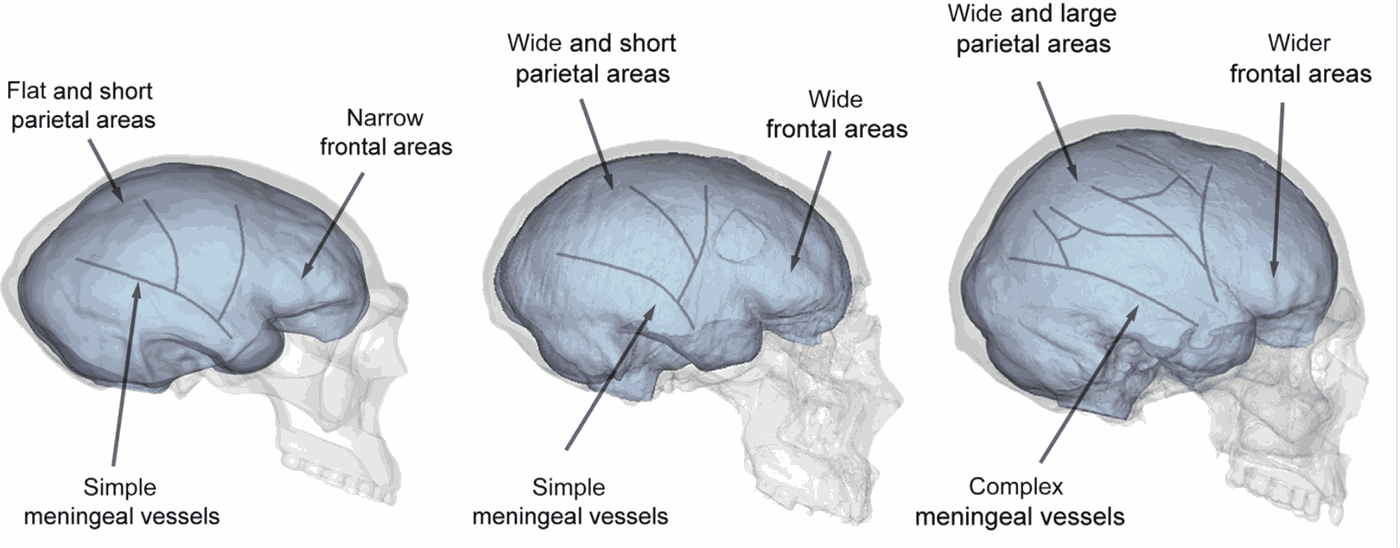
Figure from:[5] Main traits associated with Homo erectus (left), Neanderthal (center), and modern human (right) endocasts
- The human brain is not more computationally efficient. Brains are very energy expensive to run and so there is a lot of selective pressure to evolve them efficiently and this is true in all species. Brain energy use scales linearly with the number of neurons, which is highly correlated with brain size.[6] Connectivity and the wiring cost are the same across all mammals—including humans.[7] Generally, brains use ~6 kcal / 1B neurons per day, the human brain costs ~500 kcal/day and is no exception.[8]
- Complexity: As shown in figure 1, while humans have more cortical neurons than most other animals (16B or 20% of our brain). Some dolphins have more neocortical neurons.[9][10]
But the cortex also breaks down into:
- Vision: In primates like humans, vision uses half the cortex (if you count frontal areas with retinotopic maps like the frontal eye fields). ~36% of these are in the primary visual cortex alone.
- The other half is equal parts ~⅛ for motor, somatosensory, auditory, and 'limbic' processes (e.g. only 0.01% of all neurons in humans (16m/100bn) are in the olfactory bulb, a similar number to species that are very reliant on smell/taste).[11]
Many of these brain areas are somehow associated with cognition and it's hard to disentangle 'cognitive brain areas' from those for 'perception and action', which take up most of the brain. Also, there's functional integration between those areas (e.g. the cerebellum is involved distinctively human abilities like language, toolmaking, complex sociality).[12]
Still, the human prefrontal, associative regions are the most heavily involved in the most advanced cognitive behaviors[13] and allow inferences based upon past and future ('deep temporal models.'[14]). But these prefrontal areas have only ~1B neurons (only ~10% cortical neurons or ~1% of all neurons; cf. baboons have only 230M prefrontal neurons).
So if the human brain is not much bigger, energy-efficient, or complex than brains of other animals lacking higher-level cognition, the compute needed for higher-level cognition can't be that big. Indeed, surprisingly, people often maintain normal cognitive function despite losing large amounts of brain tissue. For instance, after epileptics have a half their brain removed, their higher cognitive functions like language are frequently less impaired than sensorimotor skills, and they sometimes show no discernible impairment at all.[15] Also, human brain size has decreased in the last 3000 years by ~10%.[16]
If human-level intelligence arises from a prefrontal cortex containing only ~1B neurons—running on a fraction of the body's energy budget—it suggests that Artificial General Intelligence (AGI) may not require planet-sized supercomputers. It may simply require finding the right architecture for the compute we already have.
Notes
[1] The remarkable, yet not extraordinary, human brain as a scaled-up primate brain and its associated cost.
[6] Scaling of Brain Metabolism with a Fixed Energy Budget per Neuron: Implications for Neuronal Activity, Plasticity and Evolution
[10] The prefrontal cortex of the bottlenose dolphin (Tursiops truncatus Montagu, 1821): a tractography study and comparison with the human - PMC