EAs should donate via Manifund
EAs used to research and discuss which charities to give to. This used to be key to get small donors excited about and engaged in EA. But now, we stop small donors from thinking about EA by pushing them to donate to expert-managed funds (such as GiveWell, EA Funds or ACE). This is bad for the community.
Early on, donation discussion caused a lot of energy and excitement in EA. We had skin in the game — we wanted our money to be used optimally — we engaged critically, thought independently, and analyzed and discussed ethics and prioritization (I'll call this 'deep engagement'). Simply put, what made EA special was not just empty talk about what to prioritize (cf. other political movements' focus on discussing stuff); rather, cause prioritization had a very concrete implication for us—we took personal responsibility to donate to a certain cause or charity rather than another.
This forced us to engage with difficult questions. Prioritization and discussion of ethics was our 'Task Y': the 'scaleable use of the people' in EA. Due to deep engagement, we early EAs became well-rounded generalists with in-depth knowledge of different causes, ethics, and prioritization.
Effective donations have a special quality: they can be continuously updated and discussed with rapid feedback loops. But now we discourage deep engagement with ethics and prioritization:
- Orgs like Giving What We Can encourage small donors to outsource their donation decisions to experts through funds
- Evaluators like GiveWell nudge donors towards 'fire and forget' standing orders and unrestricted funding to regrant at their discretion
- There's more emphasis on altruism through direct work, and many people doing direct work in EA essentially donate to their employer via salary sacrifice, focussing less on donations
These practices do have benefits (more below). But they emerged because of perverse incentives and goodharting for short-term, easy-to-evaluate metrics like 'money moved' over deep engagement metrics (e.g. do we donate more effectively?).
The benefits of outsourcing donation decisions are small. Though donating to expert-managed funds does make small donors more effective, due to wealth inequality, the overall amounts of money moved are relatively trivial and dwarfed by the donations of large foundations.
But the costs are large: deferral on donation decreases deep engagement with EA and increases information cascades, groupthink, 'buzz talk', and what Weyl calls technocratic blind spots (see Appendix). There's also less discussion across causes as people are more siloed into their causes.
Something is missing in EA discussions these days, and perhaps this is it. Forum newcomers want to learn and do something and help, but they end up often discussing trivial stuff like April Fools' jokes or Petrov Day posts, sucked into community drama and bikeshedding, or sharing productivity advice (which is not neglected by the wider world and not our comparative advantage).
What should we do? I'd be excited to see more funds follow the model of Manifund, and more small donors donating there. On Manifund, you can propose projects and donors can either donate to projects directly, or donate to expert regrantors who will distribute the funds to promising projects on Manifund or elsewhere. Innovating mechanism design in philanthropy is important. I applaud the hard work that goes into funds, donor lotteries, etc.—the following is meant to be productive criticism. EA funds in particular should turn their
Practices that decrease thinking and discussion about ethics and prioritization | Practices that increase thinking and discussion about ethics and prioritization |
Philanthropic funds | Crowdfunding like Manifund |
Donor lotteries and Donation Elections | (Funding) student prioritization projects, Giving Games |
Direct work, which often includes large salary sacrifice, and is theoretically equivalent to a standing order to one's employer | Earning to Give |
Nudging people towards 'fire and forget' standing orders in line with big donor preferences (big donors get a leveraged 'multiplier' on their donations) | |
Charity evaluators that encourage people to give unrestricted funding for the evaluator to assign | High net worth individuals funding re-granting initiatives |
Charity evaluators optimizing for money moved | Charity evaluators optimizing for engagement with research |
Table 1: Practices that decrease and increase thinking and discussion about ethics and prioritization
Expert-led funds
Benefits
Charitable funds have benefits.
1. Economies of scale
All else being equal: Even though there are diminishing returns to scale as funding increases, at first there are increasing returns to scale and constant returns to scale:
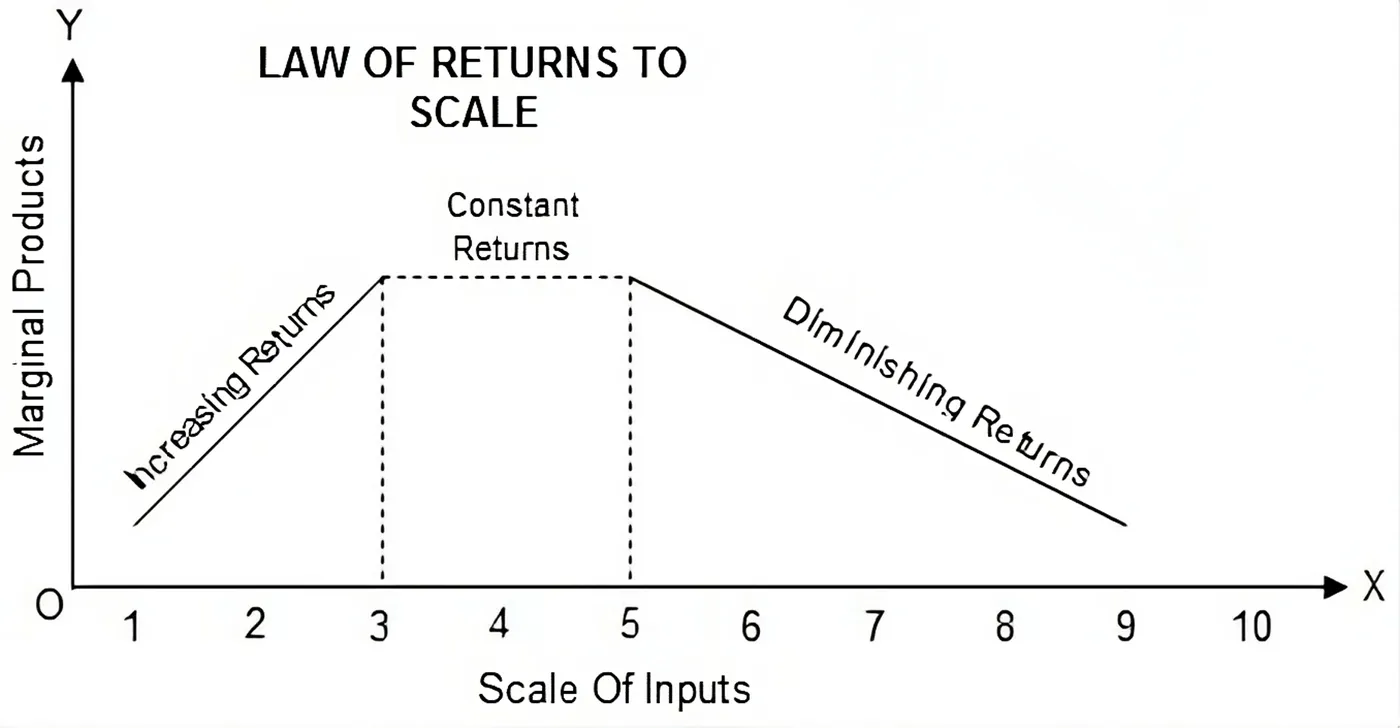
And so, if one charity gets a $100k grant from a fund, then that will do more good than if 100 equally effective charities get $1k from 100 different donors.
Similarly, a fund manager who researches for 100 hours will donate better than the average of the charities that 100 people will find researching for 1 hour each.
2. Expertise
Generally, experts allocate money to more effective projects than lay people. Since it's much more important to make the best possible use of a $1B endowment than $500, if you're given $500 which you may donate to any cause you like, you should pass the buck if possible, giving control of your decision to a larger org with more decision-making resources.[1]
And as one EA Forum commenter puts it:
'EA Funds are usually a much better opportunity in terms of donation impact than donor lotteries and having one person do independent research themselves (instead of relying almost entirely on recommendations), unless you think you can do better (according to your own ethical views) than the researchers for each fund. They typically have at least a few years of experience in research in their respective areas, often full-time, they have the time to consider many different neglected opportunities, and they probably get more feedback than you'll seek. I think the average EA is unlikely to have the time or expertise to compete, especially if they're working full-time in an unrelated area. If your ethical views are similar to the grantmakers of your preferred EA fund, I'd expect every dollar not given to the fund (either directly or after winning the lottery) would be better given to the fund, and the difference could be pretty big.'
Another benefit of outsourcing donation decisions to experts is that we spread the norm of relying on expertise, which seems valuable.
3. Convenience and ease
A few earn-to-givers that I talked to said that they really like funds: donating to funds saves them time and relieves them of the pressure to decide on how to donate effectively ('the maximally lazy way to donate'[2])
4. Preventing unnecessary distraction
Askell warns against falling into 'intelligence traps',[3] where people end up working on problems that are interesting, but unimportant. Donating to funds stops people from falling down research rabbit holes about things that don't really matter.
Further discussion of the advantages of expert-led charitable funds can be found here: Why Giving What We Can recommends using expert-led charitable funds.
Costs
'World makers are moral prophets who simply see the world as no one else (yet) sees it. Their worldmaking power is governed, not by a self-conscious pragmatism about representational change, but by an insistence on describing the world as they see it. Prophets, not mere pragmatists, are the most powerful world makers.'
Amia Srinivasan - ‘Genealogy, Epistemology And Worldmaking’
'Charity standing orders [...] An empowered and informed member of society (pragmatism not idealism)'
Radiohead — 'Fitter Happier'
Expert-led funds also have costs.[4]
Loss of deep thinking about charity
When discussing expert-led funds, people often frame the need to research charities as a cost. While some people certainly experience it this way, more people thinking about where to give might actually be good for the community. The marginal cost of smart, small donors (think: bright-eyed students and young professionals) to decide which charitable projects (on Manifund) to give $100 a month might be low: they might even have expertise in an area that they donate to. The opportunity cost of engaging with ethics and prioritization might be reading the news (or worse). What's more, small donors often enjoy thinking about and discussing prioritization and ethics (more here).
In theory, there could still be discussion about which fund to pick, although this does not seem to happen that much. But there might be even more discussion if the decisions weren't outsourced to experts (see next section). Because the grants have been made, many people might not feel motivated to engage with fund decisions after the fact, unless there is a scandal.
In contrast, from my experience crowdfunding for effective nonprofits, asking people to donate to crowdfunding engages people in discussion[5] (and useful confusion), because they are still faced with the decision of whether to donate. This gives the donor more agency in the donation process. Some argue that we should talk about donations earlier and more and focus on getting good at thinking.
When you research where to donate, since the outcome will determine whether they part with their hard-earned cash, then this is a revealed preference (cf. How can we make it easier to change your mind about cause areas?). Without skin in the game, we can write and upvote stuff that's not actionable (see e.g. Will [BLM] protests lead to thousands of coronavirus deaths?). Donating can also act as a filter for people who are more interested in being an edgelord than actually taking action.
This trend may be why there is 'missing cause prioritization research'.
So people want to think about their donations, but is that actually useful? Maybe, because small donors' donations are trivial compared to billionaires, they might help more by researching and reflecting on charities (e.g. EA-aligned funds sometimes regrant to, say, 80k, but most of their funding comes from big not small donors). So a small donor may help more by thinking and writing about if say 80k really is the best place to donate to and writing up their thoughts, rather than donating say $1k to 80k. Also, because some charitable giving can maybe be 100x more effective than others[6], donors should perhaps donate less but put more time into researching where to donate (cf. Considerations for Fundraising in EA).
Generally, we shouldn’t tell small donors: 'If you're interested in EA, stop worrying about how to do the most good with a given unit of resources — just donate your $50 to EA funds'. It seems like outsourcing your ethics to others. I talked to a very promising young EA recently, and pitched them the broad idea for the article, and they said that it would be logical to defer their ethical decisions to experts. I was baffled. How far is this going to go? Deferring your vote to others? Empirics you can defer on, but morality seems too sacred.
This argument also applies to donor lotteries. Yes, the EV(donor lotteries) = EV(donating yourself). We find this counterintuitive (cf. posts explaining lotteries highlighting the expected value calculation[7],[8]). This makes lotteries fun to think about, and maybe as a result there is a risk of being nerd-sniped and overstating their case.
Loss of 'Wisdom of the crowd'
If more people donate to expert-led funds, fewer hobbyists engage with prioritization and ethics. In early EA, this hive-mind with different opinions on where to give created a buzz.
Funds, on the other hand, lead to information cascades, where people primarily share what they believe but not why. Because people update on each other's beliefs you end up with a lot of people all believing the same thing precisely because everyone else does.[9]
Grantmakers' decisions are influenced by 'buzz talk', which involves 'making highly subjective assessments of people's abilities, putting a lot of weight in those assessments, and communicating them to others in the community'. Buzz talk benefits those who are similar to current EAs.
Loss of enthusiasm about and productive engagement with EA
In 2020, one post asked 'How have you become more or less engaged with EA in the last year?[10]. Two comments:
- '99% of the time I spend on EA is figuring out where to donate.'[11]
- 'Another thing which makes a significant difference to my motivation is continuing to think and talk about arguments around what causes and interventions are most pressing. One way I do this is to articulate intuitive worries I have that I'm not working on the right thing as they come up, and debate them with people who have similar values to me. Doing that helps me to get a sense for which of my views feel intuitive but I don't ultimately believe, and which I actually endorse and can defend.'
Small donors donate in ways big donors can't
If 100k people each give $10 to lobbying efforts, then this has more democratic legitimacy than one person giving $1m to lobbying (cf. politicians refuse large donations[12] and some think tanks are criticized for taking money from the rich[13]). Shu argues that there's a role for small EA donors in campaign finance.
Small donors might also be able to vet giving opportunities with very small funding gaps but higher cost-effectiveness (cf. Microgrants; see EA is vetting-constrained[14]). Journalism is also important for small donors to fund. When a single ultra-wealthy individual owns a newspaper (as, for example, Jeff Bezos owns the Washington Post), there are risks that their preferences will skew reporting and introduce bias. It would be more democratic for journalism to be funded by small donors.
Regressive wealth transfer
Due to wealth inequality, we small donors can give only trivial amounts compared to big philanthropists. For example, EA Funds seems to have paid out ~$30M to date, much less than the largest OpenPhil grant. Giving to EA funds is a bit like giving your money to billionaires, i.e. topping up their grants; such funds often don't share much information on their decision-making process.[15]
- A dollar is worth ~1/x times as much if you are x times richer. A billionaire is 10,000x richer than someone with a net worth of $100k. And so, $1 provides 10,000x more utility to you if your net worth is $100k than it does to the billionaire. Put another way, the billionaire would need to give $10k to lose as much utility as you with a net worth of $100k giving just $1.
- Now consider a $1M grant. For the billionaire, donating $1M is like someone with $100k donating $100 in terms of utility loss. And so, to a first approximation, crowdfunding from 10,000 people who all donate $100 each and all experience the same utility loss as the billionaire, is 10,000x harder.
Lack of democratic accountability
If you've found your cause due to crucial considerations, deemphasize donations, and focus on careers, you're left with inflexible career capital and it doesn't make sense to engage with cause prioritization anymore.
If you just funge with OpenPhil it might be problematic if you don't know that 'feels incompletely aligned with OpenPhil who e.g. donate $786,830 to crustacean welfare.' (SSC)
Bottlenecks
'sadly had to reject a significant number of applications that we thought were quite promising because we didn't have enough time to vet them'
Asya Bergal writes that '[EA Funds] isn't structurally well set-up to handle its current application load'[16]. In other words, there are more applications than grantmakers have time to vet, and sometimes due to time or funding constraints, promising opportunities don't get funded.
This problem could be mitigated by crowdsourcing vetting — for example, filtering based on the number of upvotes for grant proposals on the Forum — which in turn might encourage more productive reflection and discussion around donation decisions.
In sum, if we want to optimize for money moved, small donors are not the way to go, since their donations are (by definition) small. But if we're interested in some of the side effects of getting small donors to donate more effectively (e.g. moral circle expansion), then our current practices that do not foster deep engagement are perhaps counterproductive for this.[17]
- 'there's a converse risk that this cements groupthink within the movement, so if you have independent views on what works — or are aware of other unique opportunities — you may not want to support the fund.)'
Recommendations
Funds should adopt a more democratic model
Manifund is promising. I like how they incorporate impact certificates and allow donors more control over their donations. It's good that their grants have write-ups of a few paragraphs, and the applications for funding are made public.
Manifold Markets had people predict if Clearer Thinking would fund certain projects. Presumably they used this information to influence their funding. People who correctly predicted which projects were funded got Manifold money which can be donated to other projects.
Still, Manifund could do better on diversity. All the regrantors are young men in their 20s.
In my ideal world, I envision an upgraded EA Funds that would function as a social network optimized for deep engagement. There, people would still donate via standing order, but without opt-out default allocation. Instead, people would accrue credits that they must eventually assign to projects themselves. An updated version of Rethink Priorities' cause prioritization tool might help people engage with ethical questions, their level of risk aversion, etc.
Initially, fund managers who would write up their reasoning for including the project transparently would select the projects. There would be tighter integration with the EA Forum: users could ask questions before the grant is made, discuss, share further research, and criticize the projects. People could also pitch (small) projects that could then be crowdfunded for and funded by EAs. They would get direct feedback on their ideas. (People might be able to earn Forum Karma which might even turn into donation credits, funded by big donors). Project / charity evaluation would be akin to citizen science.[18]
We now have grant applications going into a black hole and never seeing the light of day. Often, they don't receive feedback. But in many cases, applicants could just post the app directly to the EA Forum. Maybe others would want to fund them.
Ultimately, in my ideal world, fund managers would become like journal editors, and researchers would submit grant opportunities like papers with open peer review.
Projects might have crowdfunding-like progress bars ('i.e. 41% of the fundraising goal hit'). That way, you could always see where your donation goes on the margin (e.g. someone starting a charity, doing a master's program, etc.). Or, to prevent dilution of funding, if funding targets were not hit, credits could be returned (like in Kickstarter). High net worths could also sponsor quadratic matching funds to incentivize donations.[19],[20]
Some other projects and proposals that encourage productive deep engagement:
- A proposal to connect Metaculus to the EA Forum to incentivize better research.
- GiveWiki: a crowd-sourced charity evaluator
- Open Petition: allows users to add arguments for and against the petition.
Presenting nine new charities- a record for the AIM (CE) Incubation Program
In contrast, some practices actually increase deep engagement—practices like student prioritization projects (e.g. oxpr.io), giving games (e.g. TLYCS), and (quadratic) matching funds.[21]
GiveWell seems to not develop and engage with criticism
Public reports are now optional for EA Funds grantees.
'Many technocrats [...] believe that democratic checks should operate at a quite high level, evaluating government performance on 'final outcomes' rather than the means of achieving these.'
Checks and balances
This might reduce the likelihood of finding cause X.
How we can make it easier to change your mind about cause areas: 'TL:DR- Individual cause area re-prioritization is hard and may be getting harder. It would be helpful to have a toolkit of techniques for making the process easier and better. I highly recommend most of you give $20 to a charity in every major EA cause area, and also do some other things.'
'The most common feedback I give to people beginning cause-prio work is to be more decision-driven (Does your work lead you to want to donate to X instead of GiveWell? What could actually change your mind?) and make more comparisons (How do damages compare to e.g. malaria?).' Luca
Is Marginalism (and ICER i.e. marginal cost-effectiveness) inherently uncooperative i.e. shirking?
- Cooperative or Competitive Altruism, and Antisocial Counterfactuals
- I'm a black climate expert. Racism derails our efforts to save the planet. 'Here is an incomplete list of things I left unfinished last week because America's boiling racism and militarization are deadly for black people: a policy memo to members of Congress on accelerating offshore wind energy development in U.S. waters; the introduction to my book on climate solutions'
Funds should encourage deep engagement
Another thing fund managers could do is fund projects that encourage deep engagement with ethics and prioritization, essentially offsetting the reduction in deep engagement that funds tend to generate.
For example, they might fund: student prioritization projects. The Oxford Prioritisation Project was a student research group that conducted research on how to allocate £10,000 in the most impactful way. Such projects may have positively influenced the talent pipeline (e.g. Ajeya Cotra ran a similar project in college[22])
In contrast, there's currently more focus on Student Fellowships, which are typically reading/discussion groups with an application process. While these might provide a detailed and accurate overview of key ideas, they're ultimately quite theoretical and don't encourage independent thinking.[23]
Other things that might encourage deep engagement:
- Giving Games
- Giving What We Can Charity Elections, Donation Election (2023)- EA Forum
- Effective Altruism Debate Championship
Coda
There's a picture from a 2013 EA retreat, on which you can see a surprising number of people who are still in very prominent positions in the EA community.[24] It would be suspicious convergence if those people just happened to be the very best people to be in such positions.
Many early EAs evaluated charities at some point and went through the world with an EA lens. The ITN framework gets you surprisingly far.
'What should we actually do?' because they were thinking about how to donate. I always thought that perhaps Will MacAskill having a student job as a charity mugger was him cutting his teeth on how to pitch proto-EA arguments to normal people outside of philosophy seminars and that's why EA took off.
- 'Actually solving problems requires a kind of persistent mindset that's not natural for many of us, and so requires a lot of effort. Every now and then I notice this mindset in someone I meet, who seems to keep pulling conversations back to what the issue really is, rather than just talking about what's interesting or feasible within clearly-defined constraints. When you ask them to make a decision, or ask why they're working on a specific project, they'll have a principled answer that comes back to something they want to achieve in the world, not a vague comment about what seemed interesting or what they think other people want to see. I'm finding myself increasingly drawn to these people, and increasingly keen to try and interrogate this mindset and figure out how to cultivate it more in myself.' Actually solving problems — Jess Whittlestone
- Carlsmith defines sincerity (in the non-standard sense) as 'actually trying to do what you have most reason to do. That is, just as scout-mindset actually tries to get your beliefs right, sincerity actually tries to get your decisions right. We can break this into two parts:
- 1. epistemic: it's scout-mindset, applied to the question of what you have most reason to do. The sincere person asks: 'what, actually, should I do?' And they really try to figure it out.
- 2. motivational: it's the readiness – indeed, the desire – to act on the answer that the first part supplies. That is, when sincerity asks 'what should I do?', the 'should' in question has real pull and force. If you talk with a sincere person about what to do, it feels like a real conversation; like the part of them that will make the decision is 'in the room' – speaking, listening, trying to see. 10 I'm interested in this definition partly because if, in my own life, I start to feel like I've lost touch with sincerity, I find questions like 'what, actually, should I do?' a helpful prompt'
Crowdfunding outreach might be more organic and natural.
Rather than community building and outreach, there could be another way that is more prudent, inspired by YC, Jews, and Aldi:
YC says don't worry about competition, just create a great product. Similarly, EA especially now with lots of criticism and competition from other movements. We should definitely do a post-mortem and continue to engage with good faith criticism, but at the current margin, I'd rather want us to move on and do a lot of robustly good stuff in the world, so that critics have no choice but to admit that 'yeah but they do actually do a lot of good stuff'.
Aldi, one of the most successful German supermarkets, didn't advertise for decades. They just had a high-quality product and low prices. Similarly, EA could just do really legible crowdfunding campaigns.
Jews don't proselytize — they reject everyone 2x before they let you convert. This seems like a good strategy to keep the community healthy — make the EA community so it's about really concrete skin-in-the-game donation stuff. From the EA grants program: 'A great way to increase your impact is to talk to others about how to think about whether it's right for them, how impactful it might be, and how to get onto it.'
Notes
[1] Heuristics for clueless agents: how to get away with ignoring what matters most in ordinary decision-making
[3] Askell on x: "I sometimes worry that the world’s best minds are hooked on what are essentially glorified crossword puzzles, since the interestingness of problems scales with features not very correlated with their importance. If there’s not a term for such problems, maybe “intelligence traps”?"
[4] Although this post focuses on expert-led funds, most pros and cons of expert-led funds also apply to donor lotteries, which a minority of EA small donors participate in.
[23] Relatedly, Buck Shlegeris in 2020 worried that EA student group members are less skeptical and independent-minded: Some thoughts on deference and inside-view models — EA Forum