On Eurocope: Europeans 'Life Goals of Dead People' are due to lack of growth
To Brits, the US is a natural antidepressant:
- The tipping culture causes great customer service which causes the professional smile, which has spillover effects to the wider hedonic macro set.
- States like California skip all the shitty seasons.
- The Latin American influence shows that white people are able to let loose sometimes
- The great bright wide culture of orthodontics, the inclusivity of the 'the more the merrier', the 'omg you should come to my party' culture.
But there's a deep relation between the macroeconomy being depressed and the population being literally sub-clinically depressed. There's a strong post-materialist, no-growth undercurrent in European culture and it's growing stronger as part of post-hoc rationalization Eurocope.
CW #firstworldproblems (but also: global frontier growth is a global public good)
I first moved to the UK from Germany in 2008. Back then the US, UK and Germany were quite comparable in terms of wealth:
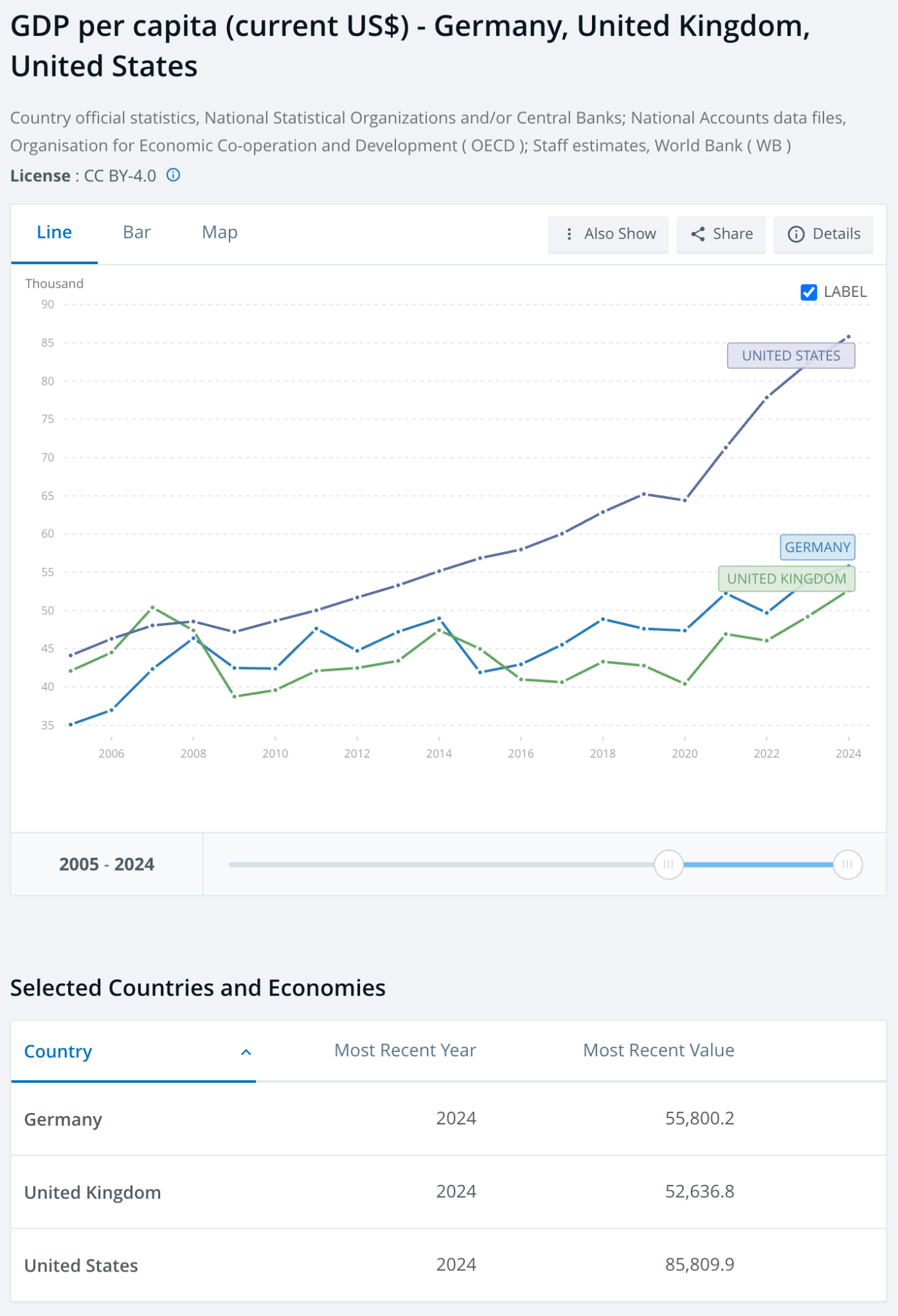 Then things came apart, and I first noticed that the UK felt poorer than Germany. Then I moved to the US from 2012-2014, but only now that I'm back in the US, like Guy I really get what's going on.
UK in particular has problems with a triple whammy against economic growth:
- 2008 hit UK much harder due to bigger financial sector
- Brexit shaved off a 8% of GDP
- Covid hit the UK particularly hard
But it's also a wider European thing. We have no growth in Europe and what does that lead to? Growth MEANS that everyone has more money to buy things they want or even need. Europeans have kind of forgotten that. It's starting to feel like the next iron curtain. That's why many Europeans have year round SAD.
I'm here not talking directly about quality of life, but rather the importance of change in state over time continuously improving being important for happiness.
Consider:
Boomers growing up in a Western country in the 1950s and experiencing 5% economic growth every year for decades- what that does to your psychology vs. us millennials: We are objectively much richer and much better off than any generation before, it's imbecilic to point at any one price like housing and saying that we're worse off than the previous generations, much discussion around that. BUT what we don't have is growth, and people need growth. The imbecilic no-growth movement doesn't make sense on the face of it, like, EVEN IF we were to perfectly redistribute, who wants to live on the global mean GDP per capita of like $10k a year? It's a sad life. Young people want to make more money, because being stagnant sucks.
Europeans increasingly have Life Goals of Dead People, scarcity/poverty mindset, and slave morality.
This what the culture tells you:
- Don't spend:
- Excessive focus on saving over making money
- A very common newspaper article in the UK is 'I save £1,000 a year on my food shop using a savvy supermarket hack'. The hack is to buy from the rotten food aisle. This pushes you further into a poverty mindset and lowers your self-esteem.
- A penny saved is two pennies earned (due to high taxes)
- Too little division of labor: 'you can save money by doing everything yourself (e.g. cleaning, cooking, childcare)'
- Old people freezing to death: There are thousands of old people freezing to death in the UK every year, it's a real public health issue. They cracked down on it in recent years but it killed millions over decades. Hundreds of thousands of Europeans are dying of heat stroke every summer because Europeans 'don't do' AC.[1]
- Don't have kids: US fertility rate is 1.6 vs. 1.5 in Western Europe
- Don't invest: It's never too early to save for retirement. Don't invest in yourself, your education, your business, or your friend's business, it's too risky. Save for retirement, put your money into an ETF and get the 5% a year. Or better yet: get on the 'property ladder'. Housing prices will always rise.
- Don't go out:
- Pubs are dying
- Stay home, watch netflix
- Get a Tesco 'Big night in' pizza meal deal. Americans do many more activities, drive places, eat out, have a bigger restaurant industry, etc. As a result they're more social.
- Treat relationships transactionally and keep a 'ledger' of who is getting the better or worse deal out of whom. Go dutch of dates
Europeans now need to be told that there are 'things you're allowed to do':[2]
'And if you grew up in a thrifty family, like me:
- Paying for parking in convenient location
- Hotels where you can sleep comfortably
- Non-public transportation, especially when traveling
- Buying a comfortable mattress, shoes, etc.
- Buying clothes for appearance or comfort instead of just the lowest price
- Bottled water when you're thirsty
- And in general fulfilling any bodily need for < $5 (restrooms, buying a hat when you forgot yours, etc.)
- Buy your way out of advertising on e.g. Spotify or YouTube
- Actually turn the heat/AC on
- And in general, being willing to spend a few minutes to fix small annoyances
- You could even get someone to observe you to help figure this out
- Seriously, just put 3-IN-ONE oil on that squeaky hinge already'
Advice is good, but it would just be better if people had more money. Acute recessions cause suicide spikes, but prolonged stagnation leads to chronic 'morbidity' (dysthymia/languishing). Dysthymia prevalence can nearly quadruple (0.4% to 1.5%) during extended crises. Biomarkers: Chronic financial insecurity increases 'allostatic load' (physiological wear-and-tear). Economic precarity in older adults correlates with dysregulated inflammatory markers (e.g., CRP), predicting higher disease risk.
Why are Europe's economies not growing?
Many reasons, but the biggest are:
Higher taxes:
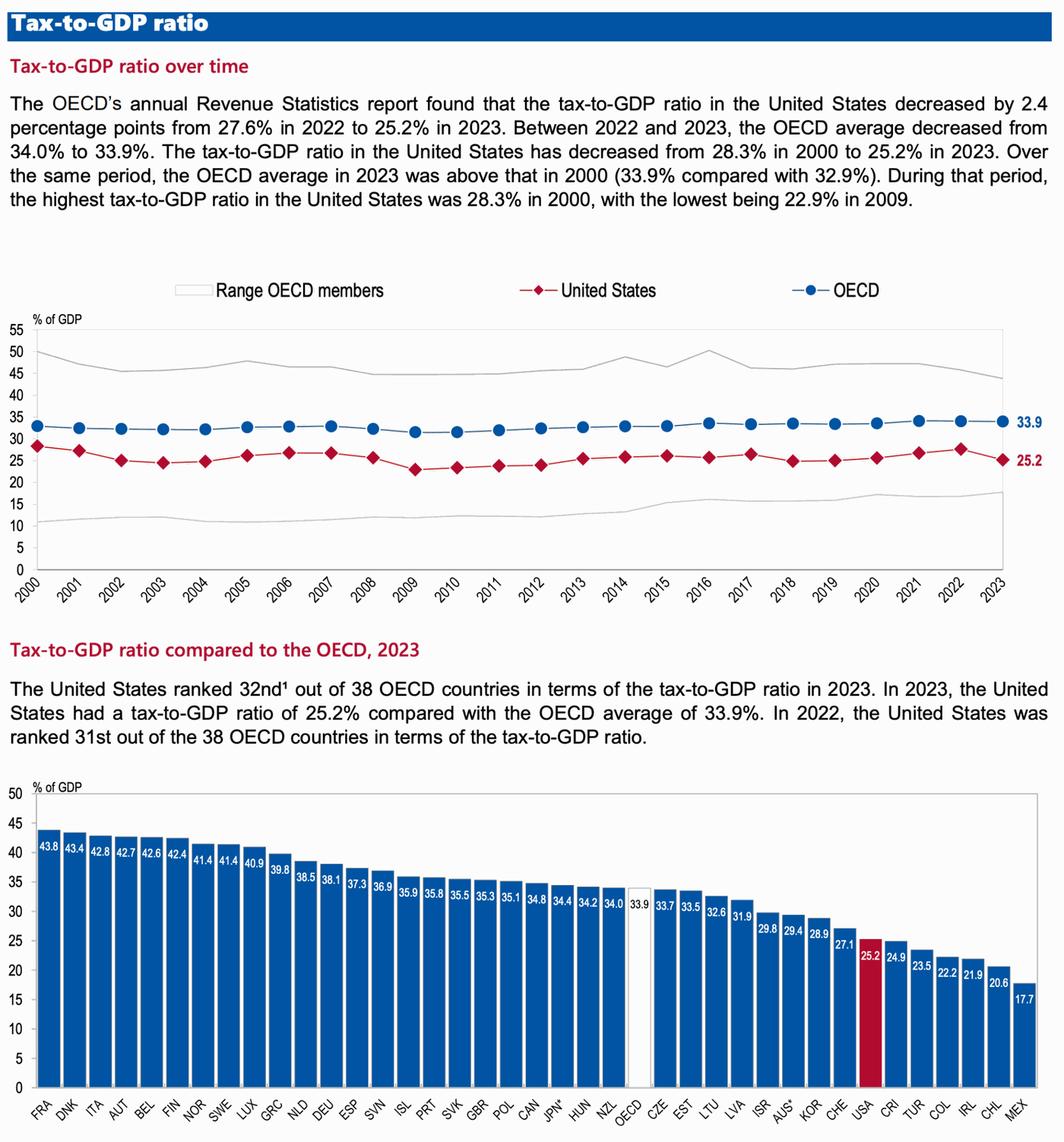
It's really hard to lower taxes, because most of it is social spending & pensions and there's a triple lock on the pension, which increases every year in line with whichever of three measures is the highest: inflation, average wages or or 2.5%. In 2023, the UK State Pension increased by 10% due to the triple lock policy, the largest single boost to the State Pension in history. The population pyramid is inverted, society is aging, the pensioner voting bloc is becoming ever bigger, but the pensioners haven't paid in enough. Brain drain. Young people go to the US. Many Brits would leave if the US eased immigration restrictions. The median age gap between EU and US has been increasing. The NHS is increasingly overwhelmed. The military budget is also very big w/ trident vs other European countries that are freeriding. Energy is expensive.
All this reduces drive: 'A big company is like a giant galley driven by a thousand rowers. Two things slow down the galley. One is that individual rowers don't see any result from working harder. The other is that, in a group of a thousand people, the average rower is likely to be pretty average.'[3]
Over regulation/dysfunction
There's lots of regulation, NIMBYs, no nuclear power, etc.). It's a cultural thing that is very wide-spread. The following are all from (all from marginal revolution reviews this in their 'Fact of the Day' column):
- Internal Trade Barriers: EU internal frictions are equivalent to a 45% tariff on manufacturing and a 110% tariff on services, causing trade across EU countries to be less than half the level of trade across US states.
- Regulatory Fragmentation: Trade between Eurozone and non-Eurozone EU members is often treated as 'external,' with national regulators frequently creating barriers to favor local banking and insurance sectors.
- Corporate Decline: In 2000, Europe held nearly one-third of the value of the world's top 1,000 firms; by 2021, this share had fallen by almost half.
- Missing Giants: Of the world's 142 listed firms worth over $100 billion, only one (SAP) was founded in Europe in the last 50 years, compared to 27 in the US.
- Wealth Origins: Half of Europe's ten richest billionaires inherited their fortunes, whereas nine of the top ten US billionaires are self-made founders.
- Energy Costs: The UK has the highest industrial electricity prices in the developed world, a key driver of its rapid deindustrialization.
- Subsidies: France spent €45 billion ($43 billion) in a single year on state subsidies to suppress energy costs.
- Industrial Peak: German industrial production likely peaked around 2018, with the 'Energiewende' policy leaving the country vulnerable to energy shocks.
- GDPR Impact: Regulations like GDPR entrench incumbents like Facebook by making compliance costs prohibitive for smaller competitors.
- AI Regulation: The EU's 'heavy hand' in regulating AI is expected to make it difficult for European startups to compete with US and Chinese firms.
- London IPO Collapse: London has dropped out of the world's top 20 IPO markets, with volume falling 69% to just $248 million, its weakest performance in over 35 years.
- Land Use: The UK has privatized approximately £400 billion worth of public land (10% of land mass) since 1979, yet planning restrictions (NIMBYism) continue to block infrastructure and housing.
- Capital Liquidity: Berkshire Hathaway alone holds over $300 billion in US Treasury bills, illustrating the massive liquidity advantage of US capital markets.
- Workforce Illness: German workers missed an average of 19.4 days due to illness in 2023, costing the economy an estimated 0.8% of GDP growth.
- Pension Burden: France spends 13% of national income on old-age benefits (vs. 7.1% in the US), and interest payments are projected to become the largest budget item within four years.
- Social Health: Ireland ranks as the 'loneliest country in Europe,' with nearly two-thirds of the population reporting anxiety or depression despite high education levels.
- Italy vs. Spain: Spain's GDP per capita (PPP) has surpassed Italy's, marking a significant relative decline for the Eurozone's third-largest economy.
- Public Sector Bloat: Sicily's regional government employs 26,000 forest rangers (more than British Columbia), highlighting extreme public sector inefficiency in Southern Europe.
- Regional Inequality: Real output per person in central London is nearly four times the EU average, making it an extreme economic outlier compared to the rest of the UK and Europe.
- Automation: High labor costs in Germany have driven a 'Ricardo Effect,' leading to double-digit growth in the market for robotic lawnmowers as households substitute capital for labor.
- France: If nothing is done, interest payments will become the largest expense in the French budget in four years, Mr. Bayrou has warned. government spending is 57 percent of the economy and the French have the longest financed retirements ever seen in the history of the world.
- Germany: A shocking example is the decrepit state of German military hardware. Of the Luftwaffe's 254 fighter planes, 150 cannot fly.
- In 2021, Germany's six nuclear reactors generated 80% of gas-fired power. Restarting all nuclear reactors could nearly eliminate gas and some coal electricity, potentially halting Russian gas imports. Conversely, closing the remaining three reactors and replacing that power with gas would increase gas burning by 30%, potentially raising Russian gas dependency by the same amount. Thus, reactivating all German nuclear reactors could stop Russian gas imports, while shutting down the remainder could increase dependency by about 30%.
So what to do about this? How do you fix this with policy?
There's a movement around progress studies people (e.g. Looking for Growth (LFG), Centre for British Progress etc.). Unclear whether that will really have a large effect. The Italian PM, an economist, wrote a report last year saying that the EU needs much more coordinated industrial policy, faster decision-making, and massive investment to compete economically with the US and China.[4] The report has 800 citations, but I'm not sure if much will change because the problems seem deeply structural. I think maybe if you had like massive philanthropic investment in the pro growth movement that could maybe do something. Europeans will probably always just do catch up growth and free ride on US efforts to push the global technology frontier, rather than really trying to catch up. It's a natural dynamic.
In terms of policy- I've written before about how it's tricky:
- Fiscal policy is very popular and very scalable (e.g. we can easily send every person a stimulus check and spend a lot of money that way) but has a small fiscal multiplier as people can't use capital as effectively as bigger firms[5] or governments,[6] and people just end up being very risk averse and just squirrel the money away and not much happens.
- Monetary policy: An example is a central bank printing $1T, then loaning it out to private banks at a below-market interest rate (say 0% though it could be negative). The fiscal multiplier of such a policy is high: banks are incentivized to recoup their investment and will loan to firms that succeed. This is very scalable and easy to do. You just need to lower interest rates and it will have a very large effect on the economy. Why would the state make concessional loans and lose money? Why not loan at market rates? For this would have no additionality, the state would just be another lender. These concessional loans pay for the service the banks provide the state. What is the service? Banks find firms that perform well, so that the state is not in the business of 'picking winners'.
- So should we just make the money printer go brrr? Alas, no, we can't do that either . Because people hate inflation and it'll cause populist backlash, it seems we're kind of hitting diminishing returns with monetary policy in terms of stimulating growth. Also we've got the triple lock which means that printing money doesn't work as well anymore. It also seems like you should go much lower than 0% percent interest rates or you create some distortions. Still more research on that seems worth it. fund academic research on Optimal Monetary Policy[7], Optimal Inflation Rate[8], Optimal Automatic Stabilizers[9] (very little work has been done[10]. Also see 'How to boost unemployment insurance as a macroeconomic stabilizer'[11]), and Optimal Spatial policies ('fostering employment growth in regions beset by chronic joblessness may help workers hurt by persistent negative local labor demand shocks. On optimal spatial policies [...] employment impacts of labor demand shocks are larger in local markets in which joblessness was initially high [...] job growth in distressed regions is especially beneficial for low-wage workers.'[12]).
- EU–INC – A true pan-European solution
- One new pan-European legal entity
- One central EU-level registry
- Standardized investment documents
- Standardized EU-wide stock options
- Local taxes & employment
- Europe’s economic stagnation and lack of tech giants (like Tesla or Google) stem primarily from restrictive labor laws rather than a lack of R&D spending. The central thesis is that the high "cost of failure"—specifically the extreme difficulty and expense of laying off workers—disincentivizes innovation.[13]
Does anybody else have any ideas?
Further reading
- Contrapoint: Challenging the Narrative of European Decline: Revised
- The End of Economic Growth? Unintended Consequences of a Declining Population
- The Hidden Cost of Hard-to-Fire Labor Laws: Why European Firms Don't Take Risks - Marginal REVOLUTION
- Europe's unemployment benefits: generous safety net or GDP anchor?
- European Merger Rules - Clark Center Forum
- America Versus Europe - Clark Center Forum
- Occupational Licensing Around the World - Marginal REVOLUTION
Notes
[1] “The Public Health Crisis: the lack of AC in Europe is causing mass preventable death.
- The Data: AC use in Europe/UK is estimated at only 20%, despite rising temperatures due to climate change.
- The Human Cost: Heat-related mortality in Europe is estimated at 175,000 annually.
- The Comparison: Smith notes that the death rate from heat in Europe (23.5 per 100k) is nearly double the death rate from firearms in the US (13.7 per 100k).
- The Solution: Citing US data (Barreca et al., 2016), Smith argues the diffusion of AC explains almost the entire decline in heat fatalities in America and could save ~100,000 European lives a year.”