Is This Data Eroding Your Belief in Free Will?
Many people believe that success in life is not determined by forces outside our control, which, ironically, can be explained well by where you were born (and also: The more attractive you are, the more you believe that economic success is dependent on effort rather than external factors[1]):
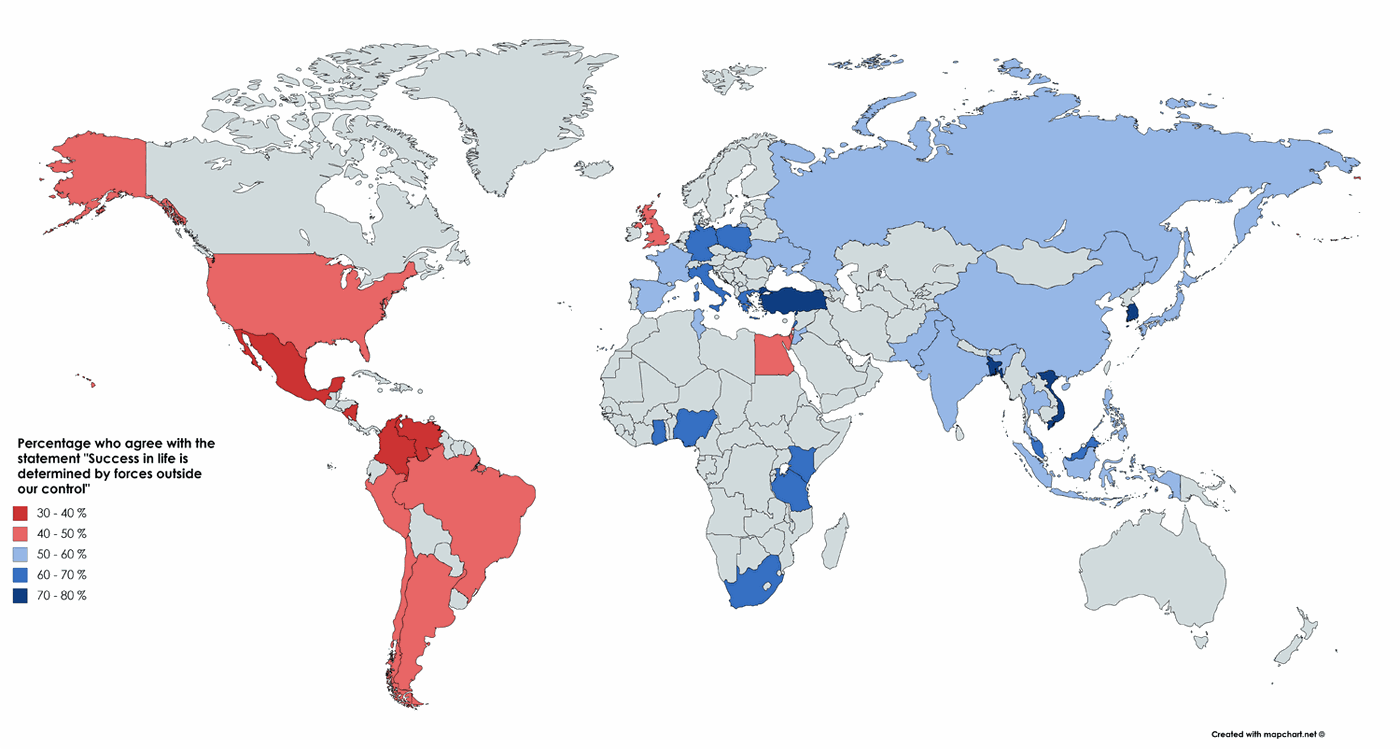
But we have been amassing a lot of data that should erode our belief in free will:
- Environment:
- Date of birth: The time of the year you were born affects your grades, the prestige of the university they later attend,[2] the risk of being prescribed stimulant medication for ADD,[3] whether you commit crimes,[4] and how many friends you make in high school, leadership roles like class president, and jobs in management and entrepreneurship.[5] This is because the youngest students in their cohorts are disadvantaged.
- Season of birth predicts birth weight, pubertal timing, adult body size, educational attainment[6], and chess skill.[7]
- Year of birth: also influences people's job prospects by determining whether they graduate into a bad or good economy.[8] A sharp drop in job availability occurred between 2008-2012. College graduate job offers fell from over 50% in 2007 to under 20% by 2009. A 2010 study showed that a 1% rise in the graduation-year unemployment rate causes a lasting 6-8% decrease in starting salary. For instance, workers from the 1981 recession still earned less ten years later. Recessions create cohorts that 'never recover.'[9] High presidential approval during a birth cohort's teen years leads them to favor that president's party for the rest of their lives.'[10]
- Early career experiences, evident in tax and US Army records, create substantial path dependence, boosting the odds of remaining in the same or a related occupation 20 years later by 19 percentage points. Earnings effects are highly heterogeneous yet predictable, with changes in occupational earnings premia accounting for over 60% of the causal variation.[11]
- Geography: odds of a child born to parents in the bottom fifth of the income distribution reaching the top fifth is 8% in the US, but not constant across local areas (it's only 4% for children born in Charlotte, North Carolina vs 11% for children born in DC).[12]
- Last name:
- Students whose surnames start with A, B, C, D or E received a 0.3-point higher grade out of 100.[13]
- Parent-child correlations for socioeconomic measures are typically 0.2-0.6, but surname evidence, using educational status in England (1170-2012) as an example, which tracked the prevalence of particular surnames in the student rolls of Oxford and Cambridge Universities over the centuries, reveals the true intergenerational correlation of overall social status is 0.73-0.9—stronger than height inheritance. In other words, if your last name is associated with the aristocracy (e.g. Darcy), for centuries you're more likely to go to Oxbridge.[14]
- Poverty can reduce life expectancy, cognitive ability, and increase impulsiveness.[15]
- Neuroscience: ~50% of homeless people have traumatic brain injury.[16]
- Genes:
- Genes can predict self-control (heritability is 60%),[17] credit card debt,[18] anti-social behavior[19], and educational achievement (up to 9% at age 16, accounting for 15% of the heritable variance).[20]
- Smoking: A 2008 hypothesis-driven gene study identified a gene on the fifteenth chromosome that codes for nicotine receptors in lung cells, officially named rs16969968, but commonly called 'the Big One' or 'Mr. Big' due to its strong link with lung cancer. This gene is associated with a 77% greater lung cancer risk in the ~10% of the population who inherit two copies of the less common variant. It also affects smoking behavior: those with the risky variant need more nicotine and have more difficulty quitting, but they respond better to nicotine replacement therapy.[21]
- Weight: Genetic factors are the decisive and primary influence on obesity. Studies, including those on twins, confirm that genes account for about 70% of the difference in weight between individuals in modern affluent nations like the US. Genes also significantly affect eating behaviors, such as meal size, satiety response, and food reward impact. Therefore, leanness or obesity today is less about willpower or gluttony and more a matter of 'genetic roulette.' The most effective path to leanness is wise parent selection.[22]
- More here: Gwern.net: Everything is heritable
In the US, there are moderately sized Gene × Socioeconomic interaction effects.[23] Generally, citizenship and parents' wealth explain 80% of your income.[24]
When we establish cause and effect relationships between factors that outside of our control (e.g. our genes, or the environment we were born into) and variables we praise (like educational attainment, income, voting behavior etc) and blame (e.g. gambling, smoking, obesity), it eats away at our pre-theoretical conceptions of free will.
Even if we can't explain all the variance yet, the more such findings we see, the more we feel the unexplained error is in principle predictable by as of yet unobserved (hidden) variables, and that science can discover it. In theory, with larger samples and more statistical power, we could add ever more variables to models to explain behavior more fully.
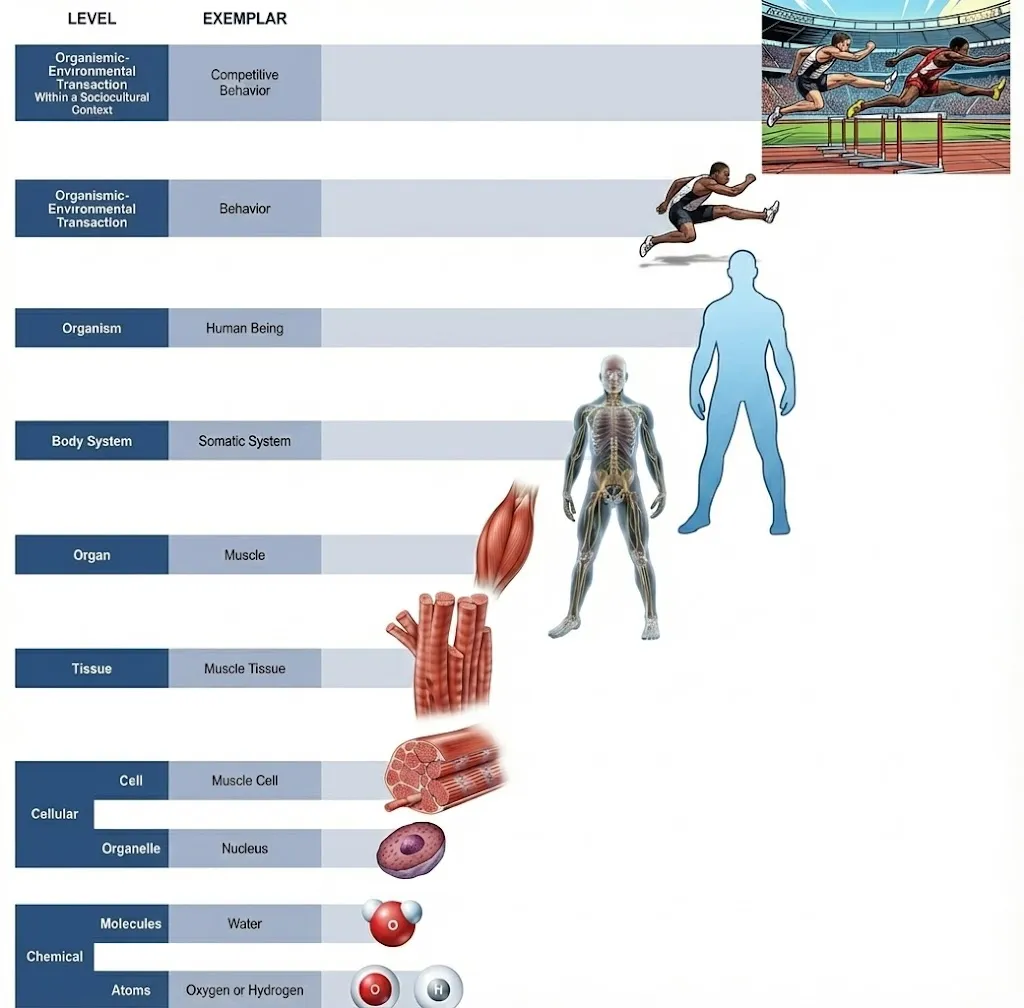
'Levels of structural organization underlying human behavior' adapted from[25]
This should give us incompatibilist intuitions, especially when factors are intuitively beyond an individual person's control (e.g. the birth date effects, the brain injury). A person's intelligence, tenacity or studiousness are intuitively more in their control, even though of course, they too, are based on nature and nurture.
What does that mean? I advance a two-level view of the free will problem called meta-compabilism: compatibilism and incompatibilism are perfectly compatible and we should use either one pragmatically based on the situation. As a rule, if we meet people in real life, we should be more compatibilist, and treat people as if they have free will (take the intentional stance). But incompatibilism is better for public policy, as we can predict behavior better on the aggregate than individual level. Because we evolved so that a belief in free will comes easy to us, on the margin, we misapply compatibilism to policy and make biased decisions that lead to bad outcomes (e.g. maybe we should base public policy based on findings like the relative age effect- e.g. by age-adjusting grades, but still tell our children that they should get good grades).
Notes
[1] Attractiveness is associated with the belief that economic success is dependent on individual effort, rather than external circumstances: science
[3] Age, Academic Performance, and Stimulant Prescribing for ADHD: A Nationwide Cohort Study | Pediatrics.
[6] Season of birth is associated with birth weight, pubertal timing, adult body size and educational attainment: a UK Biobank study - ScienceDirect
[8] The long-term labor market consequences of graduating from college in a bad economy - ScienceDirect
[9] The long-term labor market consequences of graduating from college in a bad economy - ScienceDirect
[10] The Great Society, Reagan's Revolution, and Generations of Presidential Voting - Ghitza - 2023 - American Journal of Political Science - Wiley Online Library
[11] Path Dependence in the Labor Market: The Long-run Effects of Early Career Occupational Experience | NBER
[15] Empirical audit and review and an assessment of evidentiary value in research on the psychological consequences of scarcity | PNAS
[16] Traumatic brain injury among men in an urban homeless shelter: observational study of rates and mechanisms of injury
[22] The Hunger Neuron
[24] Milanovic, Branko. "Global inequality of opportunity." Development Research Group, World Bank, siteresources. worldbank. org/INTDECINEQ/Resources/Where6. pdf (2008)