Gates critique
Some critical thoughts on Gates
Bill Gates and his foundation has had a lot of memetic influence on the EA community. It has funded and highlighted the research / advocacy to prioritize global health, biosecurity, and energy innovation for climate change.
Gates seems well-intentioned and I commend him for thinking carefully about philanthropy and donating so much. But I’ll now focus on being more critical, because there are few good critical takes on him.
After watching the Netflix documentary, I came away a bit disillusioned and more critical about Gates. I used to think Gates' actions were pretty much roughly optimal. The documentary has three parts:
1. on water sanitation and hygiene,
2. polio eradication
3. climate change and energy innovation.
This might reflect actual spending priorities for Gates, but it might be a simplification. I’ll go through those.
Generally, the documentary seems like a long promotional video which only portrays Gates in a very positive light. Gates seems to try very hard to craft a certain public persona of authority and the documentary is very much in line with this. I think this is also why so many people were betting on him running for president a while back. He seems to have spent a lot on communications / PR and has amassed a massive twitter following that he uses to push his priorities. Because these priorities might not be optimal (e.g. aid spent on global health might be worse than spending aid on infrastructure), and he uses his wealth to leverage public funds, this might be bad.
Relevant quote from The Effective Altruist's Political Problem
“Commonsense morality holds that treating someone fairly in a debate requires affording that person the same opportunities to make their position known as one affords oneself. A helpful way of understanding this, according to Daniel Viehoff, is a willingness to set aside certain arbitrary advantages one may have.71 It would be wrong of someone with a loud voice to shout down their opponents in a town hall meeting. It would be wrong of someone to threaten their friend with a knife in the course of an argument about where to order takeout food. And it would be wrong for a spouse to claim authority over household decisions on the basis of their superior salary. A loud voice, a capacity to inflict bodily harm, and a high-paying job do not make one’s opinions more credible or one’s interests more valuable than those of others. To the extent that they can influence the outcomes of a debate, these properties count as arbitrary advantages. Using these features to one’s benefit in a debate is to mistreat one’s opponent—to treat one’s opponent as an object to be overcome, rather than as an equal person to be reasoned with.
Viehoff’s argument is meant to explain why democracy enjoys special authority as a form of collective decision making. Obeying democratic procedures, in his view, prevents us from relying on these kinds of arbitrary advantages. But I think the argument also contains a general point about the ethics of advocacy. That is, under conditions of radical economic inequality, leveraging one’s superior wealth for the sake of political influence can be a way of mistreating one’s opponents. It attempts to win extra influence by relying on an arbitrary source of strength. In so doing, one objectionably subordinates one’s opponents.”
1. Toilets / WASH (Water hygiene and Sanitation)
The Gates foundation focuses on this, because diarrheal deaths are about 1m/year.
They invested quite heavily in this and also seem to routinely leverage money from governments, and influence the discourse on the relative priority of WASH within global development. This could be net negative because global health might not be as effective as other economic development interventions (c.f. the work by Lant Pritchett).
He seems to have spent an extraordinary amount of money on WASH and just generally global development.
What caused him to focus on this? And what is thus the more distal cause for EA focusing on global health? Thinking about this might uncover non-optimal path dependency.
There seem to be a few causes:
- because he read a NYT article[1] by Nicholas Christofis on diarrheal disease, which because it affects people directly.
- because he experienced burnout at Microsoft and wanted to do something more meaningful and direct
- He personally went to India and vaccinated children himself giving him an emotional attachment to the cause[2]
I used to be quite the fan of Gates until now, and though I thought his foundation could have done better if it were more flexible, I always thought he gets things roughly right.
Now I think given the three focus areas of his foundation that he could actually do significantly better in terms of using his funds more optimally.
It made me update to think that working for the Gates foundation is probably very effective if one could change its policies from the inside, but likely not very effective if there's strong institutional inertia there and it will just continue on its path.
2. Polio eradication
Here also the Gates Foundation might be using their funds suboptimally.
I also heard somewhere that Gates himself has to sign off on every check above a certain amount (I believe it's $1m).
He seems to be running a pretty tight ship at the foundation as he did at Microsoft as highlighted throughout the documentary.
So it's not like he's democratizing, technoratizing his $100bn foundation and just completely outsourcing his grant making to his smart employees. To be fair: his foundation has 2000+ staff or something and so is more demo/ technocratic with a better staff to grant ratio than many other foundations.
Polio eradication is something he pursues with a certain relentlessness, pouring something to tune of billions into it.
His argument is sort of driven by cost-effectiveness but a bit dogmatic: "It's good to eradicate disease no matter what, because when it's done, you never have to take care of it again, no matter the costs" .
It might simply be more effective to not eradicate polio, because of diminishing returns. It might be better to stabilize polio and wait for economic growth to catch up with some countries which might make it much cheaper to eradicate at a later date.
I'm very unsure about this point of course, and maybe everyone should focus much more on disease eradication over say just decreasing malaria deaths, but Gates really just seems hell-bent on it. (see “Early on, Melinda and I were lucky to work with Bill Foege, a key architect of that feat. He made it clear to me why eradicating a disease is a gift to all future generations. People are freed forever from a deadly threat, while the resources that were devoted to fighting that disease are freed up for solving other problems. Plus, victory is energizing: the defeat of smallpox helped inspire a global push to raise vaccination rates and lower childhood mortality. Such benefits, Bill Foege said, can make eradication “the ultimate return on investment.” [3])
See figure below, on research interest in polio, which is much higher than its DALY burden for obvious reasons.
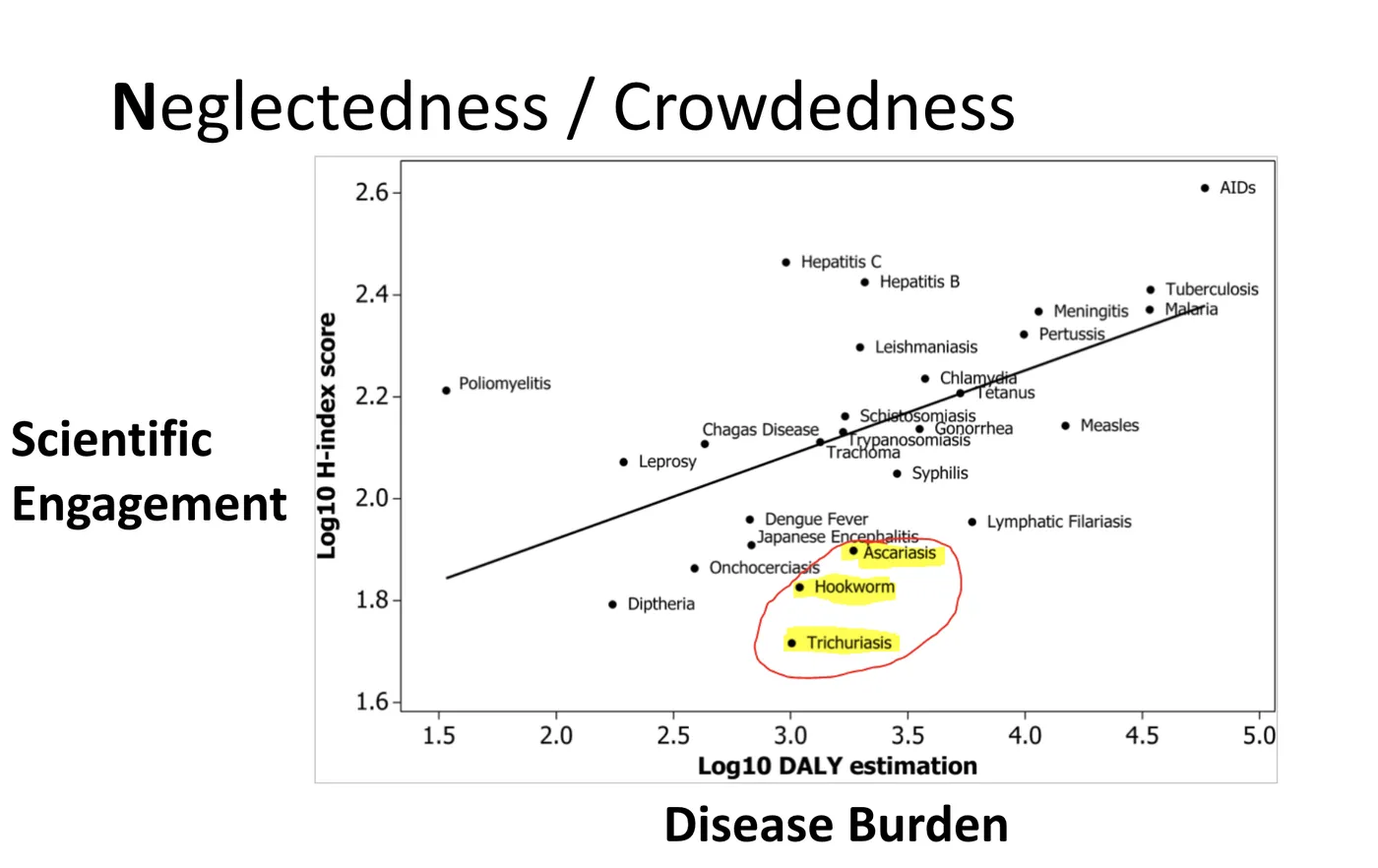
It’s probably ~similar w/ spending on it.
But because he’s leveraging government funds, this might be problematic (this in addition Reich’s arguments about getting tax incentives for non-profits).
3. Climate change and energy innovation
At other times, Gates neglects policy over technological innovation. He appears to fund less policy such as carbon pricing advocacy but rather funds tech innovation directly. Getting a new type of nuclear plant built is costly even for him (but I'm biased here see Lets-Fund.org/Clean-Energy).
Generally, he seems to not like policy approaches and rather fund tech innovation.
For instance, one weird character in the documentary is a scientist Gates has funded to build the fusion reactor who seems like a typical Californian “we can invent anything” kinda person, seemingly burning through a lot of money with little peer review.
–
At the very end of the documentary, the filmmaker says that he’s gonna throw Bill a not-a-softball question (which actually comes across as a bit of a softball question). He says “Well your toilets are still too expensive to scale to the developing world, you haven’t eradicated polio despite pouring lots of money into it, and you haven’t developed your next gen nuclear power thing in china due to the trump administration interfering.” Gates obviously says something like “well moonshots, expected value etc.” but I think the director is onto something here.
There are a few biases that he seems to display, which are portrayed as positive character traits. He appears to believe in tech solutions / “disruption” over policy approaches. (“It’s fundamentally hard to model geopolitics, macroeconomics, or really anything that hinges on human decisions rather than the laws of nature.”[4])
To be fair, I think it's also good that he's actually paying for things himself (like direct interventions), and not just trying to influence government funding and influence policy, which say, based on my naive impression, the Koch Brothers and the Soros foundation seem to be doing more of. But then again I think he does fund a lot of research / policy and advocacy and leveraging money that in some cases might be suboptimal.
–-
He himself is constantly praised throughout the movie for reading many pop science books. “Enlightenment Now” is strategically placed in many places throughout the film (in his bookshelf, and once in a bag that he has his assistant carry around). He seems to really want to control the discourse and get people to read particular books.
To be fair he is also shown reading actual reports from international organisations that have graphs and hard data. I also remember reading somewhere that he has the Disease control priorities book on his nightstand.
So this is reassuring in the sense that a powerful person reads a lot, and also some of the original scientific literature. But it still seems quite old-fashioned that he just reads a lot of popular science books, which leaves him in roughly the mainstream memesphere.
The film also glorifies his “protestant work ethic”. His then-wife also makes a weird and awkward impression by putting “his intellect and knowledge” on a pedestal. There’s some supplementary reading here:
From the cutting room floor | Bill Gates
Related: Against Against Billionaire Philanthropy
The Gates Foundation's surprisingly successful strategy
Further reading
Bill Gates Has Perfected Managerial Philanthropy
Bill Gates started Microsoft China
“The country’s AI ecosystem got a boost in 1998 when Microsoft CEO Bill Gates decided to open a research lab in Beijing. The lab, known as Microsoft Research Asia (MSRA), was led by Kai-Fu Lee, a Taiwan-born AI researcher who had worked on cutting-edge speech recognition technology at Apple in California before joining Microsoft. MSRA quickly became a hotbed for AI work and a magnet for talented Chinese researchers. Many of those researchers would go on to lead technical teams at China’s internet giants and create some of China’s most influential AI startups.6 By 2004, the MIT Tech Review had crowned MSRA “the world’s hottest computer lab.”7”[5]
Notes
[1] "For Third World, Water Is Still a Deadly Drink - The New York ...." 9 Jan. 1997, https://www.nytimes.com/1997/01/09/world/for-third-world-water-is-still-a-deadly-drink.html. Accessed 24 Sep. 2019.
[2] "A bet on humanity worth every dollar | Bill Gates - Gates Notes." 20 Sep. 2019, https://www.gatesnotes.com/About-Bill-Gates/A-bet-on-humanity. Accessed 24 Sep. 2019.
[3] "A bet on humanity worth every dollar | Bill Gates - Gates Notes." 20 Sep. 2019, https://www.gatesnotes.com/About-Bill-Gates/A-bet-on-humanity. Accessed 24 Sep. 2019.
[4] "How I test bold ideas | Bill Gates - Gates Notes." 20 Sep. 2019, https://www.gatesnotes.com/About-Bill-Gates/How-I-test-bold-ideas. Accessed 24 Sep. 2019.