Causes of the industrial revolution
The ultimate cause of ideas is material: the industrial revolution led to Smith's Wealth of Nations, describing the new economic order, rather than Smith's ideas causing the revolution. So, what caused the industrial revolution? Below I describe how the Industrial Revolution already got its start in the 1500s and wasn't a single invention, but a convergence: a political event (Henry VIII) that created a profit motive (private land), which used information tech (printing press) to import existing tech (water mills) to meet a new demand (population growth), all made possible by logistics tech (better ships).
Most people think the Industrial Revolution started with the steam engine in the 1700s. And indeed Watt's improved steam engines were a greater cause of the industrial revolution than the influence of contemporary government figures, but historians studying Britain's 'Source Advantage' highlight the generally already high technical literacy, especially among mill workers, early mechanical engineers, and machinists, crucial for adopting new iron-based machinery across industries.[1] By 1800, the division of labor was already 2.5x that of the 1600, with significant advancements in English manufacturing, particularly the mechanical subsector, and, to a lesser degree, services.[2]
In fact, by 1640, Britain was already burning 3x more coal than the rest of Europe combined and was off to the industrial revolution.[3] A recent paper[4] finds that economic growth had already begun around 1600, with productivity growth of 2% per decade between 1600 and 1800, increasing to 5% per decade between 1810 and 1860, but much of the output growth was not due to faster productivity growth, but because of the falling importance of land in production.
Britain's coal mines yielded very cheap coal and the shift to coal around the 1580s replaced wood and other fuels (turf, peat, etc.). This freed up a lot of wood-, heath-, and marshland, which was converted to agriculture to grow grain and raise livestock. Brits also switched to coal from wood for heat and machinery much sooner than other nations. 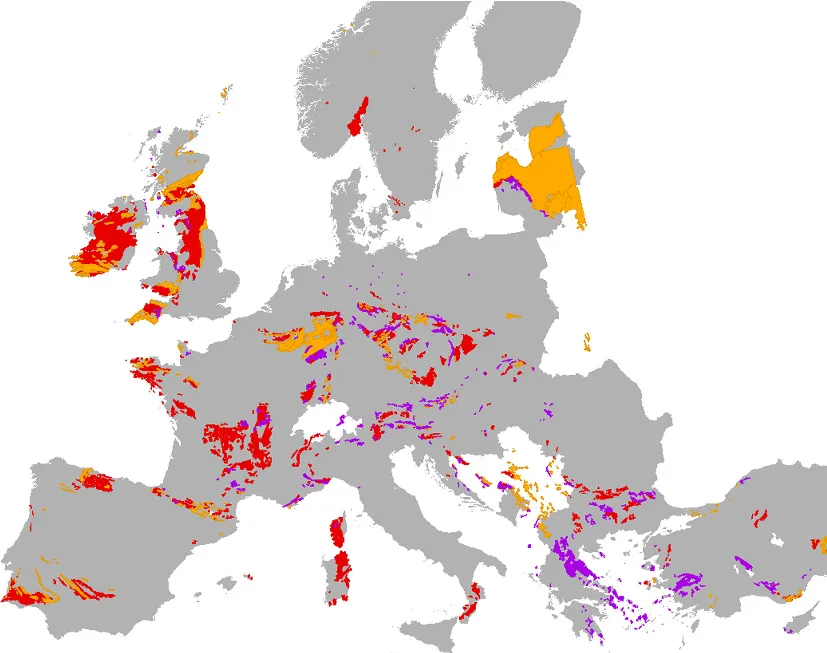 Map of European Coal Deposits Source[5]
But why didn't people mine coal on an industrial scale even before then?
After all, coal has 5x more potential energy than the same space filled with dry wood and that makes it far more efficient to mine, transport, and store, enabling the concentration of energy needed for factories and steam engines. Also, coal mining has been used in England since the 2nd century for blacksmithing and limeburning.
It's pretty hard to mine coal on an industrial scale. By 1550, coal was a mature, but medieval industry, geographically widespread and integrated into key sectors of the economy, but it was technologically static and constrained by a niche market and controlled by the church.
A few things came together so that coal and some inventions were just barely useful enough to create a sustainable take-off:[6]
- Politics and economics: The Church's policy of 'short-term leases' on its extensive coalfield holdings, stifled crucial capital investment in deep shafts and drainage. Henry VIII's Dissolution of the Monasteries in 1527 transferred this land to new, commercially-focused private owners. Long-term ownership provided the profit motive and security necessary for the massive capital investment required for deep coal extraction.
Also, Howes[7] argues that there was a crisis in early 1500s Britain, which worsened under Henry VIII due to expensive wars, leading to high wealth taxes, property insecurity, and the currency debasement, which caused runaway inflation in the 1540s and near state collapse. A small, influential group (like Thomas Gresham) diagnosed this, driving a state mercantilist push. Since the Crown was impoverished, this group funded new institutions using private capital and foreign expertise: Joint-Stock Corporations for high-risk ventures and Monopoly Patents to incentivize foreign experts to bring advanced techniques (e.g., navigation, mining) to England. Two English mining monopoly companies were incorporated by royal charter in 1568.
- Demand surge:
- Blast Furnaces & Ironworking: Growing iron demand led to the construction of fuel-hungry blast furnaces, power hammers, and rolling mills. The enormous, continuous need for charcoal caused a 'timber crisis' in England, making coal the only viable solution.
- The 'Military Revolution': The demand for copper (for bronze guns) and iron (for cannons) spurred general mining development and, consequently, the fuel-hungry metallurgy process.
- Due to the Malthusian population cycle: In 1280, England's population was 4.8M. Around 1350, the plague killed up to half the population. The population slowly went back up to 4.4M in 1600, and wages grew along with it. London's population also doubled to 200,000 by 1600- it was the fastest-growing city in Europe. There was a massive demand for energy that wood couldn't meet.
- Genetics: After the 1350, higher-status and higher-income families had more surviving children and genetic analysis shows that people with traits conducive to economic success such as higher cognitive ability, future orientation, thrift, self-control, had more surviving children. Over centuries, this created a slow but directional shift in the distribution of these traits.[8] After ~1350, in this northwest-European sample, the average educational-attainment polygenic score drifted upward by about 0.8 of a standard deviation over the following centuries — which, translated very roughly into present-day terms, is on the order of a few IQ points (~3–5) of actual ability. Holding the spread fixed and pushing the mean up by the estimated 0.8 SD, an equal-sized population ends up with about 6× as many people above the (1850) top-5% line and about 10× as many above the top-1% line
- Technology[9]: Also a bunch of technologies were invented that were needed for coal mining to take off before that:
Time Period | Invention / Development |
1100s- 1400s | General Tech (Mining hoists driven by a water wheel, horse haulage of ore, horse-powered drilling machines, fulling-mills, mechanization with a water wheel, iron smelting, lathes) |
1200s | Nautical Tech (Compass, modern steering) |
Late 1200s | Mechanical Clock |
1300s | Press (for paper, oil, wool) |
1300s | Inland Waterways (Improved) |
1300s | Water Locks (in Netherlands) |
1433-1466 | Economic Expansion / Start of 'Early Phase' |
1400s | Water Locks (in Italy) |
1440 | Printing Press |
1400s | Caravel (Complex Rigged Ship) |
Late 1400s | Industrial Revolution (start of the process) |
c. 1500 | Primary, primitive industry (in mining) |
1500s | 'Long Sixteenth Century' (Capitalist World-Economy) |
1500–1800 | Growth of commercial maritime tonnage |
Three inventions seem especially crucial:
- The Water Mill (Water Wheel): By the 1100s, England had already 5,600 watermills. This crucial early invention was key to deep mining from about 1100–1400, powering hoists and pumps to counter the main barrier: flooding of mines.
- Animal-Powered Machines: Improved harnesses and machines like horse-powered drilling and haulage made moving coal both inside and outside the mine more efficient from 1100s-1400s.
- Better ships: In the 1500s, the average tonnage of ships increased by 10x. Better ships and navigation made the long-distance sea transport of 'sea cole' (coal) from Newcastle to London economical.
It seems that some of the later necessary technologies were spread by the invention of the printing press in 1440. The printing press fueled the Renaissance and catalyzed the Scientific Revolution by facilitating scientific publishing. Compared to Asian printing, which involved manual rubbing and non-mass-produced metal types, the printing press allowed for 10x more pages to be produced, leading to books becoming up to 1000x cheaper by 1600: [10],[11]
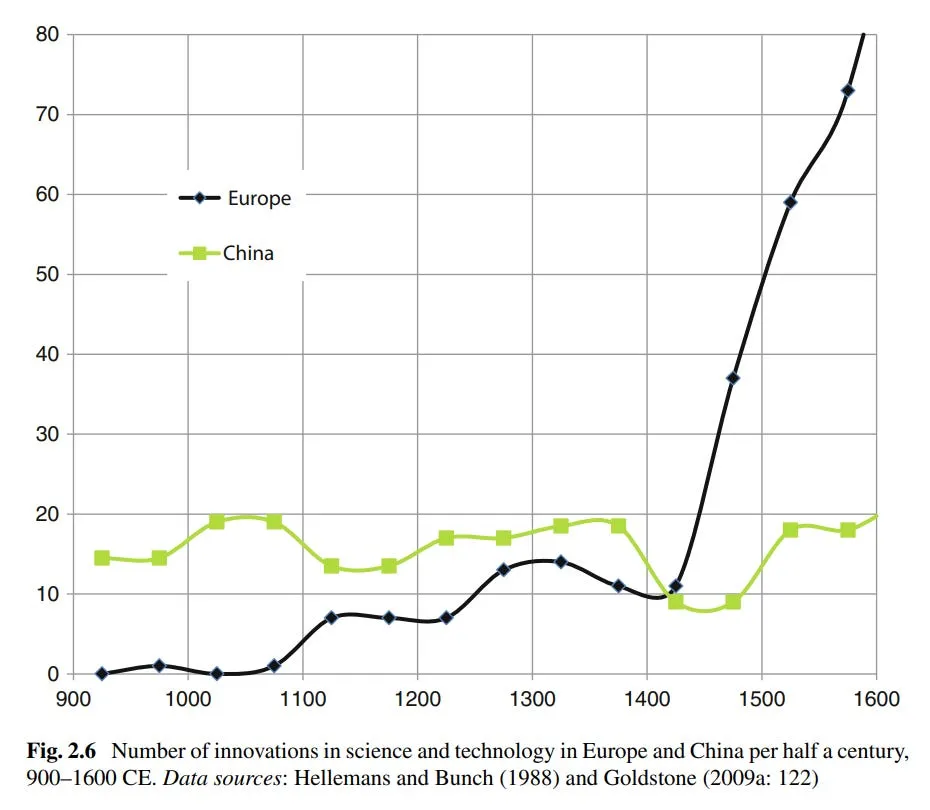 Source [12]
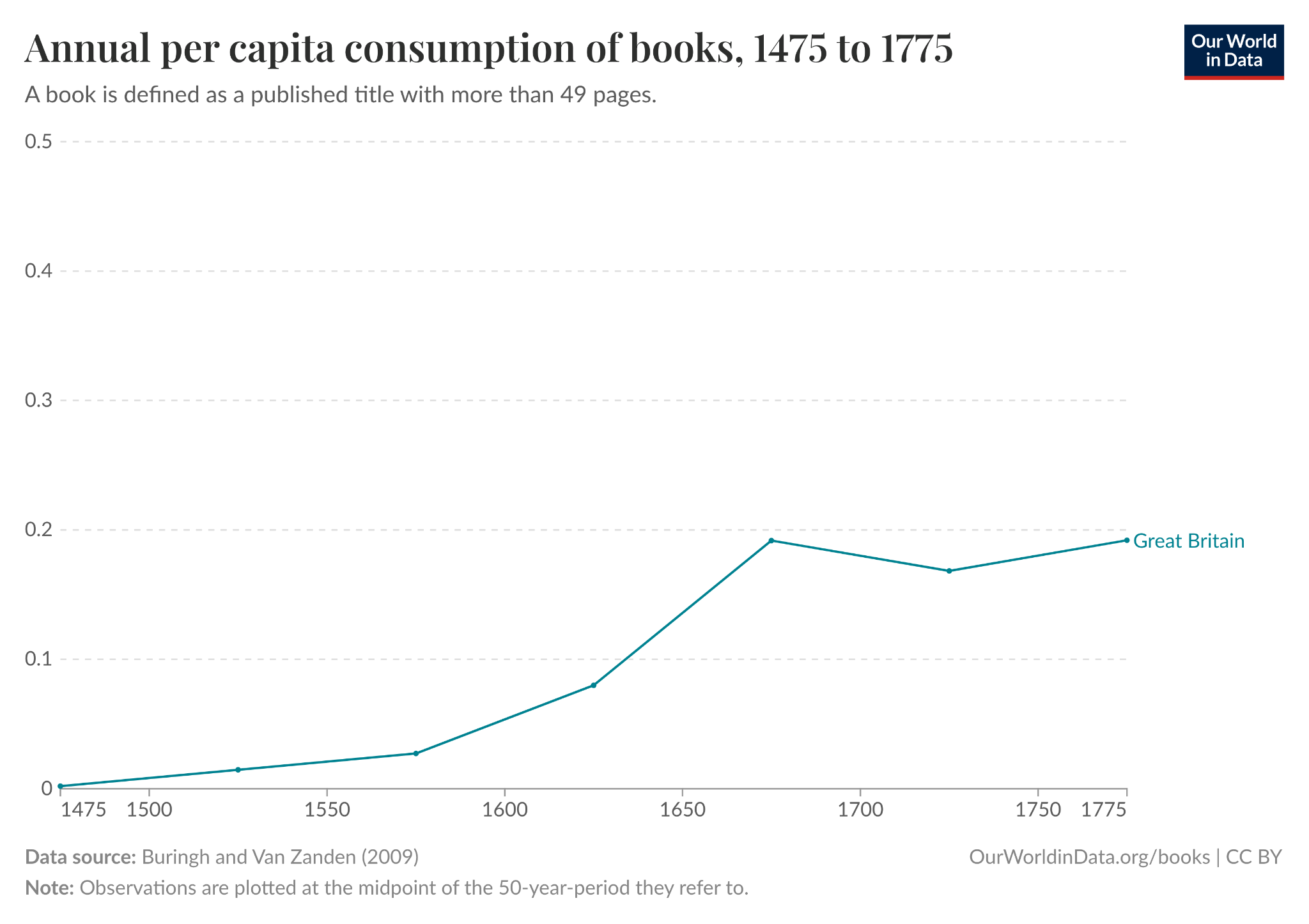
European cities with printing presses established in the 1400s grew 60% faster between 1500 and 1600 than similar cities without. This growth wasn't due to prior advantages or printers choosing favorable locations; evidence, using distance from Mainz (the birthplace of printing) as an instrument for adoption, supports printing's causal role in subsequent urban growth.[13]
This entire 'how-to' spread was epitomized by one book: Georgius Agricola's De re metallica. Published in 1556, it was a detailed, illustrated encyclopedia of mining, made possible by the printing press. Its famous woodcut diagrams showed exactly how to build the advanced German-engineered water pumps, hoists, and ventilation systems. It was, in effect, the 'how-to' manual that allowed English entrepreneurs, now motivated by private land ownership, to import and build the complex machinery needed to conquer the flooded deep mines and unleash the coal revolution.[14] 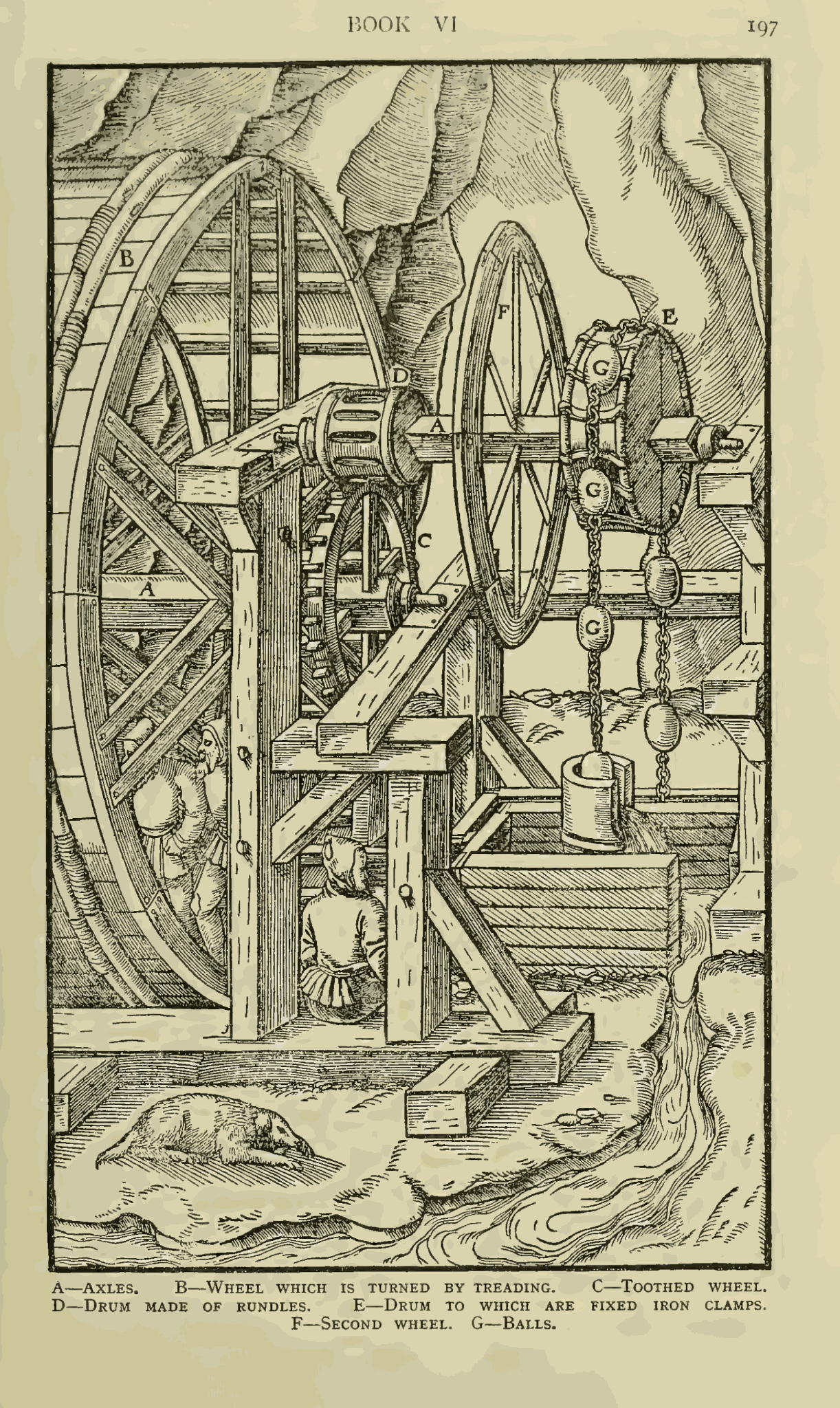 The book also disses alchemists ('if you're such an alchemist how come you're not rich?'),[15] and reassures you that mine gnomes are usually harmless ('they mimic men. They appear to laugh with glee and pretend to do much, but really do nothing... This kind does not often trouble the miners, but they idle about in the shafts and tunnels and really do nothing, although they pretend to be busy in all kinds of labour').
Notes
[15] “nor do we now see them growing rich, although so many nations everywhere have produced, and are producing, alchemists, and all of them are straining every nerve night and day to the end that they may heap a great quantity of gold and silver, I should say the matter is dubious."