Small brains can do a lot
Small brains can be surprisingly intelligent
Surprisingly, animals with such small brains and much less compute than humans often perform seemingly hard tasks very well:
- Dolphins and chimps are very good at pattern recognition.[1] Chimps can even be trained to outperform humans in strategic games and short-term memory tasks.[2]
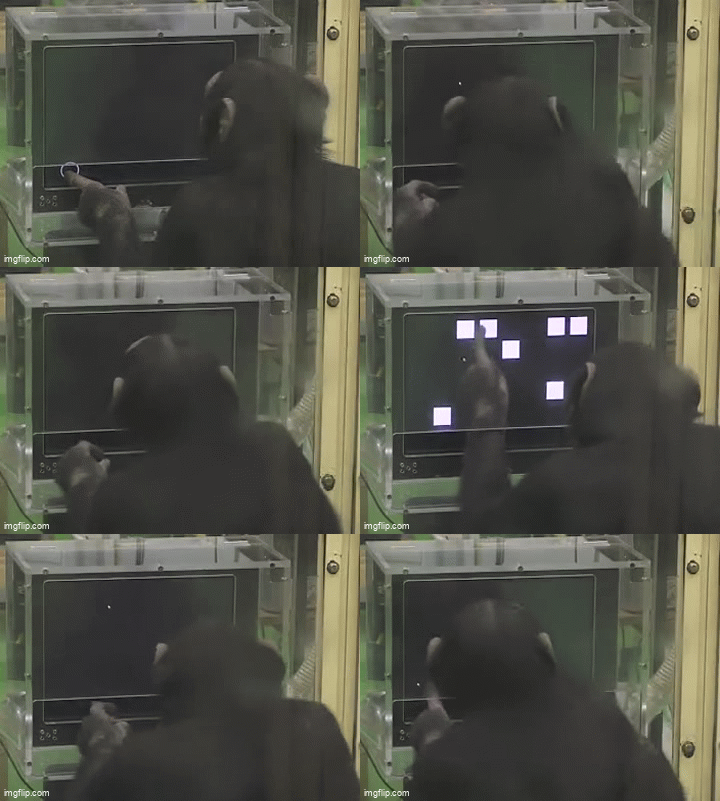
The social brain hypothesis, which suggests humans have larger brains due to the cognitive demands of social modeling, has recently been questioned. [3],[4] (e.g. whales in the largest social groups have smaller brains than those in mid-sized groups).[5]
- Rats can drive.[6]

- Squids can delay gratification.[7]
- Birds:
- Corvids exhibit working memory mastery similar to primates, successfully completing complex behavioral tasks. Like primates, vision is a key sense in many bird species.[8]
- Some birds can listen to complex sounds and imitate them exceptionally well (e.g. the lyrebird[9]), despite their relatively small brains (though with 3B neurons bird brains are bigger than of some monkeys,[10] and some have a cortex[11] with primate-like numbers of neurons in the forebrain[12]).
Bird song has evolved due to sexual selection (being able to record and play songs signals neurophysiological fitness) and not natural selection purposes (it's not adaptive above and beyond sexual selection, and only to signal neurophysiological fitness).[13] Yet, many animals have independently evolved actually useful communication like alarm calls. Parrots can imitate language very well, but sound is not very difficult computationally: it can be broken down into a simple fourier transform and every sound you hear literally passes through an actual bone in your head- a very primitive technology compared to vision.
- Fish have complex cognitive abilities despite their small brains e.g. they can inhibit motor control.[14]
- Reptilian Cognitive Abilities might have been underestimated as well.[15],[16]
- Insects: Insects can learn concepts,[17] display empathic behavior,[18] and build bridges [19] using simple algorithms and associative learning. Ants Recognise Infected Wounds and Treat Them[20] Spiders can count.[21]
- Cognition in insects- PMC
- Fruit flies have attention, working memory and conscious awareness [22]
- Ants can do this:
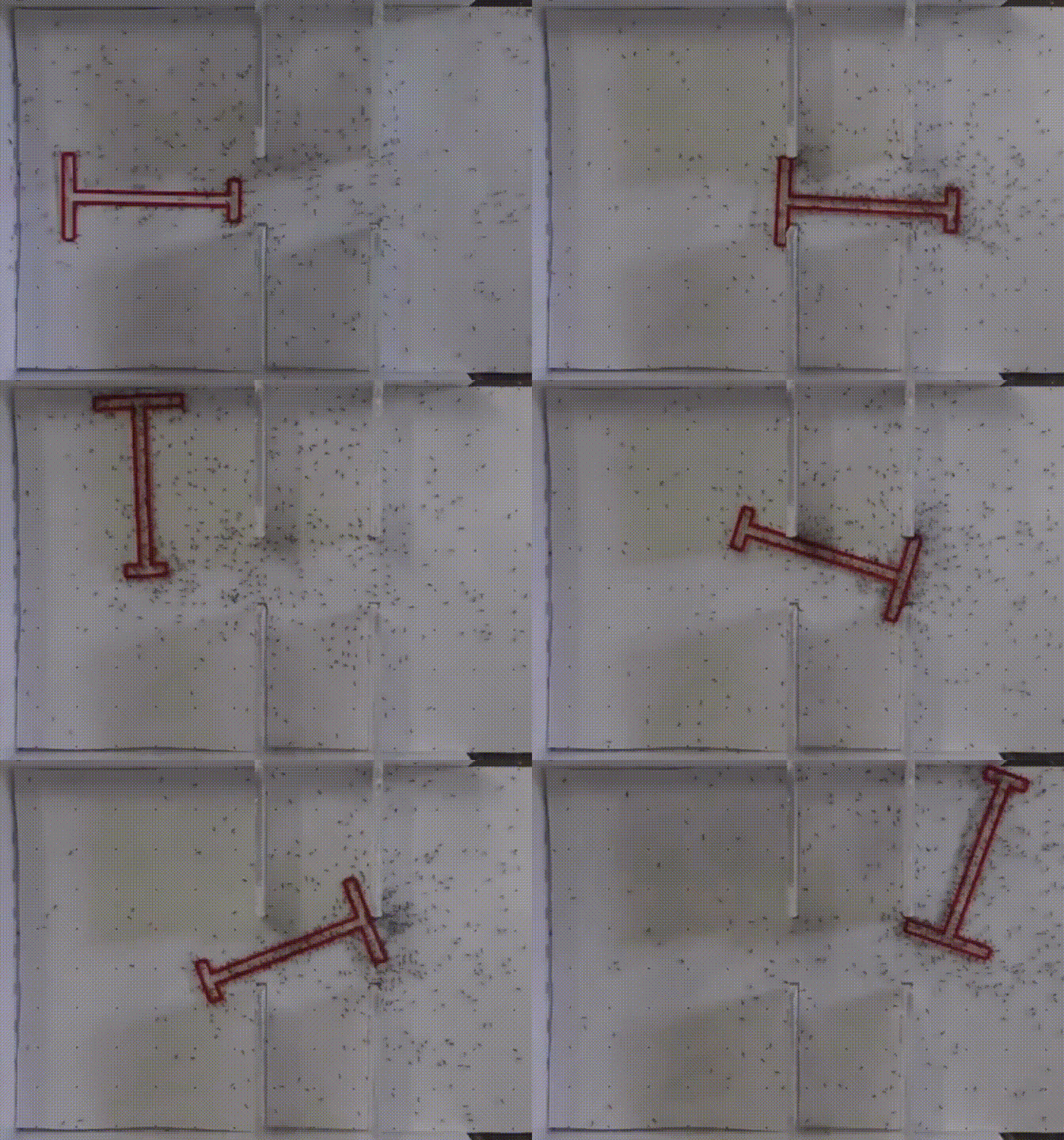
- Even nematodes like caenorhabditis elegans with its 302 neurons, are capable of associative learning.[23]
- And even bacteria 'can learn'[24]. Even without brains, some simple cells show basic cognitive thinking and problem solving abilities.[25]
- AI: OpenAI has recently shown that comparatively simple agents can learn sophisticated tool use in a high fidelity physics simulator, even though the largest artificial neural networks have only ~10s of millions of neurons.[26] But even complex behavior like cheating has emerged in AI with even much less compute.[27] Current AI systems are the size of insect brains, and the largest LLM is finally nearing the scale of a mouse brain, though still less than 1% the size of a human brain.[28]
Morgan's canon states that 'In no case is an animal activity to be interpreted in terms of higher psychological processes if it can be fairly interpreted in terms of processes which stand lower in the scale of psychological evolution and development.'[29] Some people and even biologists anthropomorphize surprisingly complex human-like behavior ('Birds have theory of mind!'). But a more parsimonious explanation is that such behavior can be implemented with simple reinforcement (associative) algorithms that can be written on the back of an envelope and need little compute (The bird brain's algorithm is merely: 'If another animal is present while burying food, then rebury it elsewhere later while no other animal is present.').[30] [31] [32] [33]
Another example: Ants can build bridges: 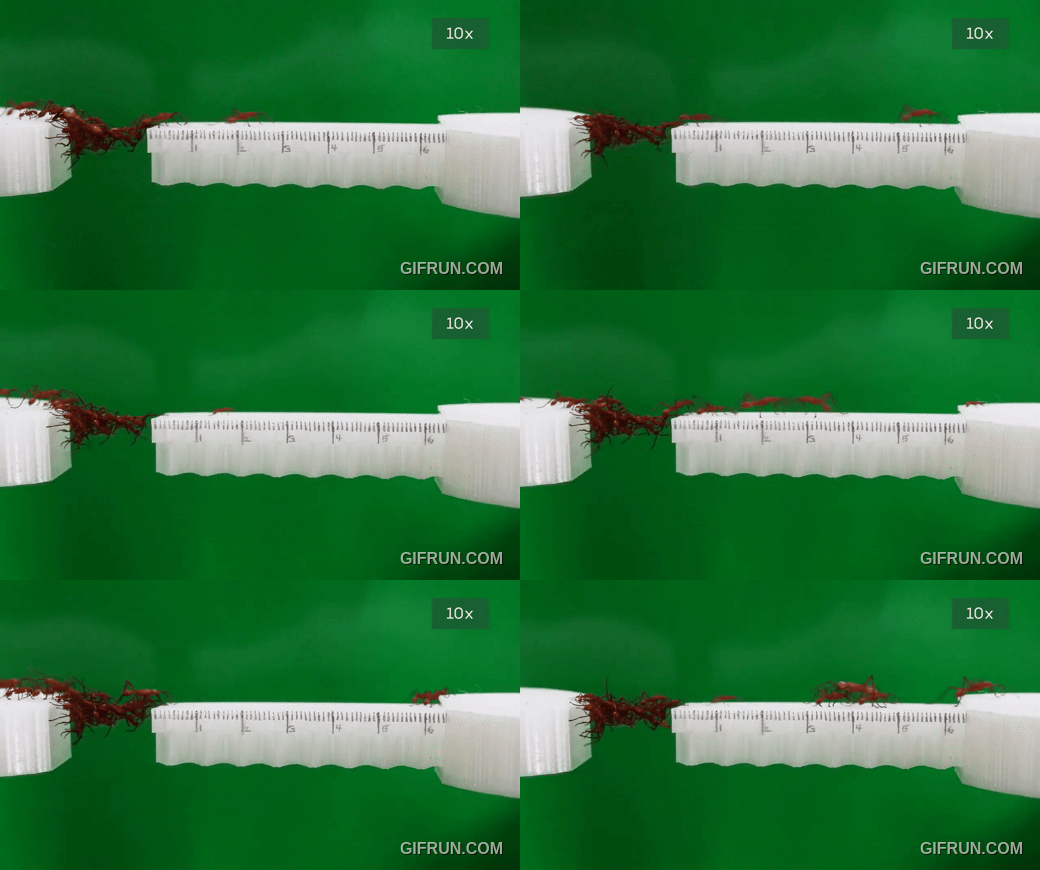
But they use a simple algorithm to build bridges: they freeze in place when traffic over their backs is too high. When traffic drops below a threshold, the ant unfreezes and rejoins the march.[34]
Biologists used to frame this as 'Fixed Action Patterns' – an instinctive behavioral sequence that is highly stereotyped. A few examples:
- A goose, upon seeing a displaced egg (a sign stimulus), performs an automatic, fixed-action pattern to roll it back to the nest using its beak. This behavior continues even if the egg is removed mid-process. Other egg-shaped objects, even unnaturally large supernormal stimuli like a golf ball, also elicit this retrieval response.).[35]
- The digger wasp's 'mindless mechanicity' allows it to be tricked into repeatedly performing its complex, but now meaningless, offspring provisioning routine after artificial disruption.[36]
- Humans with memory impairment can sometimes get into similar fixed action pattern loops.[37]
There are more modern neuroscience experiments that have a similar vibe (e.g. olfactory bulbectomy in mice causes cannibalism).[38]
As per above, though often seen as pre-programmed, even small animals like insects can learn: Early work focused on simple associative learning, like remembering patterns, colors, and places, and initial claims of true insect cognitive abilities were met with skepticism.[39] There's now an active debate in how far animals 'reason' or have 'cognition' versus associative learning.[40]
If small brains and few neurons support complex behavior, social structures, and cognition (like numerosity), then why evolve larger brains with more neurons?
Some notes from 'Are Bigger Brains Better?'[41]
- 'Larger brains primarily enhance existing abilities like memory, sensory resolution, and parallel processing through enhanced circuit replication and storage, not adding new functions. Qualitatively different behaviors are unlikely due to size alone; modularity and interconnectivity may be more critical. Bigger brains also have increased redundant memory.
- Larger animals have bigger sense organs, allowing for a more detailed mapping of their environment.
- Larger animals' somatotopic mapping generally requires larger corresponding brain areas
- Larger animals need bigger muscles, and thus possibly greater numbers of motor neurons and axons with larger diameters to cover longer distances in the nervous system.
- Increased precision in motor skills is correlated with increases in the corresponding motor cortex area's size
- The additional total brain volume found in primates might, to some extent, go towards processes unrelated to behavioral repertoire or cognitive capacity
- Within large brains, additional parallel processing pathways and stages of serial processing allowing the computation of novel receptive fields may be added more easily than in insect brains where space may impose more severe constraints. Smaller brains can therefore maintain a higher density of computations.
- Basic forms of cognition will 'pop out' even of relatively small neuronal circuits: Insects demonstrate surprising cognitive abilities with small brains of only dozens or hundreds of neurons. Millions of years of intense selective pressure for minimal space and maximal computation have likely resulted in highly efficient evolutionary solutions, similar to those found in neural network models.'
Notes
[7] Cuttlefish exert self-control in a delay of gratification task | Proceedings of the Royal Society B: Biological Sciences
[17] Conceptual learning by miniature brains | Proceedings of the Royal Society B: Biological Sciences
[21] Representation of different exact numbers of prey by a spider-eating predator | Interface Focus
[25] Brains Are Not Required When It Comes to Thinking and Solving Problems--Simple Cells Can Do It | Scientific American