Using VIX options to hedge against tail risks
Philanthropic foundations face a cruel timing problem. Major crises—pandemics, financial collapses, geopolitical shocks—are precisely when charitable capital is most valuable. Yet these are exactly the moments when endowment portfolios crater, leaving foundations with depleted resources when the need is greatest.
COVID illustrated this perfectly. In March 2020, global markets crashed 30%+ while simultaneously creating urgent funding needs: vaccine development, economic relief, institutional support. Foundations found themselves asset-poor at the worst possible moment.
Mission hedging offers a solution: structure investments so that returns are highest precisely when your cause area needs resources most. As Tran (2019) demonstrates, 'foundations may benefit from skewing investment toward assets that correlate with the foundation's mission-based need, aligning funding availability with need.'[1],[2]
But what if you're cause-neutral and want to hedge against unknown unknowns/tail risks/GCRs?
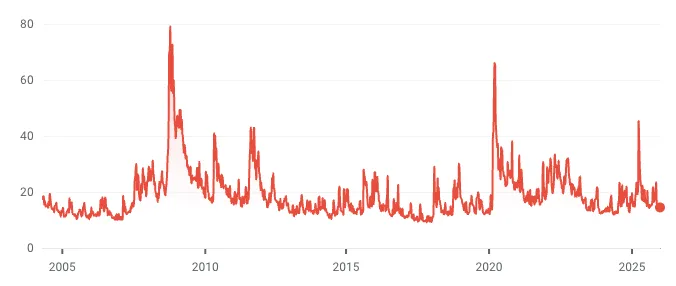
The elegant feature of the VIX—the CBOE Volatility Index, often called the market's 'fear gauge'—is its generality. It spikes during any major crisis regardless of source. You don't need to predict what causes the next catastrophe. Pandemic, financial crisis, war, technological disruption—all register as volatility.
Date | Event / Reason | VIX Peak (Approx. High) |
1990-08-06 | Gulf War / Iraq Invades Kuwait | 36.5 |
1997-10-27 | Asian Financial Crisis | 38.2 |
1998-08-31 | Russian Debt Default / LTCM Crisis | 45.7 |
2001-09-21 | 9/11 Terrorist Attacks | 43.7 |
2002-07-24 | Dot-com Bust / WorldCom & Enron | 45.1 |
2008-10-24 | Global Financial Crisis (Lehman Collapse) | 89.5 |
2010-05-06 | The Flash Crash | 40.7 |
2011-08-08 | U.S. Credit Rating Downgrade / Euro Crisis | 48 |
2015-08-24 | Chinese Yuan Devaluation | 40.7 |
2018-02-05 | 'Volmageddon' (Short Volatility Implosion) | 37.3 |
2020-03-16 | COVID-19 Pandemic Lockdowns | 82.7 |
2022-01-24 | Fed Rate Hike Fears / Russia-Ukraine Tension | 38.9 |
2024-08-05 | Yen Carry Trade Unwind / US Recession Fears | 65.7 |
This matters because the most damaging crises are often the unknown unknowns. The VIX let you hedge against the category of 'something very bad happens' without specifying what.
Research on systematic VIX call buying finds that 10-delta calls (those with roughly 10% probability of expiring in-the-money) occasionally deliver 50x or greater returns during their lifetime, despite expiring worthless 97% of the time.[3]
What Would Have Happened During COVID?
The VIX rose from around 15 in early February 2020 to a peak of 82.69 on March 16—a level not seen since the 2008 financial crisis. Here's what various VIX call positions purchased in January 2020 would have returned at peak:
Strike | Approx. Jan 2020 Price | VIX Peak (Mar 16) | Intrinsic Value at Peak | Return Multiple |
30 | ~$3.00 | 83 | ~$53 | 18x |
40 | ~$1.50 | 83 | ~$43 | 29x |
50 | ~$0.70 | 83 | ~$33 | 47x |
60 | ~$0.40 | 83 | ~$23 | 58x |
70 | ~$0.25 | 83 | ~$13 | 52x |
80 | ~$0.15 | 83 | ~$3 | 20x |
A foundation that had allocated $10M to VIX 50-strike calls in January 2020 would have held approximately $470M at peak—liquid capital available precisely when COVID created unprecedented charitable needs.
The Strategic Case
The core insight: marginal philanthropic dollars are likely far more valuable during crises than during normal times. A dollar deployed for pandemic preparedness in February 2020 was worth far more than a dollar deployed in February 2019.
VIX tail hedging aligns capital availability with this reality. The strategy costs money during calm periods—but calm periods are precisely when that cost matters least. When volatility is low, charitable needs are typically well-served by existing funding. The premium paid for crisis insurance is essentially transferring resources from low-need states to high-need states.
For foundations focused on existential risk, catastrophe prevention, or global health security, this alignment is particularly valuable. These cause areas have funding needs that spike dramatically during the crises they're trying to address.
Implementation Considerations
A practical approach for a major foundation:
- Allocate 1% of endowment annually to systematic VIX call purchases at strikes 50-80
- Use 90-120 day expirations rolled monthly for consistent exposure
- Pre-commit deployment plans specifying how crisis capital will be allocated
- Maintain relationships with grantees who can absorb rapid funding during emergencies
The pre-commitment aspect is crucial. Having $500M arrive during a crisis is only valuable if you can deploy it effectively. This requires advance planning: which organizations can scale quickly? What emergency grants are pre-authorized? Who has decision rights to deploy capital within days rather than months?
VIX tail hedging won't improve risk-adjusted returns in the traditional sense. Most years, the options expire worthless. But for philanthropists who believe their dollars matter most during crises, this 'loss' is actually a feature: it transfers resources from states where money matters less to states where money matters most.